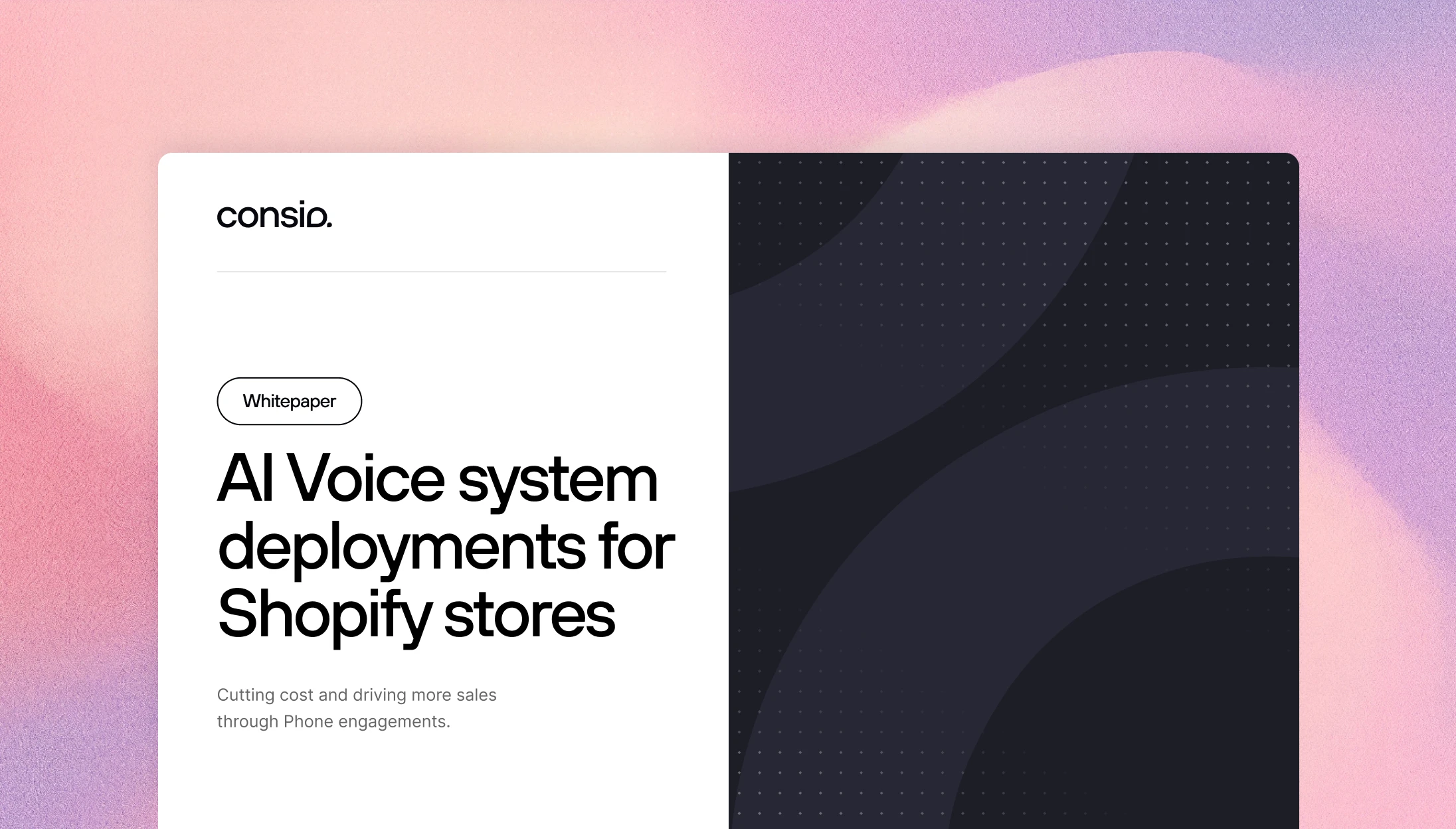
AI Voice system deployments for Shopify stores
Learn how Shopify brands reduce support costs and recover revenue with AI voice agents and human-led outbound calls.
Shopify brands are entering a new phase of commerce where speed and trust define conversion. When shoppers hesitate around shipping, returns, sizing, product fit, or payment, delays create friction and friction turns into abandoned carts. This whitepaper explains why support is no longer just a cost center, but a direct lever for revenue, retention, and margin.
Free download
AI Voice system deployments for Shopify stores
Learn how Shopify brands reduce support costs and recover revenue with AI voice agents and human-led outbound calls.
What this white paper covers
This guide presents a practical deployment model for AI voice systems in Shopify environments. It explains how brands can automate repetitive inbound support requests with a 24/7 AI voice agent, while using human-led outbound calls to recover revenue from high-intent moments such as abandoned cart, abandoned checkout, post-purchase upsell, and VIP follow-up.
Why voice matters for Shopify brands
Most support stacks are built around email, chat, SMS, and helpdesk workflows. Those channels remain useful, but they often break down when purchase intent is high and a customer needs immediate reassurance. The whitepaper makes the case that voice is becoming a high-performing commerce channel again because AI and Shopify context now make it scalable, measurable, and profitable.
What you’ll learn
Why support questions are often hidden sales objections
Why text channels are not always enough at checkout
Why phone has historically been underused in ecommerce
How Consio separates inbound AI automation from human outbound sales workflows
Which inbound and outbound use cases create the most value
How to deploy an AI voice channel in days, not months
What guardrails are needed to keep voice scalable and trustworthy
Key takeaways
The whitepaper introduces the idea of commerce voice context: Shopify-native access to customer, cart, order, and policy data. That context allows voice interactions to become more accurate, more useful, and easier to attribute to business outcomes. It also outlines a phased deployment approach, from day-0 setup, to stabilization over days 1–3, to launching outbound revenue campaigns by days 4–10.
Typical use cases covered
On the inbound side, the document covers WISMO, shipping updates, returns, exchanges, cancellations, product questions, store operations, after-hours coverage, checkout assistance, lead qualification, VIP escalation, and intelligent call transfer. On the outbound side, it highlights abandoned cart recovery, abandoned checkout recovery, draft order follow-up, post-purchase upsell, replenishment reminders, failed payment recovery, churn win-back, and VIP outreach.
Proof and next steps
The final section shares proof points from client deployments and recommends starting with two simple workflows: inbound policy and order-status handling via AI, and outbound abandoned cart recovery led by humans. The broader vision is clear: the Shopify call center should not be treated as a cost center, but as a growth engine.
Ready to turn your Shopify call center into a growth engine?

Growth Marketing