Best AI tools for Shopify brands in 2026
Discover the best AI tools for Shopify brands, from phone agents and support automation to analytics, CRO, conversational commerce, and customer recovery.

Shopify brands have more data than ever.
They can track product page behavior, checkout drop-off, abandoned carts, customer support tickets, email flows, SMS performance, ad campaigns, post-purchase questions, and revenue attribution across dozens of tools.
But more data does not automatically mean more revenue.
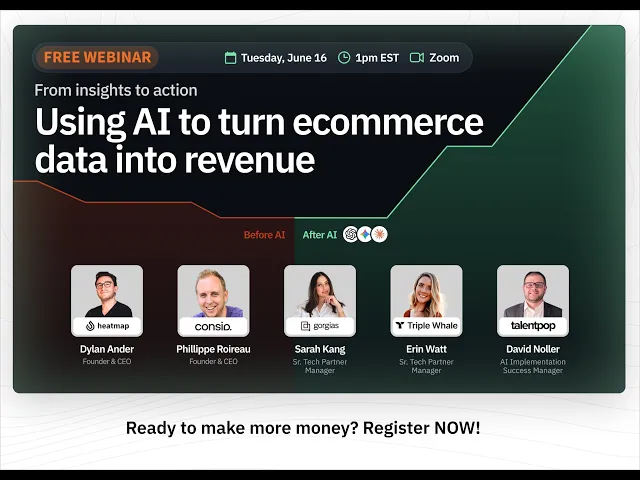
The real challenge for ecommerce teams in 2026 is knowing what to act on first. That was the main theme of our recent webinar, Using AI to Turn Ecommerce Data into Revenue, featuring:
Dylan Ander, Founder and CEO of Heatmap
Philippe Roireau, Founder and CEO of Consio
Sarah Kang, Senior Tech Partner Manager at Gorgias
Erin Watt, Senior Tech Partner Manager at Triple Whale
David Noller, AI Implementation Success Manager at TalentPop
Together, they explored how Shopify brands can use AI to identify revenue leaks, reduce customer friction, prioritize the right data, and turn insights into measurable action.
What are AI tools for Shopify brands?
AI tools for Shopify brands are apps, platforms, or workflows that use artificial intelligence to automate tasks, analyze customer behavior, personalize experiences, recover revenue, or help teams make better decisions.
For ecommerce teams, AI can help with:
Answering customer questions 24/7
Recovering abandoned carts
Recommending products
Prioritizing high-intent customers
Analyzing funnel drop-offs
Identifying revenue leaks
Automating repetitive support tickets
Optimizing product pages
Creating better segments for email, SMS, and phone campaigns
Measuring which actions actually drive revenue
The best AI tools do more than save time. They help Shopify brands increase conversion, reduce support volume, improve customer experience, and generate measurable revenue.
How we chose these AI tools
We evaluated these tools with a Shopify-first, revenue-first lens.
The goal was not to list every AI tool available. Instead, we focused on tools that help ecommerce teams answer four practical questions:
Where are shoppers getting stuck?
Which signals can we trust?
What action should we take next?
How does that action turn into revenue?
We prioritized tools that are useful for Shopify brands because they connect to key ecommerce workflows: support, analytics, conversion rate optimization, phone, conversational commerce, product discovery, customer recovery, and customer experience operations.
Best AI tools for Shopify brands: quick comparison
Tool | Category | Best for | AI use case | Revenue impact |
|---|---|---|---|---|
Consio | AI phone agent & calling | Phone sales, support, abandoned checkout recovery | Inbound AI calls, outbound call campaigns, SMS follow-ups | Recover high-intent shoppers and attribute phone revenue |
Gorgias | AI customer support | Support automation and conversational commerce | Automate tickets, answer pre-sales questions, route complex issues | Reduce friction before and after purchase |
Triple Whale | AI analytics & attribution | Revenue intelligence and prioritization | Find what changed, explain why, prioritize actions | Focus teams on the highest-impact revenue opportunities |
Heatmap | AI CRO & behavior analytics | Product page and funnel optimization | Analyze customer behavior and page elements tied to revenue | Find and fix conversion blockers |
Rep AI | AI conversational commerce | Proactive sales and support automation | Behavioral engagement, guided product discovery, omnichannel support | Convert hesitant shoppers and reduce repetitive support |
Algolia | AI search & discovery | Large catalogs and product discovery | Personalized search, typo tolerance, product ranking | Help shoppers find the right product faster |
Tidio | AI chat & automation | Small-to-mid-sized support teams | AI chatbot, FAQs, live chat automation | Answer questions instantly and reduce support load |
Octane AI | AI quizzes & personalization | Product recommendation quizzes | Personalized quizzes and zero-party data collection | Improve product matching and email segmentation |
TalentPop | AI + human CX operations | Scaling support and revenue-trained CX | AI triage plus trained human agents | Turn CX conversations into revenue moments |
1. Consio — AI phone agent and calling platform for Shopify
Consio is an AI phone platform built for Shopify brands that want to turn phone calls into a measurable revenue channel.
Most ecommerce teams have optimized email, SMS, paid ads, product pages, and live chat. But phone is often still disconnected from the rest of the ecommerce stack.
That creates a major blind spot.
Calls go unanswered. Revenue from phone conversations is not attributed. Support teams spend time answering repetitive questions. And high-intent shoppers who need one final answer before buying often drop off.
Consio helps solve this by combining:
24/7 AI inbound phone support
AI voice agents with Shopify context
Outbound call campaigns
Power dialing
Voicemail drops
SMS follow-ups
Call transcripts and summaries
Shopify revenue attribution
The biggest opportunity is that phone captures customers with high intent. These shoppers are not casually browsing. They are calling because they have urgency, uncertainty, or a final objection before buying.
During the webinar, Consio shared examples of inbound callers converting at 25% to 50% when calls are answered. One brand saw a 50.8% conversion rate on answered inbound calls, meaning roughly one out of every two answered calls led to a sale.
Consio also shared an example of a brand generating $1.79M in phone sales year to date, with phone outperforming its Klaviyo-attributed revenue.
Why it’s a must: most Shopify brands already have high-intent shoppers who need help before buying. Consio helps brands answer those calls, recover more revenue, follow up by SMS, and attribute phone-driven sales directly to Shopify.
2. Gorgias — AI customer support and conversational commerce
Gorgias is one of the leading customer support platforms built specifically for ecommerce brands.
It helps Shopify teams manage customer conversations across channels such as email, chat, social, and helpdesk workflows. With AI, Gorgias can automate common questions, suggest responses, pull order context, and help support teams resolve tickets faster.
But the bigger opportunity is not just ticket deflection.
It is using customer conversations to understand buying friction.
In the webinar, Sarah Kang from Gorgias explained that many shoppers do not abandon purchases because they lack interest. They abandon because they lack confidence.
A shopper can want your product and still hesitate. They may have a question about sizing, delivery, returns, compatibility, ingredients, or whether the product is right for their use case.
Those are not just support questions. They are conversion questions.
Gorgias helps brands identify and respond to these moments faster. AI can handle repetitive post-purchase questions like “Where is my order?” or “How do I start a return?” while human agents focus on more complex, high-value interactions.
Why it’s a must: support is no longer only post-purchase. For Shopify brands, customer conversations now influence conversion, trust, and revenue before checkout.
3. Triple Whale — AI analytics and attribution for ecommerce
Triple Whale helps ecommerce brands understand what is working, what is not, and what to do next.
One of the biggest problems for Shopify teams is data overload. Meta, Google, TikTok, Shopify, Klaviyo, SMS platforms, support tools, and internal dashboards all tell different stories.
Every platform claims performance. But those stories do not always match.
That makes decision-making slower.
In the webinar, Triple Whale focused on a key idea: the real bottleneck is not accessing data. It is prioritization.
The best ecommerce teams do not chase every spike or drop. They identify the revenue leak that matters most.
Triple Whale helps brands bring data into one place, validate performance, and use AI to understand what deserves attention. This can include attribution, marketing mix modeling, incrementality testing, and AI-generated insights.
The practical value is simple: teams can move from “what happened?” to “what should we do next?”
Why it’s a must: many ecommerce teams waste hours building reports instead of acting on insights. Triple Whale helps teams prioritize revenue opportunities faster.
4. Heatmap — AI-powered CRO and revenue-based behavior analytics
Heatmap.com helps ecommerce brands understand what visitors are doing on their site and which page elements are tied to revenue.
Traditional heatmaps show clicks, scrolls, and user behavior. That is useful, but it does not always show which behaviors actually matter to revenue.
The bigger CRO question is not “what looks interesting?” It is “what is hurting conversion?”
During the webinar, Dylan Ander from Heatmap explained that CRO is not about finding what is already working well. It is about finding what is not working and fixing it.
That is where AI can be especially useful.
AI is strong at pattern detection. When it has access to customer behavior, site analytics, product page data, ad data, customer support data, and revenue data, it can help identify the elements causing friction.
For example, AI can help answer questions like:
Which collection page should we optimize first?
Which products are too low on the page?
Which elements get engagement but do not convert?
Which product pages are leaking the most revenue?
Did a conversion change come from traffic mix, a promo, or a page update?
Why it’s a must: CRO teams should not rely only on instinct. Heatmap.com helps brands connect behavior to revenue and use AI to prioritize fixes.
5. Rep AI — AI conversational commerce and sales agent
Rep AI is an AI-powered conversational commerce platform built for Shopify brands that want to increase sales and automate customer support.
Unlike traditional chatbots that wait for shoppers to ask a question, Rep AI analyzes behavioral signals such as hesitation, product comparisons, repeated browsing, and exit intent. It can then proactively start a contextual conversation at the moment a shopper may need help.
Rep AI can guide shoppers through product discovery, compare options, answer pre-purchase questions, and recommend relevant products based on what the customer is looking for.
It also handles common support requests, including:
Order tracking and shipping updates
Returns and exchanges
Cancellations and address changes
Product discovery and comparisons
Contextual upsells and cross-sells
Policy and frequently asked questions
Routing complex issues to human agents
Rep AI works across the storefront, email, Instagram, Facebook, and WhatsApp. Conversations are consolidated into one platform, allowing teams to identify recurring objections, missing product information, customer experience issues, and other signals that may be affecting conversion.
The platform also includes a unified AI-native helpdesk, shopper insights, natural-language product search, automated support workflows, and native integrations with tools such as Klaviyo and Gorgias.
Pricing starts at $49 per month for the AI Support Agent, $99 per month for the AI Sales Agent, and $118 per month for the complete AI Concierge plan. All plans include a 14-day free trial with no credit card required, and Rep AI offers a 5x ROI guarantee.
Why it’s a must: support and sales are increasingly part of the same conversation. Rep AI helps Shopify brands answer questions before they become lost sales, guide shoppers toward the right products, automate repetitive support, and turn customer conversations into actionable insights.
6. Algolia — AI search and product discovery
Algolia helps ecommerce brands improve site search and product discovery.
For stores with large catalogs, search can be one of the highest-intent parts of the shopping journey. If a shopper searches for a product, they are not just browsing. They are actively trying to find something.
Poor search creates friction. If customers cannot find the right product quickly, they leave.
AI-powered search can help by improving:
Typo tolerance
Query understanding
Synonyms
Product ranking
Personalized results
Merchandising rules
Search analytics
For Shopify brands with many SKUs, product discovery becomes a revenue lever. The faster shoppers find the right product, the more likely they are to buy.
Why it’s a must: AI search helps reduce product discovery friction, especially for stores with complex catalogs, multiple categories, or shoppers who know what they want.
7. Tidio — AI chat and support automation
Tidio is a live chat and chatbot tool used by ecommerce brands to answer customer questions quickly.
For smaller or mid-sized Shopify brands, Tidio can be a practical way to add instant support without building a large support team.
AI chatbots can answer common questions, collect customer information, route conversations, and help shoppers while they browse.
Common use cases include:
Product questions
Shipping questions
Return policy questions
Discount questions
Order status support
Basic pre-purchase guidance
The main value is speed. If a customer has to search through FAQ pages or wait hours for a response, purchase momentum can disappear.
Why it’s a must: many conversion blockers are simple questions. Tidio helps answer them faster before shoppers leave the site.
8. Octane AI — quizzes and product personalization
Octane AI helps Shopify brands create product recommendation quizzes and collect zero-party data.
This is especially useful for categories where customers need guidance before buying.
Examples include:
Skincare
Supplements
Beauty
Apparel
Fitness
Pet products
Home goods
Complex product lines
Instead of forcing shoppers to browse a full catalog, a quiz asks questions and recommends products based on the shopper’s answers.
This improves the customer experience and gives the brand better data for segmentation.
For example, a skincare brand can ask about skin type, goals, sensitivity, and routine. A supplement brand can ask about health goals, diet, and lifestyle. An apparel brand can ask about fit, occasion, and style preference.
Why it’s a must: quizzes help shoppers make confident decisions while giving brands better customer data for email, SMS, and retargeting.
9. TalentPop — AI plus human CX operations
TalentPop helps ecommerce brands build and run customer experience operations with a mix of AI and trained human agents.
This matters because AI does not capture every revenue opportunity by itself.
AI can clear the path by automating repetitive volume, triaging tickets, and giving human teams more capacity. But brands still need trained people to handle high-value conversations.
In the webinar, TalentPop described a three-layer model:
AI agents handle repetitive tier-one volume.
Revenue-trained CX agents handle higher-value interactions.
Brand concierge specialists proactively recover revenue.
That includes moments like:
Abandoned cart recovery
Cancellation saves
Subscription recovery
Product swaps
Post-purchase outreach
Upsells and cross-sells
Customer retention conversations
TalentPop also emphasized that CX teams should not only be measured by operational metrics like first response time, average handle time, and CSAT.
Those metrics matter, but they do not capture all revenue opportunities.
A customer asking to cancel may be saveable. A customer asking about a return may actually need an exchange. A shopper with a full cart may need one final answer before buying.
Why it’s a must: AI gives CX teams capacity. TalentPop helps brands turn that capacity into revenue-generating customer conversations.
How to choose the right AI tools for your Shopify store

The best AI tool depends on your biggest revenue bottleneck. Do not start by asking, “What AI tool should we buy?” Start by asking, “Where are we losing revenue?”
Here is a simple way to decide.
If shoppers are asking questions before buying
Look at tools like Gorgias, Tidio, Octane AI, Rep AI, or Consio. These tools help answer questions, recommend products, guide buying decisions, and reduce purchase hesitation.
If high-intent shoppers are calling or need human help
Look at Consio. Phone is especially valuable for high-AOV products, complex purchases, urgent delivery questions, and shoppers who want reassurance before buying.
If your team is drowning in dashboards
Look at Triple Whale. This helps teams prioritize which channels, campaigns, and opportunities matter most.
If your product pages are leaking revenue
Look at Heatmap. This helps identify where customers are getting stuck and which page elements may be hurting conversion.
If your support team is overloaded
Look at Gorgias, Tidio, Rep AI, TalentPop, or Consio. AI can automate repetitive requests, while human agents focus on complex or high-value customer conversations.
If shoppers hesitate or struggle to choose the right product
Look at Rep AI, Algolia, or Octane AI. Rep AI can proactively engage hesitant shoppers and guide product discovery, while Algolia improves search and Octane AI provides quiz-based recommendations.
Common mistakes Shopify brands make with AI tools
Installing AI tools without a clear use case
Do not add AI just because it is popular. Start with a specific business problem: missed calls, slow support, abandoned carts, poor attribution, low conversion, or high support volume.
Automating the wrong customer moments
Not every interaction should be automated. AI is great for repetitive and time-sensitive tasks, but humans still matter for emotional, complex, or high-value conversations.
Measuring only efficiency
AI should not only be measured by time saved. Shopify brands should also measure revenue recovered, conversion rate, AOV, retained customers, and customer satisfaction.
Keeping tools disconnected
AI works best when it has context. If your AI tools are disconnected from Shopify, customer history, order data, product data, and revenue attribution, they will be less effective.
Ignoring phone as a revenue channel
Many brands optimize email, SMS, chat, and ads but ignore phone. For high-intent shoppers, phone can be one of the most valuable channels because it resolves uncertainty quickly.
Final thoughts
AI will not automatically grow your Shopify store.
The value comes from using AI to identify where revenue is leaking and act faster.
For some brands, that means answering customer questions before checkout. For others, it means automating support, improving attribution, fixing product page friction, or calling abandoned checkout shoppers.
The winning ecommerce teams in 2026 will not be the ones with the most AI tools.
They will be the ones with the clearest system:
Find the revenue leak.
Validate the signal.
Take action.
Measure the revenue impact.
That is how Shopify brands turn AI from a buzzword into a growth engine.
If you want to see how Consio helps Shopify brands turn phone calls into revenue with AI voice agents, outbound campaigns, SMS follow-ups, and Shopify attribution, book a demo with our team.
FAQs
What are the best AI tools for Shopify brands?
The best AI tools for Shopify brands depend on the use case. Consio is best for AI phone calls and phone revenue attribution. Gorgias is best for ecommerce support automation. Triple Whale is best for analytics and attribution. Heatmap.com is best for CRO insights. Klaviyo is best for email and SMS automation.
How can AI help Shopify brands increase revenue?
AI can help Shopify brands increase revenue by answering customer questions faster, recovering abandoned carts, identifying revenue leaks, personalizing recommendations, automating repetitive support, improving product discovery, and helping teams prioritize high-impact actions.
Should Shopify brands use AI for customer support?
Yes, but AI should be used carefully. AI is best for repetitive, high-volume questions such as order status, returns, shipping updates, FAQs, and basic product questions. Human agents should still handle complex, emotional, or high-value conversations.
What is the best AI tool for abandoned cart recovery?
For email and SMS abandoned cart recovery, Klaviyo is a strong option. For phone-based abandoned checkout recovery, Consio helps Shopify brands call high-intent shoppers, leave voicemails, send SMS follow-ups, and attribute recovered revenue back to Shopify.
What is the best AI tool for ecommerce analytics?
Triple Whale is a strong option for ecommerce analytics, attribution, and AI-powered insights. It helps teams understand what is working, validate signals, and prioritize which actions can drive the most revenue.
What is the best AI tool for ecommerce phone support?
Consio is built for Shopify brands that want AI-powered phone support and phone sales. It handles inbound AI calls, outbound campaigns, SMS follow-ups, and Shopify-native revenue attribution.
Can AI replace human support agents?
AI can automate many repetitive support tasks, but it should not replace every human interaction. The best customer experience often combines AI for speed and scale with human agents for empathy, judgment, and revenue-sensitive conversations.
How should I choose the right AI tool for my Shopify store?
Start with your biggest bottleneck. If calls are missed, choose an AI phone platform. If support volume is too high, choose a helpdesk or AI support tool. If attribution is unclear, choose an analytics tool. If product discovery is weak, choose search or quiz tools. The best AI tool is the one that solves the highest-impact revenue problem first.

Growth Marketing