BFCM Customer Service: The Coverage and Conversion Playbook
Build a BFCM customer service plan with smarter staffing, AI phone automation, and proactive outreach to recover abandoned carts and boost Shopify sales.

BFCM customer service is no longer just about answering tickets fast enough to survive the spike. It is about staffing for the surge, automating the routine, and turning high-intent conversations into attributed revenue. For most Shopify and DTC brands, Black Friday and Cyber Monday are the moment every gap in the support operation becomes visible at once. Ticket volume climbs to three to five times baseline, chat volume quadruples, and the pressure lands hardest on nights and weekends when teams are running on skeleton crews. The brands that win peak season are not the ones that react faster. They are the ones that planned coverage in advance, used AI to absorb the routine load, and gave their teams the tools to engage rather than only respond.
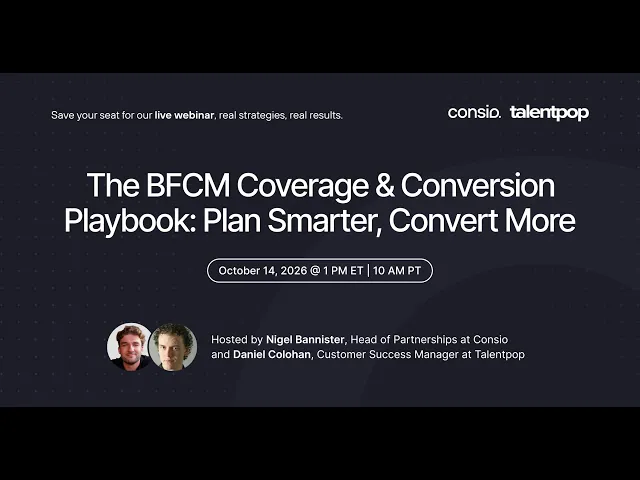
In the Consio × TalentPop session The BFCM Coverage & Conversion Playbook, Nigel Bannister (Head of Partnerships at Consio) and Daniel Colohan from TalentPop walked through the three levers that decide how a CX team performs during peak: forecasting coverage, optimizing with AI, and delivering revenue through proactive outreach. This article turns that playbook into a step-by-step guide you can apply before your own peak.
The BFCM customer service playbook at a glance
Lever | What it solves | Core tactics | Who owns it |
|---|---|---|---|
1. Forecast coverage | Being understaffed for a 3-5x volume spike | Historical ticket analysis, capacity math, staffing lead time | Support leadership + TalentPop |
2. Optimize with AI | Routine volume swallowing your team's hours | AI phone deflection, Shopify context, lossless AI-to-human handoffs | |
3. Deliver revenue | Checkout abandoners and churn slipping through | Outbound dialer on Shopify/Klaviyo segments, peer-to-peer SMS, revenue attribution | Consio Ecom Power Dialer + specialist agents |
The three levers build on each other. You cannot run profitable proactive campaigns if your team is drowning in order-status tickets, and you cannot automate your way out of being structurally understaffed. The sequence matters: forecast first, automate second, then convert.
1. Forecast your BFCM coverage before the spike hits
The single most common BFCM mistake is treating peak like a 10% bump. It is not. Across hundreds of brands, Consio and TalentPop see ticket volume rise to three to five times standard baseline during BFCM, with chat volume climbing roughly four times. The surge concentrates on the nights and weekends when most teams are least staffed. When a brand reacts to that wave instead of planning for it, the backlog does not clear when the promotion ends. It rolls forward for days, weeks, and sometimes months of returns and where-is-my-order follow-up.
Start with historical ticket analysis, not guesswork
There are several ways to size your coverage need, but the recommendation from the session is clear: historical ticket analysis gives you the most reliable number. Look at what your volume actually did during last year's peak, layer in this year's projected revenue growth, and work backward to the headcount required. TalentPop built a free forecasting calculator, distributed to attendees by email after the session, that lets you model coverage from either projected revenue or current team capacity.
The capacity math is straightforward once you have the inputs. Here is a worked example from the session. A brand doing roughly 6,000 monthly tickets against 35,000 monthly orders has about a 17% ticket-to-order ratio. If a single agent handles an average of 60 tickets a day (top-tier agents handle 80 to 100), five days a week, that is roughly 1,097 tickets of monthly capacity per agent. Divide your projected peak volume by that number and you have your staffing target.
Mind the staffing lead time
Coverage you plan in November is coverage that arrives too late. TalentPop's typical turnaround to source, onboard, and deploy new CX team members is one and a half to two and a half weeks, depending on how many members you need and the scope of coverage. With BFCM landing at the end of November, mid-October is the window to lock in additional staffing so new agents are trained and productive before the first wave, instead of learning your brand voice during it.
Case study, Jackson: planning ahead pays off. According to the session, Jackson came to TalentPop looking to streamline and scale customer support ahead of a heavy holiday season. The team started with two agents on the account and scaled to about 17 agents at peak. Because they staffed ahead, during BFCM they held a first response time of 2 minutes 12 seconds, an under-12-minute resolution time, and an 8.75% live-chat conversion rate on the days themselves, generating roughly $100,000 in revenue that would otherwise have slipped away.
2. Optimize phone coverage with AI
Once you know your coverage number, the second lever is efficiency. Most e-commerce teams have already automated some portion of email and chat tickets. Phone, though, remains badly under-automated, and it is exactly where peak-season callers pile up with simple, repetitive questions.
Put an AI agent in front of the phone line
An AI voice agent sitting at the front of your phone line can deflect roughly 40% of calls on its own: order status, subscription modifications, order cancellations, FAQs, and product-catalog questions. Those are resolved without a human ever picking up, and anything that genuinely needs a person is intelligently escalated. Automating 40% of call volume is a direct, immediate increase in the capacity you would otherwise have to hire for.
Give agents Shopify context at their fingertips
When your team does answer, the platform matters. If agents have every piece of Shopify information in front of them (the customer's order, tracking, and history, with duplicate profiles merged), they are not tabbing between tools to find a tracking link mid-call. That alone sharply reduces handle time on every phone ticket.
Make the AI-to-human handoff lossless
Here is the piece most teams miss. The calls that do transfer to a human are not starting over. With Consio, the human who picks up a transferred call gets a full summary of what the customer already discussed with the AI agent: the order number, the intent, the context. Instead of re-asking every question, the agent picks up mid-problem and resolves it far faster. So AI increases capacity twice. It eliminates the routine calls, and it shortens the human calls that remain.
The compounding effect is what makes phone automation such a strong BFCM lever. During peak, you are drowning in order-status and simple questions. The AI absorbs them up front, and your humans are freed to spend their time on the complex, high-intent conversations that actually need a person, the ones that are worth real money.
3. Stop losing the silent revenue: turn support into a profit channel
This is where a BFCM customer service strategy stops being a cost center. The average e-commerce conversion rate sits around 1.65%, which means roughly 98% of your site visitors leave without buying anything, and about 69% of carts are abandoned. During peak, with coverage gaps on nights and weekends, even more high-intent shoppers slip through.
Nigel framed it with an analogy worth keeping. It is like a retail store where customers walk in, pick up items, hesitate, and walk out, with nobody approaching them. That is revenue walking out the door, literally and figuratively. The opportunity for CX teams is to be the person on the floor: to reach out, close the loop, and own a revenue number they can take to the C-suite.
Build two specialist roles around the customer journey
The session's model splits proactive CX into two complementary roles.
The e-commerce sales specialist works the front of the journey: reaching out to abandoned carts, calling shoppers to see what the blocker was and closing the sale, converting customers into subscribers, saving order cancellations, running proactive live-chat campaigns, and handling personalized upsell and cross-sell. In a live chat, this specialist can draft the order for the customer as they chat and get it across the finish line.
The retention specialist works the back of the journey, after purchase: subscription recovery and win-backs, refund-and-return saves, cancellation intercepts, payment recovery, and post-purchase check-in calls. Because it is four to five times more expensive to acquire a new customer than to retain an existing one, and repeat customers are far more likely to order again and spend more, this role protects the revenue you have already earned.
The key insight is that both roles work on existing traffic, not net-new acquisition. These are shoppers already engaging with your brand during BFCM. You are converting demand you have already paid to generate.
Case study, men's basics brand: $189K through CX alone. According to the session, a men's basics brand running these specialist roles during BFCM saw $189,000 in revenue through the CX channel alone, at a 10.9% CX conversion rate and a $156 average order value, all from existing traffic. That is more revenue from customer conversations than most brands ever expect from support.
Run the outbound playbook with the right tools
Proactive outreach works best when it is systematized. The results the teams cited: proactive chat can drive roughly a 40% conversion lift, strong proactive live-chat campaigns convert at rates as high as 60% when a specialist drafts the order in-conversation, abandoned-cart outreach converts in the low double digits (around 12%), and a retention specialist can hit roughly a 36% save rate on cancellations.
Case study, checkout-abandoner outreach that pays for itself. According to the session, one furniture brand had a single rep calling checkout abandoners convert at around 20%, driving roughly $450,000 a month in sales from that one rep, on a high-AOV, big-and-bulky catalog where that conversion rate is remarkable. Separately, a subscription brand that waits until 120 to 128 days post-churn, long after every other save flow has run, still recovers about 13% of those customers from connected calls while gathering valuable churn feedback along the way.
How Consio powers it
Consio runs this with a segment-based outbound dialer that a human agent sits inside. You take any Shopify or Klaviyo segment (checkout abandoners, churned subscribers, new purchasers who just unlocked loyalty points, trade-program or B2B leads) and queue it into the dialer, with pre-recorded voicemails per campaign and peer-to-peer SMS that works well for high-volume outreach. Every conversion is attributed back through Shopify to the exact rep, call recording, or SMS transcript that drove it.
You can run this strategy without specialized software, but it becomes a lot of copy-pasting phone numbers from Shopify into a dialer and a lot of manual attribution. Running it through Consio's Ecom Power Dialer gives you roughly 1.5 to 2x the output of an agent doing it by hand, and it makes the reporting trivial.
Putting the three levers together
A complete BFCM customer service strategy runs in sequence. Forecast your coverage from historical data and lock in staffing with enough lead time. Optimize with AI across phone, chat, and email so your team is efficient and never buried in routine volume. Then, with the capacity you have freed up, deliver revenue by running proactive plays on your highest-intent segments, and attribute every dollar back. Many brands bring on a specialist agent dedicated to the proactive work because the ROI speaks for itself.
Key takeaways
Plan for 3-5x, not +10%. BFCM ticket volume multiplies and concentrates on nights and weekends, so size coverage from historical ticket analysis rather than optimism.
Staff by mid-October. New CX members take 1.5 to 2.5 weeks to onboard, so coverage planned in November arrives too late to be trained.
Automate the phone. An AI voice agent deflects around 40% of calls and gives humans full context on the rest, increasing capacity on both ends.
Own a revenue number. With around 98% of visitors leaving and about 69% of carts abandoned, proactive CX on existing traffic is the clearest path from cost center to profit channel.
Systematize and attribute. A segment-based dialer with Shopify attribution roughly doubles agent output and proves the revenue CX creates.
FAQs
How much should I staff up for BFCM customer service?
Size it from historical ticket analysis rather than a flat percentage. BFCM volume typically runs three to five times your baseline, with chat up around four times. Take last year's peak volume, layer in projected revenue growth, and divide by realistic per-agent capacity (roughly 1,000 or more tickets a month per full-time agent). Start the hiring process by mid-October, since onboarding new agents takes one and a half to two and a half weeks.
Can AI help with conversion and prevent cart abandonment, not just deflect tickets?
Yes, but the strongest results come from pairing AI with human follow-up. AI at the front of your phone line resolves routine questions instantly, and for shoppers stuck at checkout, the highest-converting play is a human specialist following up with checkout abandoners by call or SMS. One brand in the session converted checkout abandoners at around 20% with a single dedicated rep. AI handles the volume while humans close the high-intent moments.
What if a shopper abandons because they realize they're chatting with AI?
This was a real question from the audience. The fix is a clean handoff. Configure your AI so that anyone with items in their cart, or anyone showing buying intent, is passed to a live teammate rather than kept in an automated loop. If you only run email and chat with no phone, set the AI to escalate high-intent conversations to a human, and check whether your helpdesk AI provider can auto-route shoppers with active carts to an agent.
How do I turn customer service into a revenue channel?
Build two specialist roles around the customer journey: an e-commerce sales specialist for the front (abandoned-cart outreach, proactive chat, upsell, cancellation saves) and a retention specialist for the back (win-backs, subscription recovery, payment recovery, post-purchase calls). Both work existing, already-engaged traffic. One men's basics brand generated $189,000 through the CX channel alone during BFCM at a 10.9% conversion rate.
Do I need special software to run proactive outreach?
You can run it manually, but it means copy-pasting phone numbers out of Shopify and reconstructing attribution by hand. A segment-based outbound dialer like Consio's pulls any Shopify or Klaviyo segment, queues it with pre-recorded voicemails and peer-to-peer SMS, and attributes every conversion back through Shopify to the exact rep and call. That is roughly 1.5 to 2x an agent's output with far simpler reporting.
When should I call churned or abandoned customers?
Sooner is generally better for recovery, but later still works and yields feedback. Abandoned-cart outreach converts best when it is prompt. For churned subscribers, calling right after churn recovers the most, yet one brand in the session waits 120 to 128 days post-churn, after every other save flow, and still recovers about 13% from connected calls while gathering valuable churn insight.
Turn BFCM conversations into revenue
Across all three levers, forecasting, optimizing with AI, and delivering revenue, the goal is the same: make customer experience a measurable profit channel during your biggest weekend of the year. Book a demo to see how Consio's AI Phone Platform, AI Voice Agent, and Ecom Power Dialer help your team run and attribute these workflows at scale.

Head of Partnerships