5 best Shopify discount apps for Shopify brands in 2026
Discover the 5 best Shopify discount apps in 2026 to boost conversions, increase AOV, and run smarter promotions with advanced pricing strategies.

You’ve got your Shopify store up and running. Products look solid. Traffic’s coming in. But conversions? Yeah… not quite there.
At some point, most merchants hit the same realization basic discounts just don’t work like they used to. In 2026, shoppers expect more. Personalized deals, smarter bundles, loyalty-based pricing… that’s the baseline now. And Shopify’s native discount system? It’s fine, but it wasn’t really built for that level of flexibility.
That’s where discount apps step in. Whether you’re trying to run a proper BOGO campaign, set up tiered pricing for wholesale customers, or auto-apply discounts based on what’s sitting in the cart the right app can completely change how your promos perform.
This guide walks you through what actually matters. What to look for, what tends to break, and how to pick something that fits your store.
What are Shopify discount apps?
At a basic level, Shopify discount apps are third-party tools that extend or sometimes replace Shopify’s built-in discount system. You install them through the App Store, and suddenly you’ve got way more control over how discounts behave.
Think of it like upgrading your pricing engine without touching code.
Here’s what they usually unlock:
Create automatic discounts based on cart value, product type, or customer tags
Set up tiered pricing (buy 3, save 10%; buy 6, save 20%)
Run proper BOGO campaigns with conditions that actually make sense
Show discounted pricing directly on product pages (huge for conversions)
Stack multiple discounts in a single checkout
Restrict offers to specific groups like VIPs, wholesale buyers, or repeat customers
Some apps go deep into one area like bundles or volume pricing. Others try to do everything.
Why Shopify stores need advanced discount apps
Running a “10% off everything” sale used to feel exciting. Now? It barely gets attention.
Customer behavior has shifted. People compare. They wait. They know when another sale is coming. And if your only move is generic discounts, you’re basically training them not to buy at full price.
Here’s what’s pushing merchants toward better discount setups:
1. Shopify’s native discount system has real limits
Out of the box, Shopify gives you four main discount types:
Percentage off
Fixed amount
Free shipping
Buy X, Get Y
Sounds fine… until you actually try to scale. They don’t stack properly. You can’t show discounted prices on product pages without workarounds. Tiered pricing gets messy fast.
Example: You want to offer 10% off for first-time buyers AND free shipping over $75.
Yeah you can’t cleanly do both in one checkout natively. That’s usually the first “okay, we need an app” moment.
2. Post-purchase and loyalty-driven discounts are becoming normal
Blanket discounts are fading out. Personalized offers are what actually move the needle now.
There’s a big difference between blasting a 10% code to everyone… and giving 15% off to someone who just placed their third order. Customers notice that kind of thing.
Example: A skincare brand I worked with started sending a small “thank you” discount after the second purchase. Nothing crazy. But it nudged repeat orders up in a way generic campaigns never did.
3. B2B and wholesale is growing on Shopify
More stores are mixing retail and wholesale in one setup. Sounds great until pricing gets complicated.
You’ve got:
Different pricing tiers for different buyers
Minimum order quantities
Special terms for trade customers
Shopify alone doesn’t handle that cleanly.
Example: A furniture store sells at full price to regular customers, but interior designers (logged into tagged accounts) automatically see 30% off.
Same store. Different experience. That’s app territory.
4. Checkout extensibility is changing the game
Shopify is moving away from checkout.liquid and pushing toward checkout extensibility.
What that means in plain English: Older apps that rely on hacks or scripts? They’re going to break or lose functionality.
Newer apps built on Shopify Functions:
Load faster
Integrate properly
Don’t randomly stop working after updates
If you’re using an older discount setup, it’s worth checking now before it becomes a problem mid-sale.
5. Cart abandonment recovery needs smarter offers
Recovery isn’t just about sending emails anymore. It’s about timing + relevance.
What actually works:
Exit-intent discounts with urgency
Auto-applied offers (no code needed)
Personalized discounts based on cart value
Example: Customer abandons a $120 cart. One hour later, they get an email with a pre-applied 8% discount. No code. Expires in 24 hours.
That kind of flow converts way better than generic reminders.
Shopify native discounts vs. discount apps: which is better?
Here’s the straight comparison:
Feature | Shopify Native | Discount Apps |
Percentage / fixed discounts | Yes | Yes |
Automatic discounts | Limited | Advanced |
Tiered / volume pricing | No | Yes |
BOGO with conditions | Basic | Advanced |
Discount stacking | Limited | Yes |
Product page price display | No | Yes (most apps) |
Customer segment targeting | Limited | Yes |
B2B / wholesale pricing | No | Yes |
Checkout UI integration | Basic | Yes (modern apps) |
Analytics on discounts | Basic | Advanced |
When native Shopify discounts are enough:
You’re just getting started
Running simple sitewide promos
Using one code at a time
No wholesale or segmentation
Don’t need pre-checkout pricing display
When you need an app:
You want “was $40, now $28” on product pages
Running bundles, BOGO, or volume pricing
Need automatic cart-based discounts
Managing different customer groups
Want deeper analytics
Most stores hit this point somewhere between $5k–$20k/month. That’s usually when the switch starts paying off. And yeah Shopify has improved its native system over time. But for anything remotely complex, there’s still a gap.
Best Shopify discount apps in 2026 (Top 5 Picks)
1. FAD Automatic Discounts
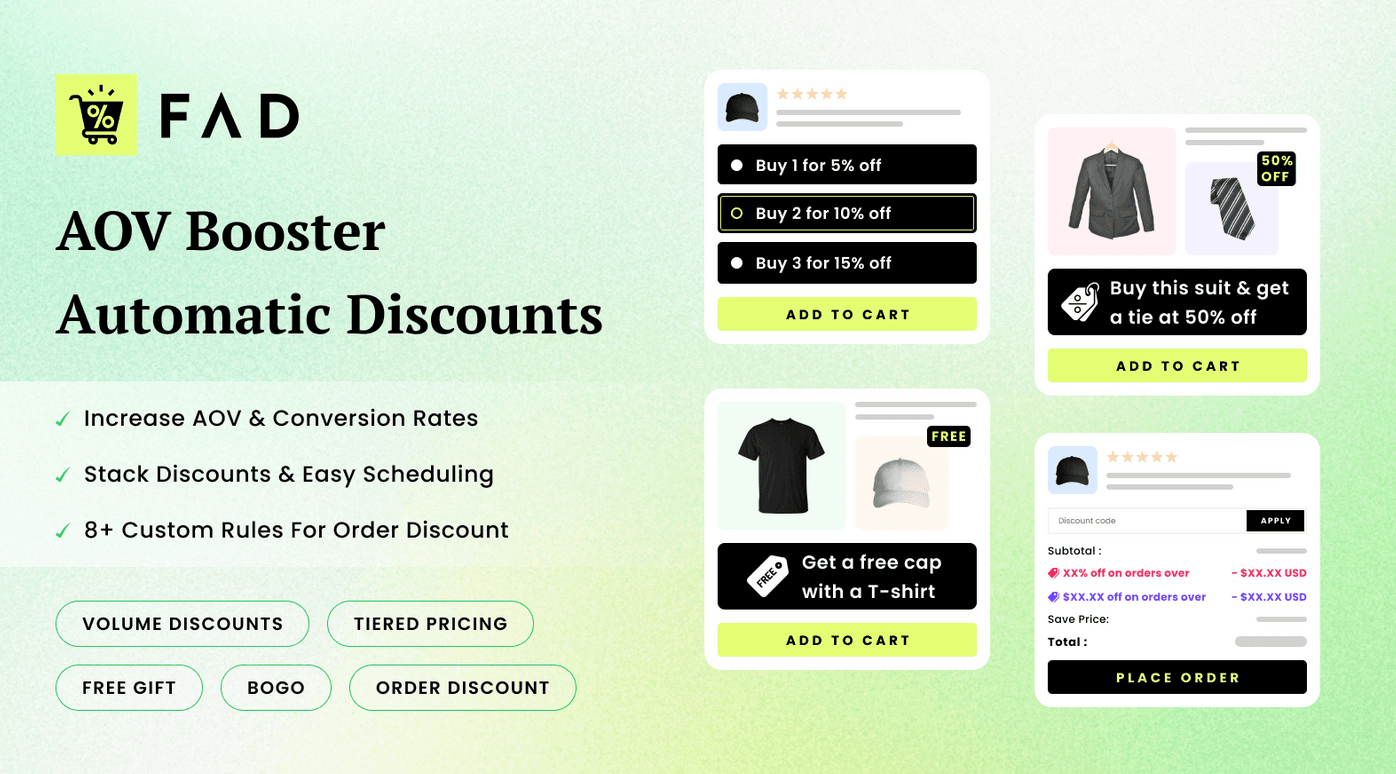
FAD - Automatic Discounts is one of those all-in-one apps that actually tries to cover the full discount spectrum and does a pretty decent job at it. You can run tiered pricing, BOGO offers, free gift campaigns, all from one dashboard. No coding, no weird workarounds. It also plays nicely with most themes, which… you’d be surprised how often that becomes an issue.
What stands out is how flexible it is across different customer types. You can show pricing tiers right on product pages, set cart goals to push higher order values, and run automatic discounts without relying on draft orders.
Works well for both B2B setups and high-volume retail promos.
Key features
Set up tiered pricing and volume discounts directly on product pages
Create BOGO, free gift, and product-specific rules
Apply percentage, fixed, or rule-based discounts
Automatic checkout discounts without draft orders
Compatible with Shopify POS
No checkout conflicts or broken cart behavior
Pricing
Development Store – Free
Basic – $4.99/month
Grow/Advance – $9.99/month
Plus – $19.99/month
2. Bulk Discount Code Bot
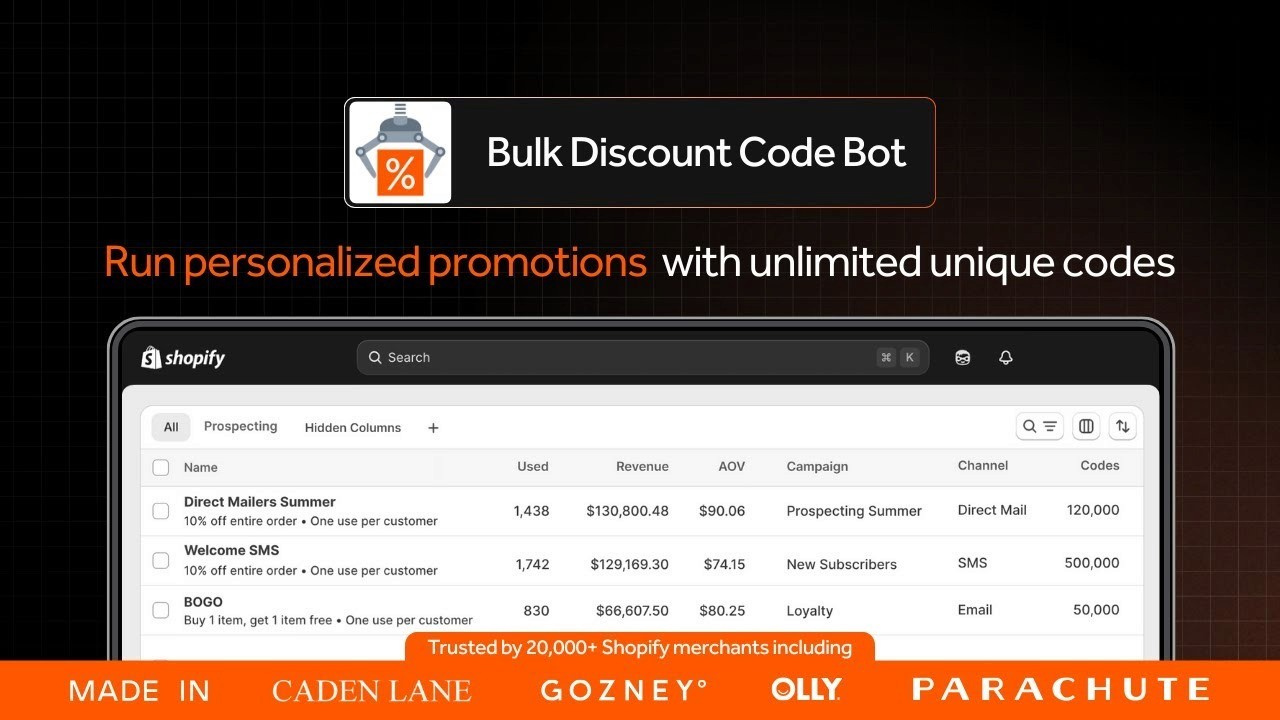
This one’s built for scale. If you’re running campaigns across email, SMS, influencers, affiliates basically anywhere and need unique codes, this app saves a ton of manual effort. Instead of reusing one code (which kills tracking), you can generate unlimited unique ones.
Where it really helps is reporting. You can actually see what’s working revenue, redemptions, AOV broken down by campaign or channel. Also includes a discount audit feature, which catches things like missing expiry dates or unlimited usage… small mistakes that quietly eat margins.
Key features
Generate or import unlimited unique codes
Export to CSV for campaigns
Track revenue and redemption data
Built-in discount risk audit
Auto-sync with Klaviyo
Supports all major discount types
Pricing
Starter – Free
Basic – $19/month
Grow – $99/month
3. Quantity Breaks & Discounts
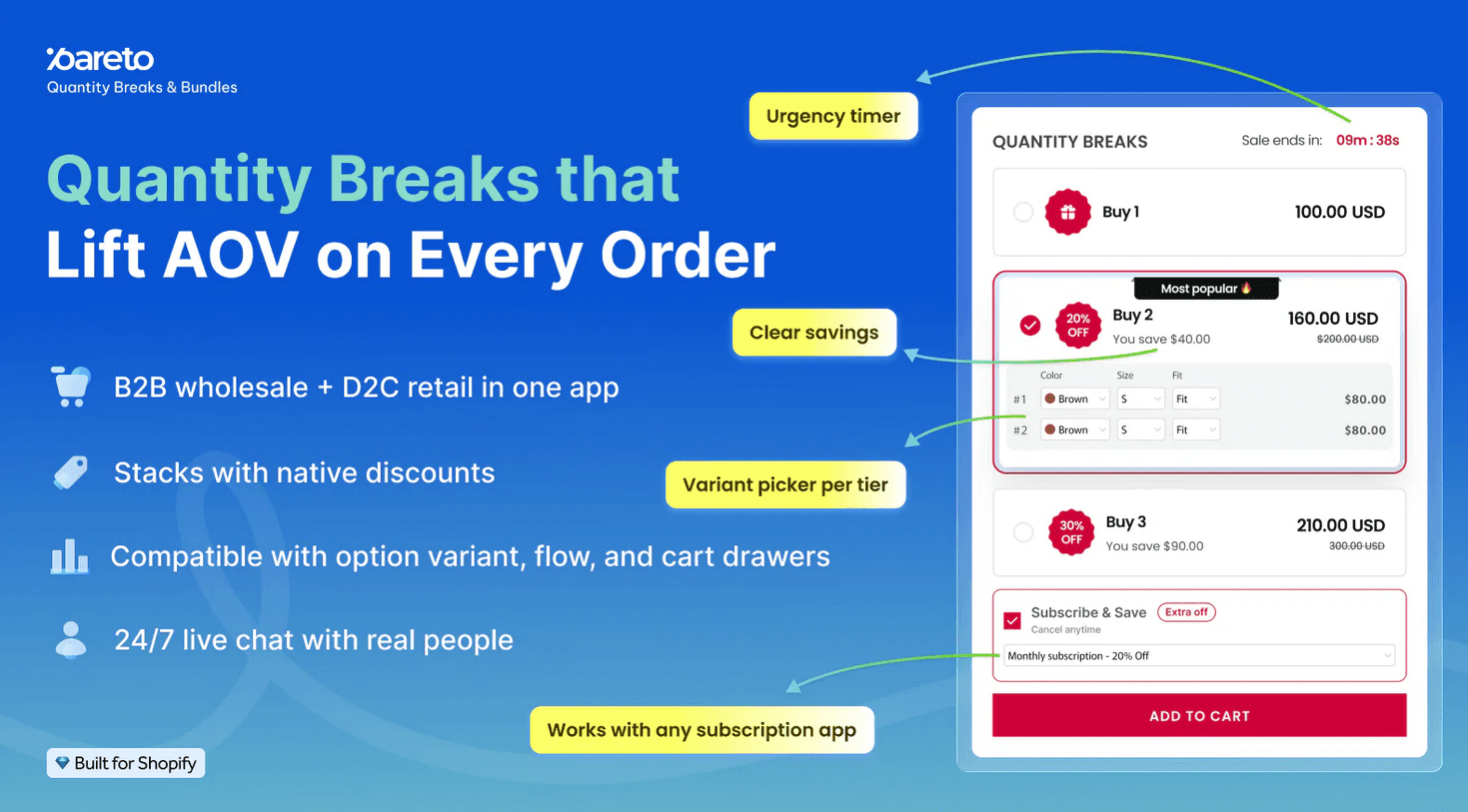
This one leans heavily into AOV growth through volume-based offers. You can set up quantity breaks, bundles, BOGO, stacking pretty much everything tied to getting customers to buy more per order. It’s also built with scale in mind. Things like customer segmentation, variant-level discounts, and market-based pricing are all baked in.
For stores running multiple regions or storefronts, the bulk export and migration tools are genuinely helpful. And yeah, it integrates cleanly with POS and mobile, which matters more than people think.
Key features
Volume discounts, bundles, and stacking
BOGO and free gift campaigns
Cart-based and B2B pricing support
Segment by variant, tag, or market
Bulk export and automation
Mobile-optimized display
Pricing
Free – Free
Basic – $11.99/month
Professional – $24.99/month
Advanced – $39.99/month
4. AIOD - Discounts, BOGO & Gifts
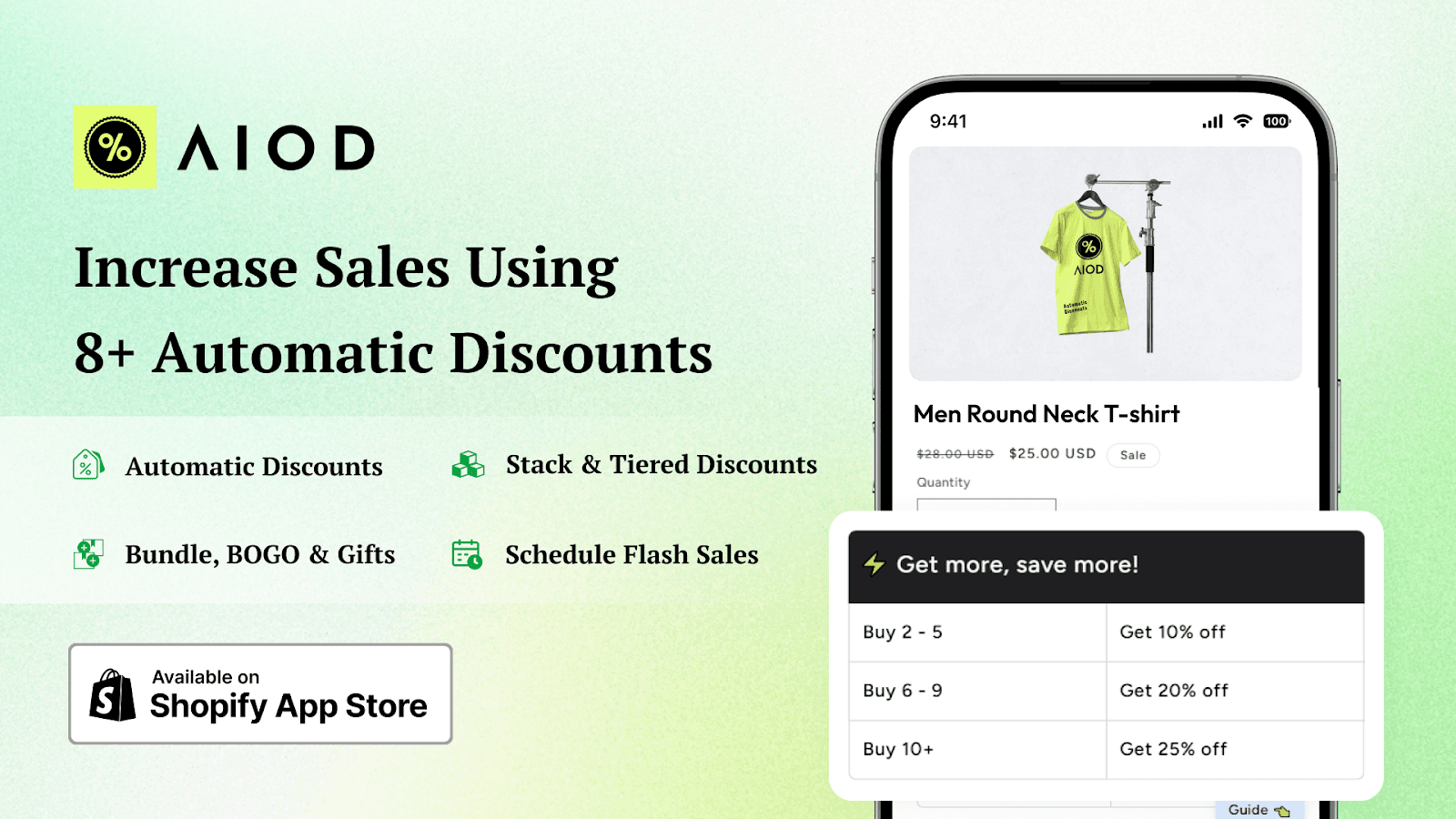
AIOD is another all-in-one option, but with a strong focus on automation. You can run bundles, BOGO, tiered discounts, wholesale pricing all applied automatically in the cart. No code entry needed, which removes a lot of friction at checkout.
That’s where you start seeing the lift. When customers don’t have to think about applying a code, they’re more likely to just keep adding items which naturally pushes up your average order value without feeling forced.
One standout feature is discount stacking. Customers can combine automatic discounts with manual codes, which is surprisingly rare and really useful. The tier progress messaging is also a nice touch. It nudges customers toward higher spend without being pushy.
Key features
Automatic discounts across all major types
Stack discount codes with automatic offers
Real-time tier progress messaging
Auto-add gifts and BOGO items
POS and mix-and-match support
Built-in performance tracking
Pricing
Development Store – Free
Basic – $9.99/month
Grow – $14.99/month
Advanced – $24.99/month
5. Regios Discounts
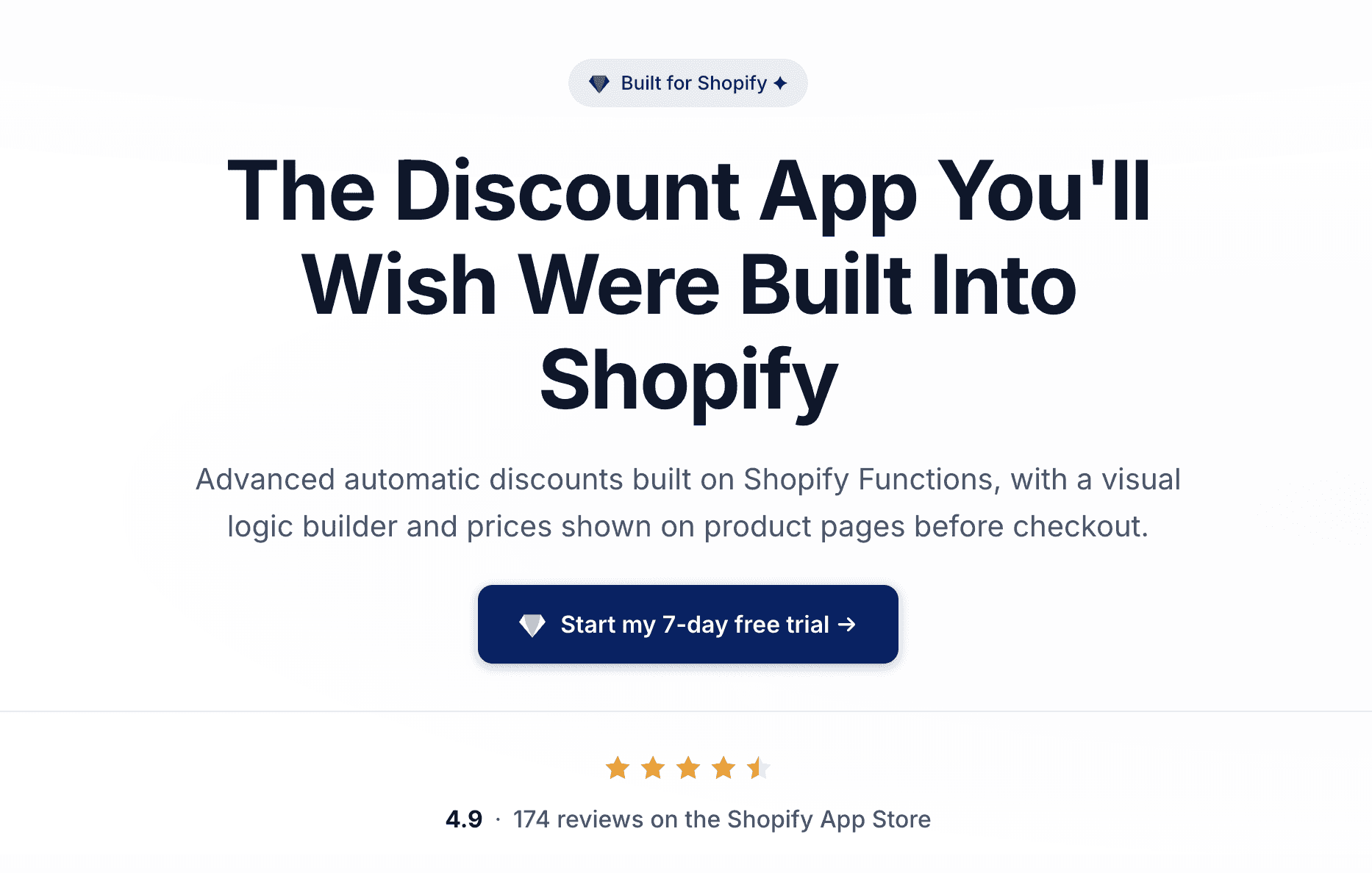
Regios Discounts is an advanced automatic discount app built for Shopify merchants that need more control over complex promotions. It is built on Shopify Functions and gives teams a flowchart-based logic builder to create conditional discounts without relying on custom development.
It works well for stores that need stacking rules, tiered pricing, BOGO offers, free gifts, customer-specific discounts, and more advanced promotion logic than Shopify’s native discount system can support.
Regios is especially useful for merchants that want to build flexible discount workflows while keeping everything native to Shopify.
Key features
Flowchart-based discount logic builder
Built on Shopify Functions
Automatic discounts and conditional rules
Discount stacking
Tiered pricing
BOGO and free gift offers
Customer and cart-based discount logic
Built for Shopify badge
Pricing
Starter – $29.99/month
Business – $49.99/month
Enterprise – $99.99/month
All plans include a 7-day free trial. Development stores can use Regios for free.
How to choose the right Shopify discount app for your store
With so many options, it’s easy to get stuck comparing features for hours. Not worth it. Here’s a simpler way to think about it:
1. Start with your actual use case
Don’t look for “the best app.” Look for the one that solves your immediate need.
Volume pricing?
BOGO?
Wholesale setup?
Cart-based discounts?
Most apps are great at one thing and average at others.
2. Check checkout compatibility
This is non-negotiable now. Make sure the app supports Shopify Functions and Checkout UI Extensions. If it doesn’t say it clearly, ask support. Otherwise, you’re setting yourself up for issues later.
3. Watch performance impact
Some apps slow your store down. Especially the ones injecting heavy scripts. Look for apps using native APIs. And test speed before going live seriously, don’t skip this.
4. Think beyond your current size
An app that’s cheap today might get expensive fast as order volume grows. Check pricing tiers carefully.
5. Look at support quality
Ratings can be misleading. Go read recent reviews. Are people complaining about bugs? Slow responses? If a discount breaks during a sale, it’s not just annoying it costs money.
6. Actually test everything
This sounds obvious, but it’s skipped all the time.
Check product page pricing
Test checkout behavior
Try stacking discounts
Look at mobile experience
You’ll catch issues early instead of during a live campaign.
7. Consider your tech setup
Custom theme? Headless? Shopify Plus? Not every app works everywhere. Especially for headless builds you’ll need proper API support.
Pro Tip: Before installing anything, document your current discounts. Codes, rules, everything.
Common mistakes to avoid
Running multiple discount apps at once (they conflict more often than you’d think)
Ignoring analytics and guessing what works
Leaving discounts without expiry dates
Relying only on discount codes
Skipping mobile testing
Final thoughts
Discounting isn’t just about lowering prices. It's a strategy. Done right, it lifts conversions, builds loyalty, and increases AOV. Done poorly… it trains customers to wait for sales and chips away at your margins.
The best Shopify discount apps in 2026 aren’t just tools they’re leverage. They let you show the right offer to the right person at the right time. That might be a tiered pricing table, a BOGO campaign, or a personalized post-purchase deal.
Start with your use case. Test properly. And revisit your strategy every few months because what works in Q1 might fall flat by Q4.
Most stores don’t need more discounts. They just need smarter ones.
FAQs
Can I use multiple discount apps on my Shopify store at the same time?
Technically yes… but I wouldn’t recommend it. Apps tend to clash in the cart or checkout. It’s cleaner (and safer) to use one app that covers multiple needs.
Are Shopify discount apps worth the monthly cost?
If you’re doing over $5k–$10k/month, usually yes. The lift in conversions and AOV tends to outweigh the cost pretty quickly. For smaller stores, native discounts might be enough for now.
Which discount app is best for both automatic and code-based discounts?
AIOD and FAD are both solid options here. Most stores end up needing both types, and managing that across two apps gets messy fast.
What’s the difference between automatic discounts and discount codes?
Codes need to be entered manually. Automatic discounts just apply when conditions are met. Less friction = better conversions. Simple as that.
Do discount apps slow down my Shopify store?
Some do, especially older ones. Modern apps built on Shopify Functions are much lighter. Still, always run a speed test after installing it’s worth the extra few minutes.

Growth Marketing