Best business phone systems for Shopify and ecommerce brands (2026)
Compare the best business phone systems for Shopify and ecommerce brands. AI calling, power dialers, Shopify integrations, and pricing, all in one guide.
If you run a Shopify store and your phone strategy is still "someone picks up when they're available," you're leaving revenue on the table.
Phone calls in ecommerce aren't just a support channel. They're where high-intent customers convert, where abandoned carts get recovered, and where VIP customers decide whether to come back. The right business phone system turns those moments into measurable revenue. The wrong one adds overhead without adding output.
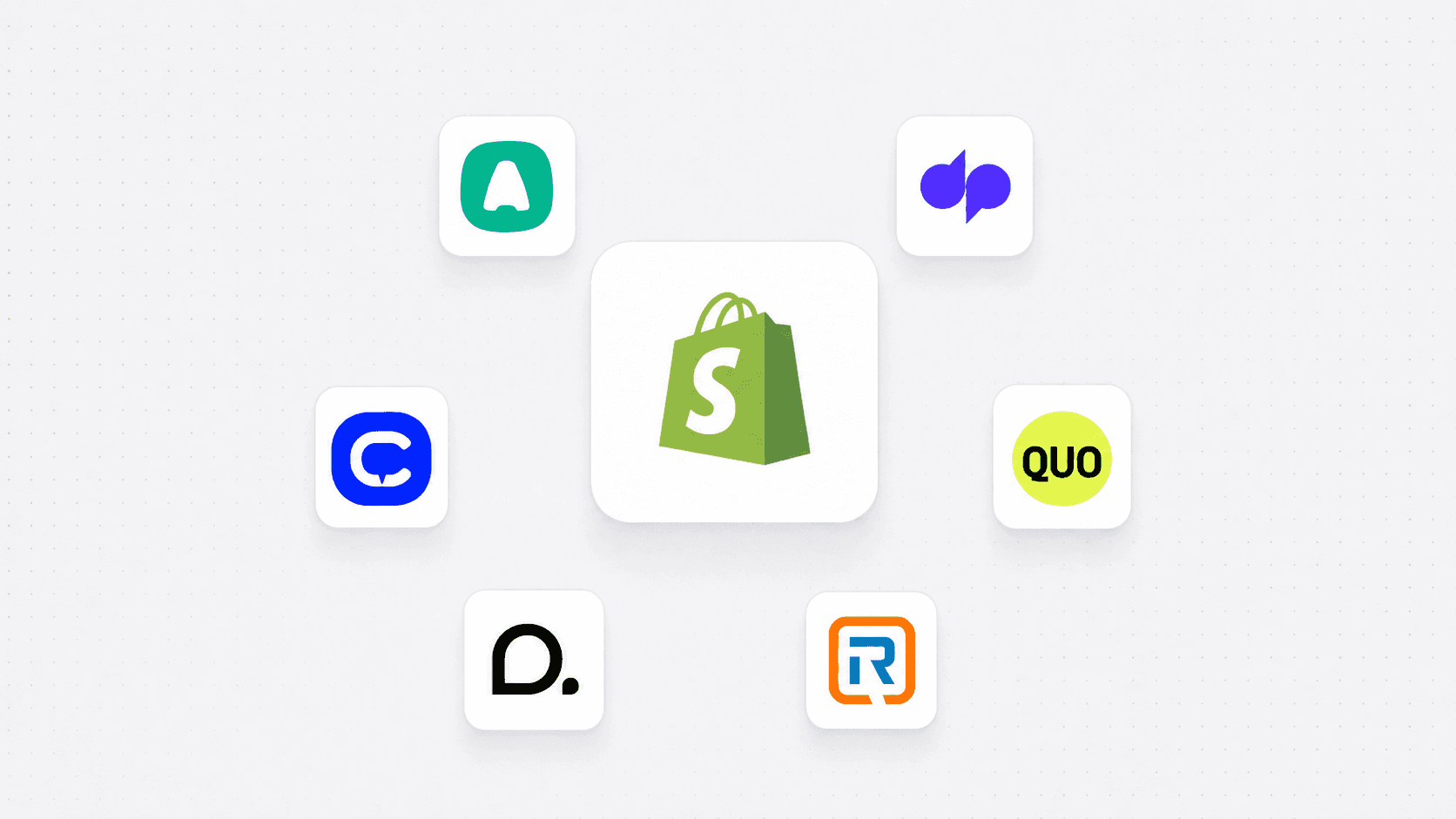
This guide compares the six best business phone systems for ecommerce and Shopify brands in 2026, covering features, Shopify integrations, pricing, and which type of store each platform is actually built for.
What to look for in a business phone system for ecommerce
Most business phone systems were built for B2B sales teams or generic call centers. Ecommerce has different needs. Before you evaluate any platform, here's what actually matters for Shopify brands:
Shopify integration depth. Can the system pull order history, customer data, and cart status into a call automatically? Or does your agent have to open three tabs to answer a basic "where's my order?" question? Native Shopify sync is the difference between a tool and a real workflow.
Inbound handling. Can the platform handle inbound calls 24/7, including after hours, without a human always available? AI voice agents and smart IVR routing are now table stakes for stores doing real volume.
Outbound campaigns. Email and SMS alone don't recover every cart. Phone-based outbound campaigns, abandoned checkout calls, VIP outreach, win-back sequences, require a power dialer and segment-level targeting, not just a "click to call" button.
SMS built in. The best phone interactions don't end when the call ends. Two-way SMS lets your team send payment links, tracking updates, and follow-up offers in the same thread as the call.
Revenue attribution. Can you tie a recovered cart or a placed order directly back to a phone call? Without attribution, your phone channel is a cost center. With it, it's a revenue driver you can actually optimize.
Pricing that fits your model. Per-user pricing can get expensive fast if you have multiple agents. Usage-based (per-minute) pricing can be smarter for stores with variable call volumes.
How we selected and compared these tools
We evaluated each platform against six criteria specific to ecommerce operations:
Shopify and ecommerce integration — native vs. API-only vs. none
Inbound AI capabilities — 24/7 coverage, IVR, escalation to humans
Outbound tools — power dialer, campaign management, voicemail drops
SMS and messaging — two-way, in-call thread, MMS support
Analytics and revenue attribution — call-to-order tracking, conversion reporting
Pricing and scalability — cost per minute or per seat, what's included
We focused on tools that a Shopify brand with 1–50 agents could realistically deploy and measure ROI on, not enterprise call-center software that takes 6 months to configure.
The 6 best business phone systems for ecommerce (2026)
1. Consio — Best for Shopify brands focused on revenue
Consio is the only phone platform built specifically for ecommerce revenue generation. It combines inbound AI calling, outbound campaign management, SMS, and Shopify-native attribution into a single platform.
Where most phone systems treat ecommerce as an afterthought, Consio starts from Shopify data: customer segments, order history, abandoned checkouts, AOV tiers. You can launch an outbound campaign targeting customers who abandoned checkout in the last 48 hours in a few clicks, something that's simply not possible with general-purpose VoIP tools.
Key features:
24/7 AI Voice Agent that handles inbound calls with full Shopify context (orders, products, customer history)
Outbound power dialer for targeted campaigns: abandoned checkout recovery, VIP outreach, win-back sequences, high-AOV segments
Automated voicemail drops when customers don't pick up
Two-way SMS/MMS in the same timeline as calls (payment links, product links, tracking updates, offers)
AI-generated call transcripts and summaries after every call
Shopify and Klaviyo native revenue attribution, link every call to an order
Unlimited agents (pricing by usage, not by seat)
Best for: D2C Shopify brands, ecommerce stores doing high-AOV sales, stores with abandoned cart or VIP outreach programs, support teams that want 24/7 inbound coverage without staffing for it.
Pricing: Usage-based. Free to start. $30/month for 100 minutes, $60/month for 400 minutes. ~$0.10/min overage. All features included on every plan.
Shopify integration: Native - orders, customers, product catalog, Klaviyo segments.
2. Aircall — Best for structured support and sales teams
Aircall is a mature cloud call center platform with deep CRM integrations and strong inbound routing capabilities. It's well-suited for ecommerce brands with structured support teams who need IVR, skills-based routing, and real-time call monitoring.
Aircall's Shopify integration exists, but it's one of 100+ integrations rather than the core of how the product is built. You get customer data on screen during calls, but Aircall doesn't natively understand your Shopify segments, cart data, or revenue attribution the way an ecommerce-first tool does.
Key features:
Advanced IVR, call queues, and skills-based routing
Power dialer available on Professional plan and above
100+ integrations (Shopify, Gorgias, HubSpot, Salesforce, Zendesk)
Real-time call monitoring, whisper, and barge for team managers
AI transcription, sentiment analysis, and call summaries
SMS in select regions
Best for: Ecommerce brands with 5–50 agent support teams, stores that already use Gorgias or HubSpot and need a phone system that plugs in cleanly, teams that need manager-level call monitoring.
Pricing: From $30/user/month (Essentials, 3-user minimum). Power dialer requires Professional plan (~$50/user/month). SMS available as add-on in some plans.
Shopify integration: Via integration marketplace. Customer data on screen; not native revenue attribution.
3. Dialpad — Best for unified communications
Dialpad offers voice, video, team chat, and SMS in one platform, making it the strongest option if your team needs internal and external communication unified in a single tool.
For ecommerce, the limitation is that Dialpad is a horizontal tool. There's no Shopify-native integration, no concept of customer segments or cart data, and outbound campaigns are not an ecommerce feature. It's excellent software for a growing team that needs a communication platform, less compelling if your primary goal is driving phone revenue from your Shopify store.
Key features:
Unified calling, SMS, video, and team messaging
Voice Intelligence™: real-time transcription, sentiment analysis, live agent coaching
Call queues, groups, and IVR routing
Integrations with Salesforce, HubSpot, Zendesk, Google Workspace
AI-powered post-call summaries and searchable transcripts
Best for: Ecommerce companies with internal team communication needs alongside customer-facing calls; tech-forward teams who want AI transcription and coaching; brands that need video conferencing and telephony under one subscription.
Pricing: Standard from $15/user/month (annual). Pro from $25/user/month. No ecommerce-specific plans.
Shopify integration: None native. Zapier or custom API required.
4. RingCentral — Best for enterprise and multi-location brands
RingCentral is one of the most established business phone platforms on the market. It covers voice, video, team messaging, and contact center in a comprehensive suite. For large ecommerce operations with complex routing requirements, multiple locations, or international presence, RingCentral provides enterprise-grade reliability and compliance.
The tradeoff: it's complex to configure, priced for enterprise, and has no ecommerce-specific functionality. Shopify integration exists through third-party connectors, not natively. For a lean D2C brand, it's likely overkill.
Key features:
Enterprise-grade cloud phone, video, and team messaging
Advanced call routing, IVR, and multi-site management
300+ integrations including Salesforce, Zendesk, Microsoft 365
Contact center module for high-volume inbound/outbound
AI analytics, quality management, and supervisor tools
Best for: Large ecommerce operations with multiple support sites or international teams; brands that need enterprise compliance (HIPAA, GDPR) alongside telephony; companies already in the RingCentral ecosystem.
Pricing: Core from ~$20/user/month (annual). Advanced and Ultra plans from $25–$35/user/month. Contact center pricing separate and significantly higher.
Shopify integration: Via third-party connectors. No native ecommerce integration.
5. OpenPhone — Best for small ecommerce teams on a budget
OpenPhone is a clean, easy-to-use cloud phone system designed for small businesses. It gives your team a shared professional phone number with call and SMS capabilities, collaborative inbox, and basic AI features like call summaries.
For a small Shopify store with 1–5 people handling calls informally, OpenPhone is a practical entry point. It doesn't have ecommerce-specific features, power dialing, or Shopify integration, but it's affordable, intuitive, and gets the basics right.
Key features:
Shared phone numbers with collaborative inbox
Unlimited calls and SMS/MMS to US/Canada
Call recordings, voicemail transcription, basic AI summaries
Internal threading and notes on contacts
Integrations: HubSpot, Zapier, Slack
Best for: Very small Shopify stores (1–5 people) that need a professional phone presence and basic team messaging without complexity or high cost.
Pricing: Starter from $15/user/month (annual). Business from $23/user/month.
Shopify integration: None native. Manual workflows only.
6. CloudTalk — Best for international ecommerce brands
CloudTalk is a cloud call center platform with strong international coverage, supporting numbers in 160+ countries, and solid outbound dialing tools. It's built for sales and support teams that handle high call volumes across multiple markets.
For ecommerce brands with significant international customer bases, CloudTalk provides the geographic coverage that US-centric tools often lack. It integrates with Shopify and Pipedrive alongside standard CRMs. The outbound features (power dialer, predictive dialer, smart dialer) are competitive with Aircall. Where it falls short is ecommerce-specific intelligence, there's no native understanding of cart data, AOV segments, or revenue attribution.
Key features:
Power dialer, predictive dialer, and smart dialer
Numbers in 160+ countries
Real-time dashboards and call monitoring
Shopify integration via marketplace
Integrations with HubSpot, Salesforce, Pipedrive, Zendesk, Intercom
SMS in select countries
Best for: Ecommerce brands selling across multiple international markets; stores with high outbound call volume that need dialer efficiency; teams using Pipedrive as their CRM.
Pricing: Starter from $25/user/month. Essential from $30/user/month. Expert from $50/user/month.
Shopify integration: Via integration marketplace. Customer data surfaced on calls; no native revenue attribution.
Side-by-side comparison table
Consio | Aircall | Dialpad | RingCentral | OpenPhone | CloudTalk | |
|---|---|---|---|---|---|---|
Built for ecommerce | ✅ Yes | ⚡ Partial | ❌ No | ❌ No | ❌ No | ⚡ Partial |
Native Shopify integration | ✅ Native | ⚡ Via marketplace | ❌ None | ❌ None | ❌ None | ⚡ Via marketplace |
AI inbound agent (24/7) | ✅ Yes | ❌ No | ❌ No | ❌ No | ❌ No | ❌ No |
Outbound campaigns | ✅ Segment-based | ⚡ Basic | ❌ No | ⚡ Contact center | ❌ No | ⚡ Basic |
Revenue attribution | ✅ Shopify-native | ❌ No | ❌ No | ❌ No | ❌ No | ❌ No |
Voicemail drops | ✅ Yes | ❌ No | ❌ No | ❌ No | ❌ No | ✅ Yes |
AI transcripts & summaries | ✅ Yes | ✅ Yes | ✅ Yes | ✅ Yes | ⚡ Basic | ⚡ Basic |
Pricing model | Usage (mins) | Per user | Per user | Per user | Per user | Per user |
Starting price | $30/100 min (unlimited users) | $30/user/mo | $15/user/mo | $20/user/mo | $15/user/mo | $25/user/mo |
Best for | Shopify revenue | Structured support teams | Unified comms | Enterprise | Small teams | International |
How to choose the right phone system for your Shopify store
There's no universal answer, but there are clear decision points:
Choose Consio if: Phone revenue is the goal. You want to recover abandoned carts by phone, run VIP outreach campaigns, or handle inbound calls 24/7 without a dedicated team. If your phone channel should be tied to Shopify orders and measurable in dollars, Consio is the only platform built for exactly that. Learn more about Consio's AI Voice Agent →
Choose Aircall if: You have a structured CX team (5+ agents), you're already using Gorgias or HubSpot, and you need sophisticated call routing, monitoring, and a wide integration library. See how Aircall compares to Consio →
Choose Dialpad if: You need a single platform for internal and external communications, voice, video, and team chat, and your team values real-time AI coaching and transcription over ecommerce-specific features. See how Dialpad compares to Consio →
Choose RingCentral if: You're a large, multi-site ecommerce operation with enterprise compliance requirements and complex routing across teams or geographies. See how RingCentral compares to Consio →
Choose OpenPhone if: You're a small team (under 5 people) that just needs a shared, professional phone presence without complexity. Great starting point; plan to upgrade as you scale. See how OpenPhone compares to Consio →
Choose CloudTalk if: You have significant international call volume and need local numbers in 160+ countries alongside a solid outbound dialer.
FAQs
What is the best business phone system for a Shopify store?
The best phone system for Shopify depends on what you want the phone channel to do. If the goal is recovering abandoned carts, handling inbound calls 24/7, and tracking revenue from phone interactions, Consio is the purpose-built option with native Shopify integration. If you need a traditional call center with deep CRM routing, Aircall is the most integration-rich choice. For small teams on a budget, OpenPhone is a solid starting point.
Do I need a business phone system if my Shopify store uses live chat?
Yes, for most stores. Live chat handles low-complexity questions well, but high-ticket items, post-purchase issues, and at-risk customers often convert or resolve much better over the phone. Phone calls also reach customers who don't respond to email or SMS, making them an important incremental channel for revenue and retention, not a replacement for chat.
Can a business phone system integrate directly with Shopify?
Most business phone systems offer Shopify integration through their marketplace or via Zapier, meaning they can surface customer data on an incoming call. Consio is the only platform with native Shopify integration that works the other way: using your Shopify customer segments, cart data, and order history to trigger outbound campaigns and attribute revenue from calls back to orders.
What's the difference between a VoIP phone system and an AI phone platform?
A VoIP phone system replaces your traditional phone line with internet-based calling. An AI phone platform goes further: it uses AI to handle calls without a human (inbound answering, qualification, routing), send SMS, transcribe and summarize every conversation, and connect call outcomes to business results like orders and revenue. For ecommerce brands, an AI phone platform provides significantly more leverage than a basic VoIP system.
How much does a business phone system cost for an ecommerce brand?
Costs range widely. Per-user platforms like Aircall and Dialpad typically run $15–$50/user/month depending on features. Usage-based platforms like Consio start at $30/month for 100 minutes with no per-seat fees, which can be more economical for teams with variable call volumes. Enterprise platforms like RingCentral can run significantly higher, especially with contact center modules. Most platforms offer free trials.
What features should a Shopify brand prioritize in a phone system?
In order of impact: (1) native Shopify integration for customer context on every call, (2) 24/7 inbound handling so no call goes unanswered, (3) outbound campaign tools tied to Shopify segments, (4) two-way SMS for call follow-ups, (5) revenue attribution to measure phone ROI. General-purpose features like video conferencing or team chat are lower priority unless you have a broader communication need beyond customer calls.
The bottom line
The right business phone system for your Shopify store is the one that connects phone interactions to Shopify data and ultimately to revenue. Most platforms on this list do some of that. Consio does all of it by design.
If you're running a D2C or Shopify brand and want to turn your phone channel into a measurable revenue driver, not just a cost center, Consio is the starting point worth evaluating.
Book a demo and see how Consio helps Shopify brands turn calls into revenue →

Growth Marketing