Best customer service tools for Shopify brands in 2026
Compare the best customer service tools for Shopify brands, including helpdesk, AI voice, live chat, surveys, and feedback.
Last updated: May 2026
The best customer service tools for Shopify brands in 2026 do more than answer tickets. They help ecommerce teams respond faster, automate repetitive questions, recover more revenue, improve customer satisfaction, and understand what shoppers actually need before and after they buy.
For Shopify brands, customer service usually happens across several moments:
A shopper has a product question before buying.
A customer wants to know where their order is.
Someone calls about delivery, sizing, returns, or a damaged item.
A VIP customer needs human help.
A support leader wants to measure CSAT, NPS, or customer effort after the interaction.
According to Zendesk's 2025 CX Trends Report, 70% of customers expect conversational experiences when engaging with brands, across every one of those moments.
That is why the best Shopify customer service stack usually includes a mix of tools: a helpdesk, live chat, AI automation, phone support, SMS, and feedback surveys.
This guide breaks down the best customer service tools for Shopify brands, what each one does well, and how they fit together.
What great customer service looks like for Shopify brands
Customer service for ecommerce is different from customer service for SaaS, marketplaces, or traditional retail.
Shopify brands deal with high-volume repetitive questions, such as:
Where is my order?
Can I change my address?
What is your return policy?
When will this be back in stock?
What size should I choose?
Can I speak with someone before buying?
But they also deal with high-value conversations that can directly impact revenue.
A shopper may be ready to place a $200 order but needs one final answer. A customer may be about to return a product unless someone helps them choose a better option. A repeat buyer may need support before making another purchase.
The right customer service tools help brands handle both sides of that equation: faster support and better revenue opportunities.
Common customer service tool categories for Shopify brands
1. Helpdesk and ticketing
A helpdesk gives your team one place to manage customer conversations across email, chat, social, and sometimes voice.
For Shopify brands, the best helpdesk tools connect directly with Shopify so agents can see customer profiles, order history, refunds, shipping status, and past conversations without switching tabs.
2. Phone and AI voice support
Phone support is often overlooked in ecommerce, but it is one of the highest-intent channels.
When someone calls a Shopify brand, they usually have urgency. They may be ready to buy, frustrated about an order, or looking for reassurance before placing a high-value purchase.
Research from Forrester shows that phone remains among the top channels for complex or high-value interactions, making it one of the most important moments to get right.
Consio is built specifically for this part of the support stack. Its AI voice agent answers inbound calls with Shopify context, including customer profiles, orders, and policies, and can resolve requests, send SMS, or hand off high-intent buyers to the team.
3. Live chat and AI chat
Live chat helps brands answer questions while shoppers are still browsing.
AI chat can go further by answering repetitive questions, recommending products, checking order status, or escalating complex issues to a human agent.
This matters because shoppers often need help before they buy, not only after they submit a ticket.
4. Customer feedback and satisfaction surveys
Customer support does not end when the ticket or call is closed.
Brands also need to know whether customers were satisfied, how easy the experience was, and where support could improve.
That is where tools like Simplesat fit in. Simplesat lets teams collect CSAT, CES, and NPS feedback, including surveys that can be embedded directly into Shopify email templates.
5. Reporting and customer insights
The best support teams do not just answer questions. They use customer conversations to improve the business.
Support data can reveal:
Product issues
Shipping problems
Confusing policies
Common pre-sale objections
Repeat return reasons
Gaps in product pages
Opportunities for upsell or retention
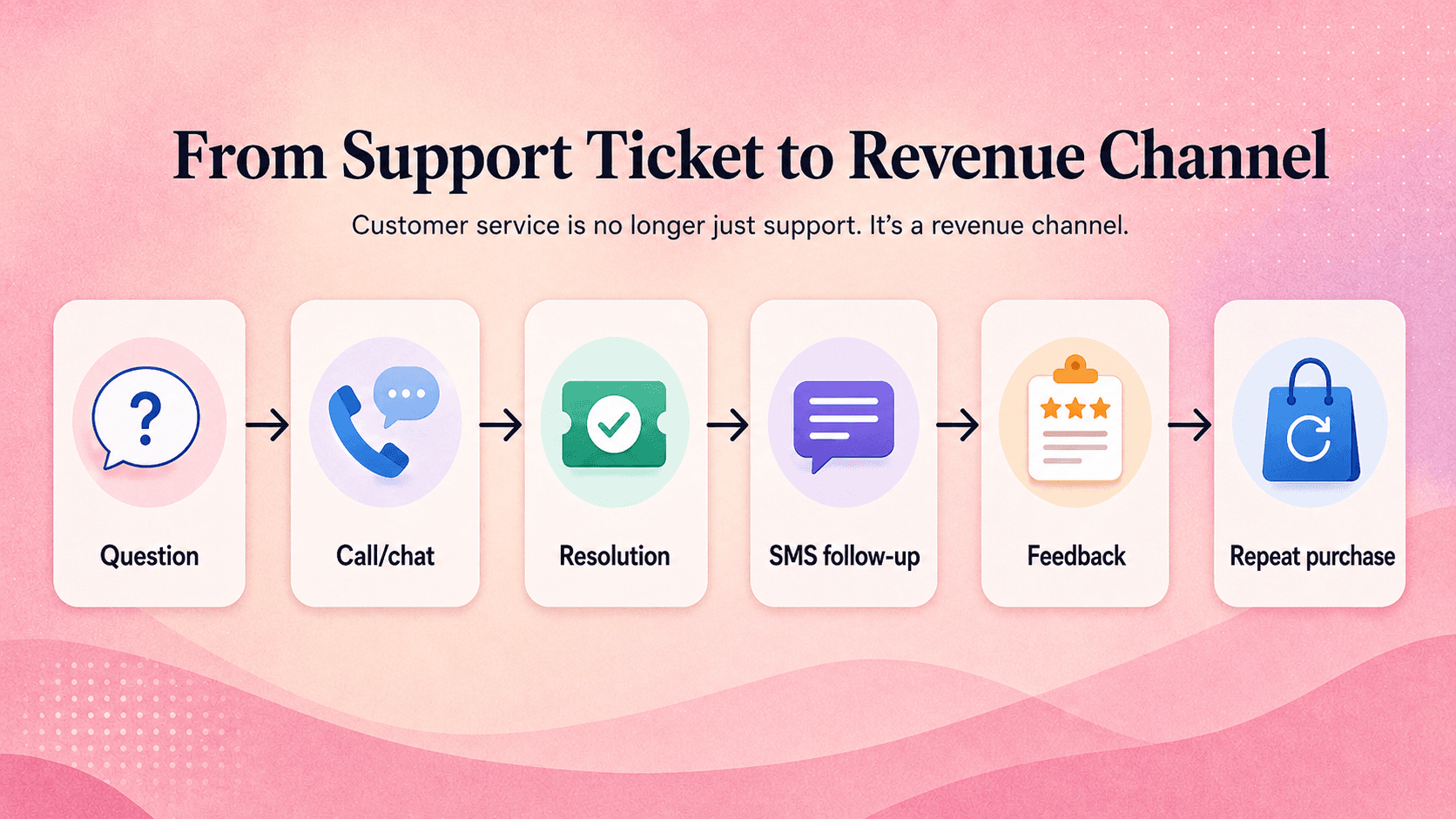
This is where the stack matters. Calls, tickets, chats, SMS, and surveys should all create a feedback loop.
Best customer service tools for Shopify brands
1. Consio — Best AI phone platform for Shopify brands
Consio is an AI phone platform built for Shopify merchants.
It helps ecommerce teams manage inbound calls, outbound campaigns, SMS, smart routing, and revenue attribution in one workspace. Consio’s AI Phone Platform is positioned as an all-in-one workspace for ecommerce teams to run inbound calls, outbound campaigns, and SMS with smart routing, a unified inbox, and order-level revenue attribution.
For Shopify brands, Consio is especially useful because phone calls are often tied to high-intent moments.
A customer calling before purchase may need help choosing the right product. A shopper calling after purchase may need a fast answer about shipping, returns, or order status. A VIP customer may need a human handoff instead of a generic ticket response.
Consio helps brands capture those moments by combining AI voice, Shopify context, SMS, and human escalation.
Best for
Shopify brands that receive inbound phone calls
Teams that want to automate repetitive phone questions
Brands that want to turn phone support into a revenue channel
Ecommerce teams running outbound campaigns
Support teams that want call attribution tied to orders
Key use cases
Answering order status calls
Handling delivery and return questions
Capturing missed calls
Routing high-value shoppers to a human
Sending SMS follow-ups after calls
Recovering carts or calling high-intent customers
Measuring phone-driven revenue
Why it belongs in the stack
Most Shopify customer service tools focus on email, chat, or tickets. Consio covers the phone channel, which is still one of the most important channels for urgent and high-value customer conversations.
2. Simplesat — Best customer satisfaction survey tool for Shopify feedback
Simplesat is a customer feedback platform for collecting CSAT, CES, and NPS.
For Shopify brands, it can be used to measure satisfaction after customer interactions, understand friction points, and create a feedback loop between support and the rest of the business.
Simplesat’s Shopify survey page highlights the ability to embed CSAT, CES, or NPS surveys directly into Shopify email templates, which makes it easier to collect feedback without sending extra emails.
Best for
Shopify brands that want to measure customer satisfaction
CX teams tracking CSAT, NPS, or CES
Support teams that want feedback after tickets, orders, or interactions
Brands that want simple, branded surveys
Teams that want to connect customer feedback to CX improvements
Key use cases
Post-purchase satisfaction surveys
Post-support CSAT surveys
NPS campaigns
Customer effort score after service interactions
Feedback after delivery, returns, or exchanges
Measuring support quality over time
Why it belongs in the stack
Support teams cannot improve what they do not measure.
Consio helps brands have better customer conversations. Simplesat helps brands measure whether those conversations actually improved the customer experience.
Together, they create a stronger CX loop: conversation → resolution → feedback → improvement.
3. Gorgias — Best ecommerce helpdesk for Shopify support teams
Gorgias is one of the most popular customer service platforms for ecommerce brands.
It combines helpdesk, AI, chat, FAQ, and automation in one platform. Gorgias positions itself as a conversational AI platform for ecommerce, with AI Agent, Helpdesk, Chat, FAQ, and integrations for ecommerce support teams.
For Shopify teams, Gorgias is often used as the central inbox for email, chat, social media, and support tickets.
Best for
Shopify brands that need a dedicated ecommerce helpdesk
Teams managing high ticket volume
Brands that want automation for repetitive questions
Support teams that want Shopify order context inside tickets
Key use cases
Email support
Ticket management
Live chat
Social media support
FAQ automation
Order-related support workflows
Why it belongs in the stack
Gorgias is usually the support command center. It works well alongside tools like Consio for phone and Simplesat for customer feedback.
4. Richpanel — Best self-service and AI support platform for ecommerce
Richpanel is an AI-powered customer service platform for ecommerce brands.
It helps teams manage emails, chats, and social channels from one dashboard, and its website positions the platform around faster, smarter ecommerce support.
Richpanel is especially useful for teams that want to reduce repetitive tickets through self-service and AI-assisted support.
Best for
Ecommerce teams that want AI-assisted support
Brands managing multiple channels
Teams that want self-service workflows
Support teams looking to reduce ticket volume
Key use cases
AI customer support
Self-service portals
Email and chat support
Social media support
Multi-brand support operations
Support team productivity
Why it belongs in the stack
Richpanel helps teams reduce support workload while keeping conversations organized across channels.
5. Zendesk — Best general-purpose customer service platform
Zendesk is a broad customer service platform used by companies across many industries.
For Shopify brands, Zendesk can work well when the team needs a mature ticketing system, workflows, reporting, and integrations across multiple business tools.
Best for
Larger support teams
Brands with complex ticketing workflows
Companies that need broad customer service infrastructure
Teams already using Zendesk across other departments
Key use cases
Ticket management
Help center
Support reporting
Multi-channel customer service
Workflow automation
Why it belongs in the stack
Zendesk is not Shopify-specific in the same way as some ecommerce-first tools, but it can be powerful for brands that need a flexible and mature customer service platform.
6. Shopify Inbox — Best free/basic chat tool for Shopify stores
Shopify Inbox is a good starting point for smaller stores that want basic chat without adding a complex support platform.
It gives merchants a simple way to respond to shoppers, answer questions, and manage basic conversations directly from the Shopify ecosystem.
Best for
Smaller Shopify stores
Teams just starting with live chat
Brands that do not need advanced automation yet
Merchants looking for a native Shopify option
Key use cases
Basic live chat
Simple customer questions
Product inquiries
Early-stage support operations
Why it belongs in the stack
Shopify Inbox is not the most advanced customer service tool, but it can be a useful first step before moving into a more complete support stack.
7. Tidio — Best live chat and chatbot tool for smaller ecommerce teams
Tidio combines live chat, helpdesk, chatbot automation, and AI support.
It can be a good fit for smaller ecommerce brands that want to add chat and automation without building a complex CX stack from day one.
Best for
Smaller ecommerce teams
Brands that want live chat and chatbot automation
Teams looking for a simple support setup
Stores that want fast implementation
Key use cases
Live chat
Chatbot flows
Basic helpdesk
Automated replies
Lead capture
Why it belongs in the stack
Tidio can help brands move from manual support to automated support without a heavy implementation.
How to choose the right Shopify customer service stack
The best customer service tool depends on the type of support your brand needs.
If you get a lot of tickets : Start with a helpdesk like Gorgias, Richpanel, or Zendesk.
If shoppers ask questions before buying : Use live chat, AI chat, and product-aware support.
If customers call your brand : Use Consio to answer calls, automate repetitive questions, route high-intent buyers, and track revenue from phone conversations.
If you want to improve satisfaction : Use Simplesat to collect CSAT, CES, and NPS feedback after support interactions.
If you want the strongest CX loop : Use tools that work together Helpdesk for tickets, Consio for phone, SMS, and AI voice, Simplesat for satisfaction and feedback, Analytics to understand what customers ask, where they get stuck, and what drives revenue
Summary
The best customer service tools for Shopify brands help teams respond faster, automate repetitive work, and create better customer experiences across every channel.
For most ecommerce teams, the best stack includes:
A helpdesk for tickets and team workflows
Live chat or AI chat for quick shopper questions
Consio for phone calls, AI voice, SMS, and revenue attribution
Simplesat for CSAT, CES, and NPS feedback
Reporting to understand what customers need and where the experience can improve
Customer service is no longer just about solving problems.
For Shopify brands, it is also a growth channel. Bain & Company found that increasing customer retention by just 5% can increase profits by 25 to 95% and great customer service is one of the most direct levers brands have to make that happen.
The right tools can help you reduce support volume, capture more high-intent shoppers, improve satisfaction, and turn customer conversations into revenue.
What is the best customer service tool for Shopify brands?
The best customer service tool depends on your support needs. Gorgias, Richpanel, and Zendesk are strong helpdesk options. Consio is a strong option for Shopify brands that need phone support, AI voice, SMS, and call attribution.
What is the best phone support tool for Shopify brands?
Consio is built for Shopify brands that want to manage inbound calls, outbound campaigns, SMS, smart routing, and revenue attribution in one workspace.
Do Shopify brands still need phone support?
Yes. Phone support is still valuable when customers have urgent questions, complex issues, or high-intent purchase concerns. For many brands, phone calls can influence conversions, retention, and customer satisfaction.

Growth Marketing