Top 10 CRM for ecommerce in 2026: choose wisely
Compare the 10 best CRM for ecommerce in 2026: features, integrations, verified pricing and time to value. Find the right fit to retain customers.

If your CRM is not performing in 2026, you are probably losing customers rather than just efficiency. Average ecommerce customer acquisition cost now sits between $68 and $84 across categories, which makes retention the cheaper half of the growth equation by a wide margin. It costs five to seven times more to acquire a customer than to keep one.
Abandoned carts, weak repeat purchase rates and missed customer inquiries usually point at the same thing: gaps in the customer record. The right CRM closes them by tracking interactions, automating follow-up and syncing with the rest of your ecommerce stack.
Some platforms handle email marketing well. Others are strong on automation. Very few capture the full picture for a brand running high traffic, multiple channels and a phone line that actually rings. Below are 10 CRM tools for ecommerce in 2026, what each is genuinely good at, and where each leaves a gap.
What is a CRM for ecommerce?
A CRM for ecommerce helps high-volume online businesses manage customer relationships at scale. Rather than tracking long B2B sales pipelines, it tracks shopper behaviour: browsing, purchases, cart activity, support contacts and, for some brands, calls.
Unlike a traditional CRM, it is built for stores handling thousands or millions of customers. It automates messages across channels and turns raw activity into segments a marketer can act on.
The effective ones do four things well:
Segment customers by behaviour rather than static lists
Reach them on the channel they respond to, which is not always email
Track actions as they happen, not on a nightly sync
Use the history to predict what the customer needs next
Benefits of customer relationship management for ecommerce
Without a CRM, teams work from stale information and lead management becomes guesswork.
A CRM centralises purchase history, browsing behaviour and support interactions into one view, so marketing can segment on real behaviour instead of assumptions and your team can prioritise high-intent customers. It also enables automated workflows for welcome sequences, restock alerts and win-backs, which keeps messaging consistent as you scale.
Most importantly, it lets you act fast. When someone abandons a cart or a payment fails, the recovery window is short, and a CRM is what makes the follow-up automatic rather than remembered.
Key features to look for
Not every CRM is built for ecommerce. Prioritise these:
Native ecommerce integration: Syncs order history, customer data and inventory from Shopify, WooCommerce or BigCommerce without middleware.
Segmentation and personalisation: Groups customers by behaviour, purchase frequency or value for targeted campaigns.
Multi-channel automation: Sends timely messages across email, SMS and push, including abandoned cart and post-purchase flows.
Customer journey tracking: Shows interactions across every channel so you can find where people drop off.
Revenue attribution: Connects individual interactions back to orders, the only way to know what the CRM is actually earning.
Support workflows: Gives your team instant access to order and interaction history, cutting resolution time.
10 CRM tools for ecommerce: our top picks
1. Consio

Ecommerce teams face a familiar trade-off. A marketing CRM knows every email a customer opened but nothing they said on the phone. A helpdesk CRM logs tickets but cannot run a campaign. Both leave the same gap, and for brands where customers call before they buy something expensive, it is the expensive gap.
Consio is the phone and conversation layer of the ecommerce CRM stack. It is not an email platform and does not pretend to be one. What it does is capture the part of the customer record every other tool on this list is blind to: the conversation.
Every call and message lands on a unified customer timeline alongside the customer's Shopify orders, with multiple profiles auto-merged so the same person is not three records. The AI voice agent answers 24/7 with full Shopify context, resolving order, shipping, return and product questions, and sends SMS and MMS during the call including tracking links and exact product variant links. On outbound, the ecommerce power dialer runs campaigns built from Shopify segments: abandoned checkout, VIP, win-back, high-AOV.
The piece that matters most for a CRM evaluation is revenue attribution. Consio reports first-touch and last-touch attribution over a window you set between 1 and 90 days, plus a funnel from contacted to reached to attributed sale. Most CRMs on this list report opens and clicks. Very few can tell you which conversations produced orders.
Key features
Unified customer timeline: Calls, SMS and MMS in one thread with Shopify order history, profiles auto-merged.
AI voice agent: Answers 24/7 with live order and product data, sends links mid-call, creates draft orders.
Ecommerce power dialer: Connects a rep only when the customer picks up, with voicemail drops and live script assistance.
Segment-driven campaigns: Built directly from Shopify segments, no list export required.
Revenue attribution: First-touch and last-touch models over a 1 to 90 day window, with CSV export.
Call intelligence: Recording, transcription with speaker labels, AI summaries and dispositions.
CRM integrations
Consio connects natively to Shopify for full order, product and customer data, and pushes conversations with AI summaries into Gorgias, Zendesk, Richpanel, Kustomer and eDesk. It syncs segments with Klaviyo, so the phone channel runs off the same audiences as your email programme rather than a parallel list.
Want to see what your phone channel is actually worth? Book a demo.
2. Klaviyo

Klaviyo is the default customer engagement platform for ecommerce, focused on email and SMS. It uses purchase history and site activity to drive behaviour-based campaigns, and includes pre-built flows for cart reminders and post-purchase sequences. It also ships a CDP, though its centre of gravity remains campaign automation.
Key features
Email and SMS automation triggered by sign-ups, purchases or cart abandonment.
Behavioural segmentation built on purchase and engagement history.
Pre-built ecommerce flows covering welcome, browse abandonment and win-back.
Pricing (as of September 2026): Free up to 250 active profiles. Email plans scale by active profile count, roughly $20 per month at 500 profiles, $100 at 5,000 and $720 at 50,000. Email and SMS bundles start around $35 per month.
CRM integrations: Shopify, Magento, WooCommerce, plus review and survey tools.
3. HubSpot

HubSpot combines CRM, marketing automation and content tools in one platform. Mid-sized businesses use it to manage relationships and run campaigns across email, social and landing pages. It is a genuinely strong CRM, though it was not built for high-volume transactional ecommerce.
Key features
Lead scoring that ranks contacts by engagement signals.
Workflow automation across multi-step sequences.
Unified marketing, sales and service records on one contact object.
Pricing (as of September 2026): Free CRM available. Sales Hub runs $20 per seat for Starter, $90 Professional and $150 Enterprise per month, with promotional annual rates below list. Marketing Hub Starter begins around $9 to $15 per seat per month, with Professional and Enterprise moving to a flat platform fee.
CRM integrations: Shopify, WooCommerce, Microsoft Dynamics 365, Airtable.
4. Gorgias

Gorgias is a helpdesk built for ecommerce that functions as an operational CRM for support teams. Its native Shopify integration pulls order history, shipment status and product data into every ticket, and agents can issue refunds or edit orders without leaving the tool.
Key features
Order data inside every ticket, with refunds and order edits in place.
AI Agent handling pre-purchase recommendations and post-purchase WISMO.
Revenue per support interaction reporting, rare in the helpdesk category.
Pricing (as of September 2026): Ticket-based from $10 per month for 50 tickets up to $900 per month for 5,000, with AI Agent conversations billed separately and overage around $0.36 to $0.40 per ticket.
CRM integrations: Shopify, BigCommerce, Magento, Klaviyo, Attentive.
5. Salesforce Commerce Cloud
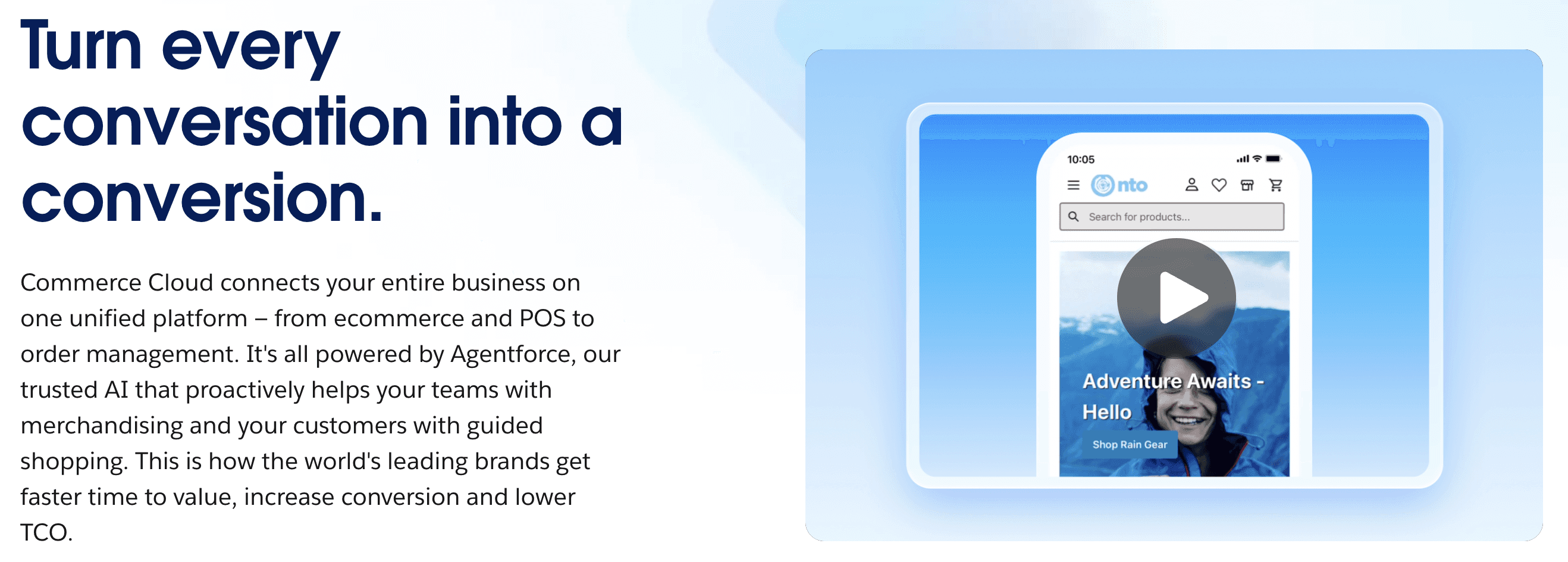
Salesforce Commerce Cloud is an enterprise platform for managing B2C, B2B and D2C selling, with storefronts, catalogs, orders and customer interactions in one system. It is most compelling for brands already invested in the Salesforce ecosystem.
Key features
Headless commerce architecture separating front end from back end.
Agentforce AI agents reasoning across native CRM data.
Unified record across service, sales and commerce.
Pricing (as of September 2026): Service Cloud editions run from $25 for Starter Suite to $175 Enterprise, $350 Unlimited and $550 for Agentforce 1 Service per user per month. Agentforce is metered on top at roughly $2 per AI conversation. Commerce Cloud itself is quoted separately, commonly on a revenue share.
CRM integrations: Native across Salesforce products, plus SAP, Oracle and Microsoft Dynamics through APIs.
6. ActiveCampaign

ActiveCampaign combines email, SMS, a built-in CRM and journey tracking. It is a strong fit for SMBs that want marketing and sales automation without an enterprise implementation.
Key features
Behaviour-triggered automation from site visits and purchases.
Predictive sending and content assistance through built-in AI.
Sales pipeline and reporting alongside marketing campaigns.
Pricing (as of September 2026): Starter $15, Plus $49, Professional $79 and Enterprise $145 per month for 1,000 contacts, billed annually. Prices scale with contact count, and CRM pipelines, SMS and custom reporting are add-ons. No free plan, 14-day trial.
CRM integrations: Shopify, WordPress, Zapier, Meta Ads.
7. Omnisend

Omnisend is an email, SMS and push platform used by ecommerce brands to automate cart recovery and post-purchase messaging. It is deliberately narrower than the broader CRMs here and easier to run as a result.
Key features
Drag-and-drop email builder with product blocks and A/B testing.
SMS campaigns with two-way messaging and subscriber tools.
AI content suggestions for subject lines and copy.
Pricing (as of September 2026): Free plan reaching 250 contacts with 500 emails monthly. Standard from around $16 per month for 500 contacts, Pro from $59. For subscriptions started on or after 4 May 2026, SMS is Pro-only and priced as an add-on from around $0.007 per message.
CRM integrations: Shopify, WooCommerce, BigCommerce, plus external CRMs through Zapier.
8. Zoho CRM

Zoho CRM is a broad customer management platform covering leads, workflows and communication across sales and support. It connects to Zoho Commerce for order activity, but its reach extends well beyond ecommerce.
Key features
Sales process automation with custom pipelines and assignment rules.
Zia AI assistant for predictive insights and lead scoring.
Product and inventory tracking including variants and stock levels.
Pricing (as of September 2026): Free edition for up to 3 users. Standard $14, Professional $23, Enterprise $40 and Ultimate $52 per user per month billed annually. Monthly billing costs 25% to 52% more per seat.
CRM integrations: Shopify, WooCommerce, Zapier, Microsoft Dynamics, Google Workspace.
9. Zendesk

Zendesk organises the customer relationship around tickets, with messaging, chat, voice, email and social layered on. For ecommerce teams it works as a service CRM, keeping a complete contact history that other tools can read.
Key features
Omnichannel ticket routing by skill, priority and capacity.
AI agents resolving common contacts across chat, email and messaging.
Zendesk QA scoring conversations automatically.
Pricing (as of September 2026): Suite plans at $55 Team, $89 Growth and $115 Professional per agent per month billed annually. Voice adds per-minute usage, roughly $0.037 inbound, with numbers from $2 per month.
CRM integrations: Shopify, Salesforce, HubSpot, Slack through native and marketplace apps.
10. Freshdesk

Freshdesk and the wider Freshworks suite cover support, sales and customer interactions in one system. Ecommerce teams use it to track contacts and automate follow-up across email, chat and WhatsApp at a lower entry price than the enterprise incumbents.
Key features
Freddy AI lead scoring ranking contacts by conversion likelihood.
Automated sequences for cart recovery and post-purchase follow-up.
Behavioural analytics triggering messages from site activity.
Pricing (as of September 2026): Freshsales runs $9 Growth, $39 Pro and $59 Enterprise per user per month billed annually, with a free tier for up to 3 users. Freshdesk support plans are priced separately.
CRM integrations: Shopify and ecommerce platforms through marketplace apps, Zapier and APIs, plus Mailchimp, QuickBooks and Slack.
Top CRM software for ecommerce: comparison table
Platform | Best for | Key strength | Time to value |
|---|---|---|---|
Shopify brands whose customers call before buying | Phone and conversation record with revenue attribution | Days | |
Klaviyo | Mid-size DTC brands running email and SMS | Behavioural campaign automation | 2 to 4 weeks |
Mid-sized businesses with broad CRM needs | Unified sales, marketing and service record | 4 to 6 weeks | |
Gorgias | Shopify DTC brands with steady ticket volume | Order data inside every ticket | 1 to 2 weeks |
Salesforce Commerce Cloud | Large enterprises running omnichannel commerce | Headless architecture and native CRM depth | 8 to 12 weeks |
SMBs needing marketing plus sales automation | Journey-based automation with built-in CRM | 3 to 5 weeks | |
Ecommerce SMBs with multichannel needs | Fast, focused email and SMS automation | 2 to 3 weeks | |
Small to mid-sized businesses on a budget | Broad functionality at low per-seat cost | 3 to 5 weeks | |
Zendesk | Teams standardised on ticketing | Complete service history across channels | 3 to 5 weeks |
Freshdesk | SMBs needing CRM with multichannel outreach | Low entry price with AI lead scoring | 2 to 4 weeks |
What is the best CRM platform for your ecommerce business?
The right choice depends on which customer signal you are currently missing, not on which platform has the longest feature list.
If your gap is campaign automation, Klaviyo or Omnisend will close it fastest. If it is ticket context, Gorgias or Zendesk. If you need one system spanning sales, marketing and service, HubSpot or Salesforce, with the cost and implementation time that implies.
If your gap is the phone, none of the above closes it. A customer who calls before spending several hundred pounds leaves no trace in an email CRM, and the conversation that decided the sale is not in your reporting. That is the record Consio captures, and it plugs into whichever CRM you already run rather than replacing it.
Curious what your phone channel is actually contributing? Book a demo and bring one real call recording.
FAQs
What is CRM in ecommerce?
CRM in ecommerce is software that manages customer relationships by tracking behaviour, orders and interactions in one record. It helps personalise communication and improve retention, and differs from a traditional CRM in being built for high transaction volume rather than long sales cycles.
What is the best CRM for ecommerce?
There is no single best CRM for ecommerce. Klaviyo leads for email and SMS automation, Gorgias for Shopify support context, HubSpot for a unified sales and marketing record, and Consio for brands where the phone drives revenue and nothing else captures those conversations. Choose based on the gap in your current stack.
Do I need a CRM for ecommerce?
If you are managing a growing customer base, sending regular campaigns or trying to improve retention, yes. With acquisition costs where they are, the cheapest revenue available to most brands is a second order from an existing customer.
What are the 4 types of CRM?
The four types are operational for automation, analytical for insights, collaborative for team alignment and strategic for long-term planning. Most ecommerce stacks combine two or three across several tools rather than finding all four in one product.
How long does it take to implement an ecommerce CRM?
A Shopify app install with a native integration goes live in days. Campaign platforms take two to four weeks once flows and templates are built. Enterprise suites commonly run eight to twelve weeks. Ask each vendor for a timeline tied to your systems, not an average.

Growth Marketing


