BFCM Customer Support: AI Playbook for Shopify brands
Learn how Shopify brands can use AI to automate WISMO, returns, order changes, phone support, and escalations during Black Friday Cyber Monday 2026.

Black Friday Cyber Monday creates a predictable problem for ecommerce brands: orders increase quickly, and customer support volume increases with them.
The answer is not necessarily to hire enough seasonal agents to match every additional ticket or phone call.
Shopify brands can use AI during BFCM to automate repetitive, policy-based customer requests such as order tracking, “Where is my order?” questions, returns, cancellations, order changes, FAQs, and after-hours phone calls, while routing complex or high-value conversations to human agents.
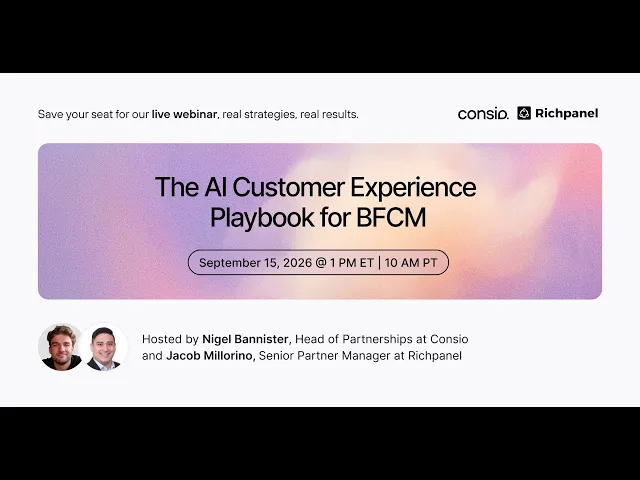
That was the central idea behind a recent webinar with Nigel Bannister from Consio and Jacob Millorino from Richpanel, focused on preparing ecommerce customer experience teams for peak season.
The opportunity is significant. Shopify merchants generated $14.6 billion in BFCM sales in 2025, up 27% year over year, while more than 81 million customers purchased from Shopify-powered brands. More than 94,900 merchants recorded their highest-selling day ever during the weekend.
More orders mean more post-purchase questions.
For CX teams, the challenge is therefore simple:
How do you handle BFCM customer support volume without scaling support headcount at the same rate?
The playbook below explains how.
Quick answer: How should Shopify brands use AI for BFCM customer support?
The most effective BFCM customer support strategy is to automate high-volume, low-complexity conversations while keeping human agents available for conversations where judgment, empathy, or commercial context matters.
A practical model looks like this:
Customer request | Recommended approach |
|---|---|
Where is my order? | AI-first |
Order tracking link | AI-first |
Standard return request | AI-first when policy allows |
Cancellation request | AI-first when order status allows |
Shipping address/order change | AI-first with business rules |
Product FAQs | AI-first |
After-hours phone call | Voice AI first |
High-value customer issue | Human escalation |
Payment dispute | Human escalation |
Strong negative sentiment | Human escalation |
Repeated unresolved contact | Human escalation |
Complex exception to policy | Human escalation |
The objective is not to automate every customer interaction.
It is to remove repetitive work from the human support queue so agents can spend more time on the conversations where they create the most value.
1. Audit your support volume before automating anything
The first step in BFCM preparation is not adding more AI.
It is understanding why customers contact you today.
Review support conversations from recent weeks and categorize them by contact reason.
For most Shopify brands, common categories include:
Where is my order?
Tracking questions
Delivery delays
Returns and exchanges
Cancellations
Address changes
Product questions
Promotion or discount questions
Order modifications
Damaged or missing products
Payment issues
Subscription questions
Pre-purchase questions
Then measure how much of total support volume comes from each category.
The goal is to identify requests that are:
frequent,
predictable,
dependent on information already available in Shopify or another connected system, and
governed by a clear business rule.
Those are usually the strongest automation candidates.
A customer asking “Where is my order?” does not necessarily need a support agent to manually open Shopify, find the order, check the tracking status, copy the tracking URL, and send a response.
If the information already exists, AI can retrieve it and respond directly.
The same principle applies across chat, email, self-service, and phone.
2. Separate transactional support from high-value conversations
One of the biggest mistakes ecommerce support teams can make during BFCM is treating every conversation equally.
They are not equal.
Consider these two conversations:
Conversation A
“Where is order #12345?”
Conversation B
“I ordered $900 worth of products for an event this weekend, the package has not arrived, and this is the second time I have contacted you.”
Both involve shipping.
But they should not necessarily follow the same workflow.
The first can often be automated entirely.
The second contains multiple escalation signals:
high order value,
urgency,
repeat contact,
potential negative sentiment,
potential retention risk.
That conversation may deserve immediate human attention.
A strong BFCM automation strategy therefore uses automation and escalation together.
AI handles the repetitive layer.
Humans handle exceptions.
This prevents support teams from wasting capacity on straightforward requests while important conversations remain buried in a queue.
3. Automate “Where is my order?” requests first
For many ecommerce brands, WISMO, or “Where is my order?”, is one of the clearest opportunities for customer support automation.
The workflow is highly structured.
A customer wants to know:
whether their order has shipped,
where the package is,
the expected delivery status,
or where to find the tracking information.
An AI support system connected to ecommerce and fulfillment data can identify the customer, retrieve the relevant order, check its status, and provide the appropriate information.
Richpanel integrates Shopify customer and order data directly into its support environment and supports customer self-service for common order-related requests through its Shopify integration.
On the phone side, Consio connects directly to Shopify so its AI voice agents can access live customer, order, product, and tracking information during a conversation. You can learn more about the Consio Shopify integration.
That changes the experience from:
Customer calls → voicemail → agent reviews voicemail → agent searches order → agent calls or emails customer back
to:
Customer calls → AI identifies request → AI retrieves order → customer gets an answer immediately
During BFCM, removing those extra steps can matter enormously.
4. Automate returns, cancellations, and order changes with guardrails
The next layer is action-based automation.
Instead of only answering questions, AI can help customers perform common ecommerce actions.
Examples include:
starting a return,
checking return eligibility,
canceling an eligible order,
updating shipping information,
modifying certain order details,
requesting a refund,
accessing tracking information.
Richpanel's Shopify integration allows teams to access Shopify customer and order information and perform order-related actions from the support environment, including managing addresses, discounts, refunds, and draft orders.
The important principle is that automation should follow the same rules your human agents follow.
For example:
Return automation might check:
Is the order within the return window?
Is the product eligible for return?
Has the item already been returned?
Does the order meet any exclusion criteria?
Cancellation automation might check:
Has the order already been fulfilled?
Has it entered the warehouse workflow?
Can it still safely be canceled?
This is why BFCM preparation should include documenting operational policies before increasing automation.
AI is most useful when the underlying rule is clear.
5. Prepare your knowledge base before BFCM starts
An AI support system is only as useful as the information and workflows available to it.
Do not wait until Black Friday to discover that your shipping policy, holiday return window, promotional rules, or product information is outdated.
Before peak season, review your knowledge base for topics such as:
BFCM promotion dates
Discount rules
Discount stacking
Holiday shipping deadlines
Shipping estimates
International shipping
Returns
Exchanges
Cancellations
Order modifications
Gift cards
Out-of-stock products
Pre-orders
Warranty rules
Subscription policies
Product sizing
Product compatibility
Frequently asked product questions
Think of your AI system like a new support agent.
Before putting that agent in front of thousands of BFCM customers, you would make sure they understand your policies.
The same should apply to AI.
For phone support, Consio's AI Voice Agent can be trained using store information, policies, FAQs, shipping and return rules, promotions, product data, and other knowledge sources so it can respond with ecommerce-specific context.
6. Add Voice AI to your BFCM support strategy
Ecommerce automation often focuses on chat and email.
But customers still call.
And phone support has a particularly difficult scaling problem during peak periods: one human agent can usually handle only one live phone conversation at a time.
When call volume spikes outside business hours, calls can turn into:
missed calls,
long hold times,
voicemail backlogs,
delayed callbacks,
or abandoned conversations.
Voice AI changes that model.
An AI phone agent can answer incoming calls and handle common ecommerce requests automatically.
Consio's AI phone platform for Shopify is built for ecommerce teams running human and AI phone support. Its AI agents can access Shopify context during a call, including customers, orders, tracking, products, and store policies.
For support teams, Consio's inbound AI support workflows can handle use cases including WISMO, shipping and delivery updates, returns and exchanges, product questions, FAQs, after-hours coverage, and human escalation.
Consio also supports SMS actions, recordings, transcripts, AI-generated call summaries, routing, and escalation to human agents.
A BFCM phone conversation could therefore look like this:
Customer:
“Hi, I'm trying to find out where my order is.”
AI:
Identifies the customer and retrieves their latest Shopify order.
AI:
Explains the current order or shipment status.
Customer:
“Can you send me the tracking information?”
AI:
Sends the tracking link by SMS.
No voicemail.
No ticket waiting until morning.
No agent manually looking up the order.
7. Use AI to cover nights, weekends, and overflow
BFCM does not follow your normal support schedule.
Customers shop:
late at night,
early in the morning,
during weekends,
across time zones.
And the moment sales volume increases is often exactly when customers need more help.
Instead of attempting to staff every potential peak manually, brands can use AI as the first layer of after-hours and overflow coverage.
For example:
During business hours
AI can resolve routine questions immediately and escalate appropriate conversations to available agents.
During peak volume
AI can absorb repetitive requests instead of allowing the queue to grow indefinitely.
After hours
AI can continue handling supported workflows such as FAQs and order tracking.
Consio's AI Voice Agents for ecommerce can answer inbound calls 24/7 and can also be configured as a fallback when the human support team is unavailable.
For conversations that need a person
The system can collect context and route or escalate the conversation rather than forcing the customer to start from zero later.
The result is not necessarily “AI instead of humans.”
It is AI extending the operating capacity of the existing team.
8. Build escalation rules before the rush starts
Automation without escalation is not a complete customer support strategy.
Your BFCM workflow should explicitly define when AI stops and a human agent takes over.
Useful escalation signals discussed in the Consio and Richpanel BFCM playbook include:
High-value customers
A customer with unusually high lifetime value or a large current order may justify priority treatment.
Negative sentiment
If a conversation becomes clearly frustrated or angry, escalation can prevent automation from making the experience worse.
Disputes
Payment disputes, fraud concerns, damaged products, and other sensitive situations often require human judgment.
Repeat contacts
A customer contacting support repeatedly about the same issue is a strong signal that the standard workflow has not solved the problem.
Complex policy exceptions
If solving the request requires overriding normal business rules, a human agent should generally review it.
The best automation systems therefore do two things well:
resolve what they can and recognize what they should not resolve.
9. Give human agents full customer context when AI escalates
A bad AI-to-human handoff sounds like this:
“Hi, can you explain the issue again?”
The customer has already explained it.
A better workflow passes the context with the conversation.
Depending on the channel and system, that can include:
customer identity,
Shopify profile,
order history,
current order,
conversation transcript,
AI summary,
actions already taken,
previous contacts,
relevant support reason.
Consio records and transcribes calls and can automatically generate summaries for support teams.
Even more importantly for teams already using Richpanel, Consio integrates directly with Richpanel.
Completed and missed calls can appear as conversations in Richpanel, with call outcomes and customer context. AI-generated summaries, dispositions, and agent notes can also be available to support teams inside Richpanel, while SMS conversations can be managed across the integration.
Richpanel also has an official Consio integration page for teams that want to connect phone conversations with the rest of their ecommerce support operation.
That means escalation should not simply transfer the interaction.
It should transfer the context needed to continue the interaction.
This is especially important during BFCM, when every unnecessary minute increases queue pressure.
10. Treat customer support as a retention and revenue channel
BFCM support should not be viewed only as a cost center.
Customers contacting support are often at critical moments in their journey.
Some are considering a purchase.
Some need product advice.
Some are trying to complete an order.
Some are worried about an existing purchase.
Some are deciding whether they will ever buy from the brand again.
A support interaction can therefore influence:
conversion,
repeat purchases,
retention,
customer satisfaction,
refunds,
cancellations,
and lifetime value.
AI creates an opportunity to automate repetitive operational work while allowing human agents to spend more time on these higher-value conversations.
Voice creates another opportunity.
A customer calling with a product question may not simply need “support.” They may need help deciding which product to purchase.
Consio's Shopify-connected AI agents can use live commerce context to answer product questions, search the catalog, access customer and order information, and send relevant links by SMS during customer conversations.
The goal for BFCM should therefore be broader than:
“How many tickets did we deflect?”
A stronger question is:
“How effectively did our CX operation resolve customer needs while protecting retention and revenue?”
Richpanel + Consio: How the two layers work together
The webinar demonstrated how Richpanel and Consio can cover different parts of the ecommerce customer journey while using Shopify context.
A simplified model looks like this:
Layer | Example workflows |
|---|---|
Richpanel | Ecommerce customer experience, self-service, support workflows, Shopify customer and order context, common order actions |
Consio | AI phone support, inbound calls, Shopify-aware voice conversations, tracking information, SMS, transcripts, summaries, human escalation |
Human team | Exceptions, sensitive situations, high-value interactions, complex problem solving |
Richpanel's Shopify integration gives support teams access to Shopify customer and order information, customer self-service capabilities, and order management workflows from the support environment.
Consio's Shopify integration connects phone and SMS conversations with live customer, order, product, cart, and purchase history context.
The platforms can also be connected directly through the Consio and Richpanel integration, bringing calls, SMS, AI summaries, call outcomes, and agent notes into the same support workflow.
For BFCM, this creates a useful operating model:
AI handles the repetitive layer → customer data provides context → humans handle exceptions and high-value conversations.
BFCM customer support checklist for Shopify brands
Before BFCM
Review your last 30 to 90 days of support conversations
Identify your highest-volume contact reasons
Calculate how much volume comes from repetitive requests
Prioritize WISMO and tracking automation
Review return and cancellation policies
Review holiday shipping policies
Update product FAQs
Update promotional FAQs
Test Shopify order lookup workflows
Test returns and cancellation workflows
Test AI responses with real customer scenarios
Define human escalation conditions
Define VIP and high-value customer rules
Configure after-hours phone handling
Test SMS tracking links and follow-ups
Make sure agents receive conversation context after escalation
During BFCM
Monitor:
total conversation volume,
AI-handled conversations,
human escalations,
unresolved conversations,
repeated contacts,
WISMO volume,
phone call volume,
after-hours requests,
returns and cancellation volume,
customer sentiment,
high-value escalations.
Do not assume that an automation working correctly on Thursday will automatically cover every scenario that appears over the weekend.
Monitor conversations and adjust workflows as new patterns emerge.
After BFCM
Review:
What generated the most support volume?
Which requests were successfully automated?
Which requests escalated unnecessarily?
Where did AI lack information?
Which knowledge base articles were missing?
Which policies created customer confusion?
Which issues generated repeat contacts?
Which conversations influenced revenue or retention?
Then keep the workflows that worked.
Peak-season automation should improve your support operation after peak season too.
What should you automate first for BFCM?
If your team has limited time before Black Friday, do not try to automate everything.
Start in this order:
1. WISMO and tracking
High volume, structured data, clear customer intent.
2. FAQs
Shipping, promotions, products, return policy, holiday deadlines.
3. Returns and cancellations
Automate straightforward cases where rules can be clearly defined.
4. After-hours phone support
Prevent simple questions from becoming missed calls and voicemail backlogs.
5. Order changes
Automate only when order state and business rules make the action safe.
6. Intelligent escalation
Make sure sensitive and valuable conversations reach humans quickly.
This approach gives the support team leverage without requiring the entire customer experience operation to be rebuilt immediately before BFCM.
FAQs
How can AI help ecommerce customer support during Black Friday?
AI can handle repetitive customer requests such as order tracking, common FAQs, returns, cancellations, and certain order modifications. AI can also answer ecommerce phone calls, provide Shopify order information, send tracking links through SMS, and escalate more complex requests to human agents.
What customer support requests should Shopify brands automate first?
For many Shopify brands, the best starting points are repetitive and predictable requests such as “Where is my order?”, order tracking, shipping FAQs, return eligibility, cancellations, and common product or promotion questions.
Can AI handle Shopify order tracking?
Yes. When the AI support platform is connected to Shopify and the relevant order or fulfillment information, it can retrieve order context and provide customers with order or tracking information.
For phone support, Consio's Shopify integration gives AI voice agents access to live order and tracking information during customer conversations.
Can AI answer ecommerce customer service phone calls?
Yes. Voice AI platforms can answer inbound customer calls and automate supported workflows.
For Shopify brands, Consio's AI Voice Agent can identify customers, access Shopify context, answer common questions, provide order and tracking information, send SMS messages, and escalate conversations when human support is required.
How can AI reduce missed calls during Black Friday?
Voice AI can provide an initial layer of phone coverage when human agents are busy or unavailable.
Consio's inbound support platform can provide 24/7 phone coverage for common ecommerce requests, while conversations requiring human intervention can be escalated with customer and conversation context.
How can Shopify brands reduce BFCM support volume without hiring more agents?
Start by identifying repetitive contact reasons and automating those workflows.
WISMO, tracking, standard returns, cancellations, FAQs, and after-hours requests are common candidates.
Then create clear escalation rules so existing agents spend their time primarily on conversations requiring human judgment.
Can Consio and Richpanel work together for ecommerce customer support?
Yes. Consio and Richpanel integrate directly, allowing phone calls and SMS conversations to connect with the support workflows managed in Richpanel.
Teams can bring call outcomes, AI summaries, agent notes, missed calls, and customer context into their support environment, helping human agents follow up without starting the conversation from zero.
The goal is not more automation. It is better allocation of support capacity.
BFCM exposes weaknesses in customer support operations because the normal workload increases in a very short period of time.
Simply adding agents can increase capacity.
But it does not necessarily fix the underlying problem.
If human agents are still manually answering thousands of predictable order-status questions, the support operation remains dependent on headcount.
A more scalable approach is to separate work into two categories:
Requests software can resolve safely and consistently.
And:
Conversations where a human can make a meaningful difference.
That is the model Consio and Richpanel presented for BFCM: automate high-volume ecommerce workflows, make Shopify context accessible across customer interactions, extend support into channels such as phone, and escalate the right conversations to humans.
The result is a customer support operation designed to absorb peak-season demand without requiring support headcount to grow at the same rate as order volume.
For Shopify brands preparing for Black Friday Cyber Monday, the best time to identify those workflows is before the first support spike arrives.
About the webinar
This guide is based on a BFCM customer experience webinar featuring Nigel Bannister from Consio and Jacob Millorino from Richpanel.
The session covers how Shopify brands can prepare customer support operations for Black Friday Cyber Monday using AI, self-service, ecommerce automation, and Voice AI.
The webinar includes practical examples and product demonstrations across Richpanel's ecommerce customer experience platform and Consio's AI phone platform for Shopify brands, including order management, product questions, order tracking, phone support, SMS, call transcripts, AI summaries, and human escalation.
Teams using both platforms can also explore the Consio + Richpanel integration to connect phone and SMS interactions with the rest of their customer support operation.

Head of Partnerships