Dialpad alternatives for Shopify brands (2026)
Compare the best Dialpad alternatives for Shopify brands in 2026. See pricing, AI features, and Shopify-native call automation built for ecommerce.

Dialpad is a capable cloud phone and contact center platform built for general business teams, not ecommerce. If you run a Shopify store, the gap shows up fast: your agents toggle between the dialer and the Shopify admin to look up an order, there is no native screen-pop with customer context, and the AI features that matter for selling are locked behind higher tiers or add-ons.
This guide breaks down the best Dialpad alternatives for Shopify brands in 2026, what to look for in an ecommerce phone system, and where each option fits.
Why Shopify brands look for a Dialpad alternative
Dialpad does a lot well for distributed teams. The friction for ecommerce is structural, not cosmetic. Here are the reasons we hear most often from Shopify operators evaluating a switch.
No native Shopify context on calls
Dialpad has no native Shopify helpdesk-style app. To get customer and order context on an inbound call, you stitch together Zapier or third-party automations, and even then a true Shopify screen-pop is fragile. For a store doing hundreds of "where is my order" calls a week, that means agents alt-tab into the Shopify admin on every call. It is slow, error prone, and impossible to scale during a launch or a holiday spike.
Pricing climbs once you add what ecommerce needs
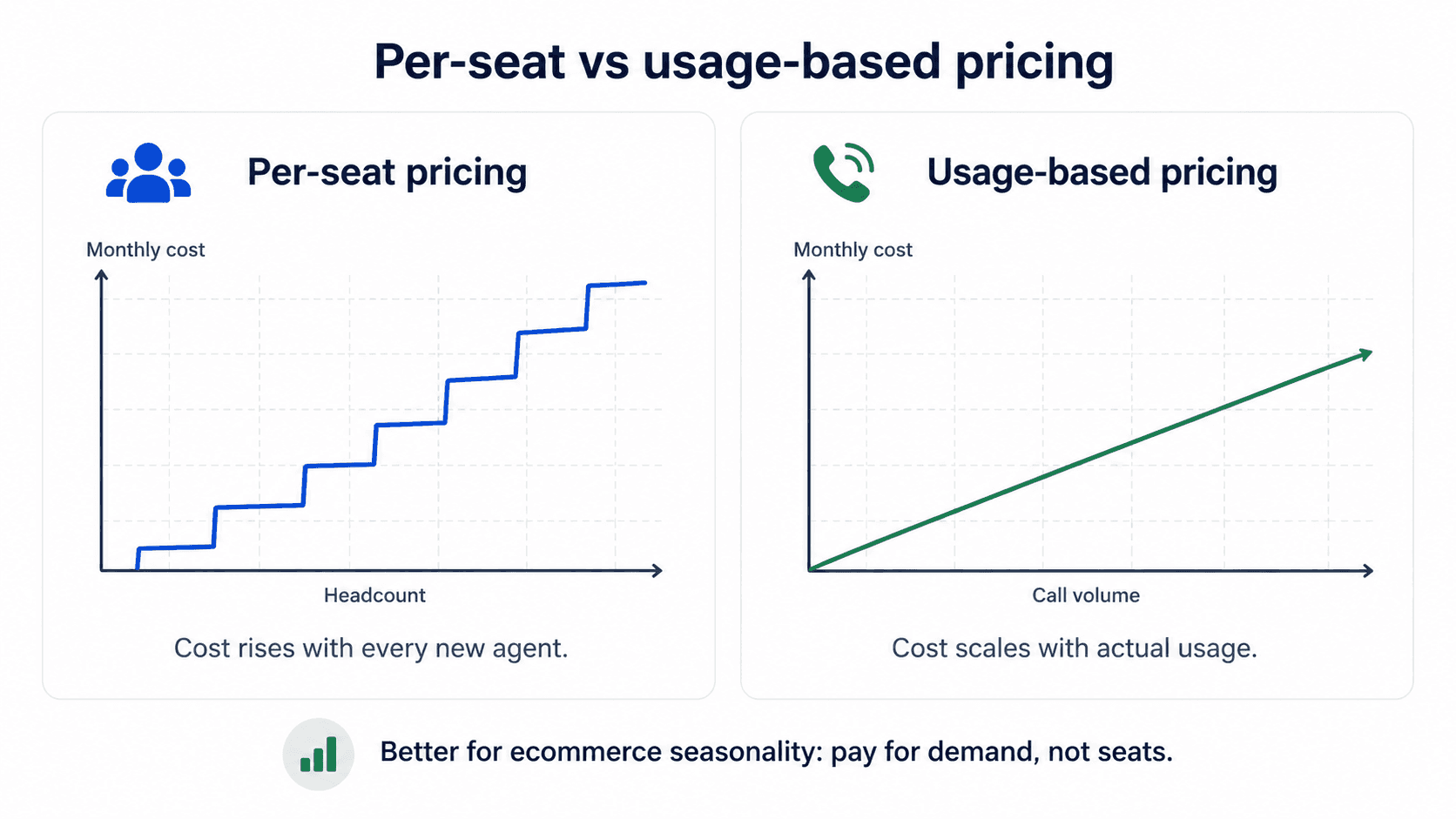
Dialpad Connect, the business phone product, starts at $15 per user per month billed annually, or $27 month to month. The Pro plan is $25 per user per month annually and requires a minimum of three users. The features ecommerce teams actually need, like advanced analytics or outbound dialing, live in the contact center and sales products. Dialpad Support starts at $80 per user per month and Dialpad Sell starts at $39 per user per month, climbing to $150 per user per month at the top. Per-seat pricing punishes you for growth: every new agent is another monthly bill, whether or not your call volume justifies it.
AI that summarizes, but does not sell
Dialpad's AI is strong at transcription and call notes. It does not place orders, recover abandoned checkouts, or tie a call back to revenue in Shopify. For an ecommerce brand, a phone call is a sales channel, not just a support ticket and a high-intent one: phone calls convert 10–15x better than web form leads (BIA/Kelsey). Most general phone systems treat that channel as a cost center instead of a revenue one.
Call quality and setup complaints
Across review sites, the recurring Dialpad complaints are inconsistent call quality on weaker connections, dropped calls and audio lag, and a learning curve during setup. None of these are dealbreakers on their own, but they push teams to look at alternatives that are simpler and purpose-built.
The best Dialpad alternatives for Shopify brands in 2026
1. Consio, the AI phone platform built for Shopify
Consio is the closest thing to a phone system designed from scratch for ecommerce. Instead of seats and a generic dialer, you get a 24/7 AI Voice Agent that handles inbound calls, understands Shopify order and product context, answers customer questions, sends SMS links, and can create draft orders during the call. That means a call is not just logged as a ticket, it can become a measurable sales opportunity.
Outbound, teams can run abandoned checkout, VIP outreach, and win-back campaigns. Calls are summarized automatically, follow-ups can be sent by SMS, and revenue is attributed back to Shopify orders.
Pricing is usage-based rather than per seat: $30 for 100 minutes, $60 for 400 minutes, and roughly $0.10 per minute after that. All features are included and it is free to start.
Best for: Shopify and ecommerce brands that want order context on every call, after-hours coverage, and a phone channel tied directly to revenue.
2. Aircall
Aircall is a popular cloud phone system with a clean interface and a large app marketplace, including a Shopify integration. It is a solid pick for support teams that want a straightforward dialer with CRM and helpdesk connectors. The trade-offs are per-seat pricing that adds up, a two-seat minimum, and AI capabilities that are add-ons rather than the core of the product. It routes and logs calls well, but it does not sell on the call the way an AI voice agent does.
Best for: support-led teams that want a reliable dialer with broad integrations and are comfortable with per-seat costs.
3. RingCentral
RingCentral is the enterprise heavyweight: phone, contact center, messaging, and video in one suite, with deep reliability and global coverage. If you are a larger brand that needs a full unified communications stack and has IT resources to configure it, RingCentral is hard to beat on breadth. For a lean Shopify team, it is often more platform than you need, with per-seat pricing and a setup that rewards dedicated administration.
Best for: larger or multi-channel brands that need an all-in-one enterprise communications suite.
4. CloudTalk
CloudTalk is one of Dialpad's most direct competitors for AI-powered call centers, with local virtual numbers in 160+ countries and strong outbound calling features. It is a good fit for international ecommerce brands that make a lot of outbound calls and want local presence in many markets. Like the others here, it is built as a general contact center, so Shopify context and revenue attribution are not native.
Best for: international brands with high outbound volume that need local numbers across many countries.
5. Nextiva
Nextiva is a dependable business VoIP and contact center platform known for strong customer support and bundled communications. It is a sensible Dialpad alternative for brands that value service and uptime over cutting-edge AI selling features. Shopify-specific workflows are not its focus.
Best for: brands that prioritize reliable voice and responsive vendor support over ecommerce-specific automation.
Dialpad alternatives compared
Platform | Pricing model | Shopify order context on calls | AI that can sell or place orders | Best for |
|---|---|---|---|---|
Consio | Usage-based, from $30/100 min, free to start | Native, built in | Yes, creates draft orders | Shopify and ecommerce brands |
Dialpad | Per seat, from $15/user/mo; contact center from $80/user/mo | Via Zapier or third-party only | No, summarizes and transcribes | General business teams |
Aircall | Per seat, two-seat minimum | Via Shopify integration | No, AI is an add-on | Support-led teams |
RingCentral | Per seat, enterprise suite | Via integrations | No | Larger, multi-channel brands |
CloudTalk | Per seat | Via integrations | Limited | International outbound teams |
Nextiva | Per seat | Via integrations | Limited | Reliability-first brands |
Pricing reflects publicly listed 2026 rates and can change. Confirm current pricing with each vendor.
How to choose the right Dialpad alternative for your Shopify store
Start with how calls actually work in your business, not with a feature checklist.
Map your call volume and after-hours gap. If most calls are order status and product questions, and a chunk arrive outside business hours, a 24/7 AI Voice Agent will deflect more than a bigger team of human seats. Count how many calls go to voicemail after 6pm and on weekends; that is recoverable revenue.
Decide whether calls are support or sales. If a call is purely a ticket, a per-seat dialer is fine. If callers are deciding whether to buy, you want a platform that can answer product questions, send a checkout link by SMS, and create a draft order on the call. That is a sales workflow, and most general phone systems cannot do it.
Check the Shopify integration honestly. "Has a Shopify app" is not the same as "shows order context automatically and writes back to Shopify." Ask whether order lookup, screen-pop, and revenue attribution are native or require Zapier glue you will have to maintain.
Pressure-test the pricing model against growth. Per-seat pricing means every hire raises your bill regardless of call volume. Usage-based pricing scales with actual demand, which is usually a better match for ecommerce seasonality. Model your busiest month, not your average one.
Insist on revenue attribution. You should be able to see which calls led to orders and how much revenue your phone channel produced. Without that, you are flying blind on whether the phone is worth running at all.
For most Shopify brands, that reasoning lands on a purpose-built, usage-based, AI-native platform.
FAQs
What is the best Dialpad alternative for Shopify brands?
For Shopify and ecommerce brands specifically, Consio is the strongest alternative because it is built for the platform. Its 24/7 AI Voice Agent handles inbound calls, understands Shopify order and product context, answers customer questions, sends SMS links, and can create draft orders during the call, so phone calls turn into orders instead of tickets. Aircall and RingCentral are better fits for general support teams that want a traditional dialer.
Does Dialpad integrate with Shopify?
Not natively in a meaningful way. Dialpad has no native Shopify helpdesk-style app, so getting order and customer context on a call requires Zapier or other third-party connectors, and a true Shopify screen-pop relies on third-party automations. Platforms like Consio show order context automatically because they are built around Shopify.
Can an AI voice agent really handle ecommerce calls?
Yes, for the high-volume, repetitive calls that dominate ecommerce. A 24/7 AI Voice Agent can answer order status and product questions, text tracking or checkout links, and create draft orders, all without a human picking up. It also covers nights and weekends, when a meaningful share of calls otherwise go to voicemail. Complex or sensitive calls can still route to a person.
Why switch from a per-seat phone system to usage-based pricing?
Per-seat pricing charges you for every agent whether or not your call volume justifies it, which penalizes growth and seasonality. Usage-based pricing scales with actual call minutes, so a quiet month costs less and a busy launch month only costs more in proportion to the value it generates. For ecommerce brands with spiky demand, usage-based pricing is usually the better economic fit.
Book a demo or explore the AI Voice Agent, the Ecom Power Dialer, and the full AI phone platform. For teams, see Consio for sales and for support.

Growth Marketing