How Shopify brands can reduce checkout friction and boost sales
Learn how Shopify brands can reduce checkout friction, improve conversion rates, and remove the most common barriers that block completed purchases.

For most Shopify merchants, traffic is not the biggest problem. Conversion is. You can optimize ads, refine creatives, and increase click-through rates, but if customers drop off during checkout, revenue leaks at the final step.
For many Shopify brands, the biggest conversion gains do not come from more traffic, but from removing friction during the final checkout steps.
Checkout friction is one of the most overlooked conversion killers in ecommerce. The good news: it’s measurable and fixable.
In this guide, we’ll break down the most common Shopify checkout friction points and show you practical ways to improve your checkout experience to increase completed purchases.
Why checkout friction matters for Shopify stores
Cart abandonment remains a persistent challenge in ecommerce. According to the Baymard Institute, the average documented online cart abandonment rate is nearly 70%. A significant portion of those abandonments happen during checkout.
Baymard’s research also shows that:
24% abandon because they are forced to create an account
48% abandon due to extra costs (shipping, taxes, fees)
22% leave because the checkout process is too long or complicated
These are not traffic problems. They are friction problems.
Reducing checkout friction on Shopify can increase revenue without increasing ad spend. Even small conversion improvements compound significantly at scale.
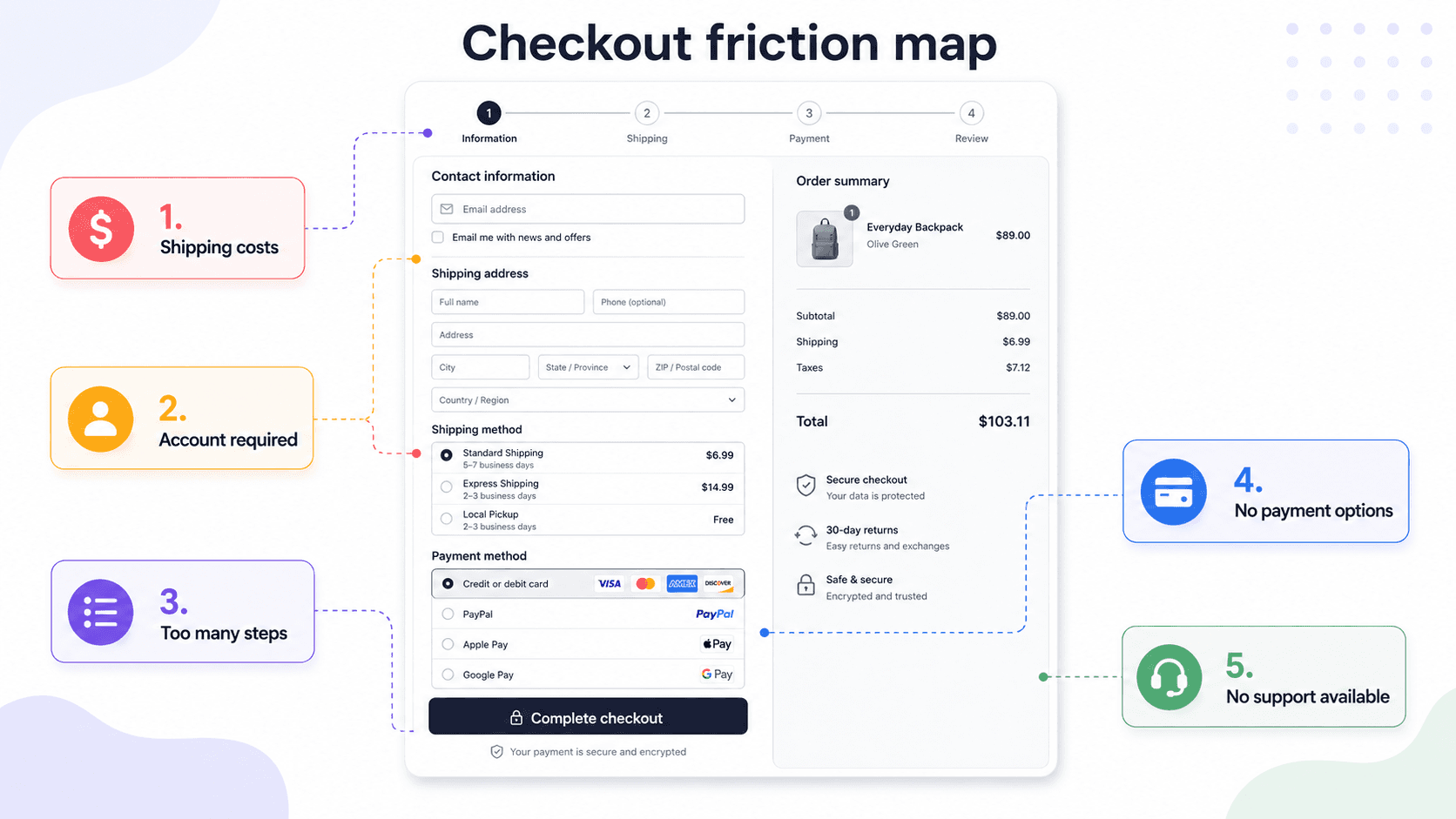
1. Reduce the number of checkout steps
The friction: Lengthy, multi-step checkouts create drop-off opportunities. Each additional click adds cognitive load.
What to do
Use Shopify’s streamlined checkout settings
Remove non-essential form fields
Enable address auto-complete
Avoid forcing upsells mid-checkout
Practical tip: Complete your own checkout on mobile. Count taps and form fields. If it feels long, simplify.
2. Offer flexible payment options
The friction: Customers expect to pay their way. If their preferred method is unavailable, they may abandon rather than switch. Digital wallets and express checkout options are now standard expectations.
What to do
Enable Shop Pay, Apple Pay, and Google Pay
Offer PayPal for trust-sensitive buyers
Consider Buy Now Pay Later (BNPL) options
According to Shopify data, Shop Pay can increase checkout-to-order conversion rates compared to standard checkout flows, largely because it reduces data entry.
3. Reveal shipping costs early
The friction: Unexpected shipping costs are one of the top abandonment drivers. Baymard reports that nearly half of shoppers abandon carts due to extra costs revealed at checkout.
What to do
Show shipping rates on the cart page
Clearly display free shipping thresholds
Include estimated delivery timelines before payment
For example: Free shipping on orders over $75. Estimated delivery: 3–5 business days.
4. Allow guest checkout
The friction: Requiring account creation adds friction and delays purchase.
What to do
Enable guest checkout
Offer account creation after purchase
Highlight benefits of account creation without forcing it
A simple rule: never put relationship-building ahead of revenue capture.
5. Make support visible and accessible
The friction: Last-minute questions can block a purchase:
“Will this arrive before Friday?”
“Can I return this if it doesn’t fit?”
“Is this product authentic?”
If customers cannot get quick answers, they often abandon.
Checkout improvements to make
Add a visible support link in checkout
Display a phone number for reassurance
Even if most customers never call, the presence of accessible support increases trust.
For Shopify brands, one overlooked friction point is that customers often hesitate because they cannot quickly confirm delivery timing, returns, or product details. AI voice agents help remove that hesitation by answering these questions instantly, while escalating only more complex cases to human agents.
This allows merchants to offer phone-based reassurance without increasing support workload.
In many cases, simply knowing that help is available improves checkout confidence.
Additional Shopify checkout elements that quietly reduce conversion
Beyond the core optimizations, merchants should also pay attention to secondary friction points such as mobile checkout optimization, trust signals, checkout speed, discount code experience, and delivery clarity.
Concretely, this means ensuring mobile fields are easy to tap and auto-fill correctly, displaying visible reassurance elements like secure payment badges, clear return policies, and satisfaction guarantees, keeping checkout fast by limiting unnecessary scripts or apps, making discount codes easy to apply without forcing users to leave checkout, and clearly showing delivery estimates before payment.
While these factors are not usually the main drivers of conversion, small issues like hard-to-use mobile forms, missing return information, slow load times, confusing coupon fields, or unclear delivery timelines can still create hesitation.
These elements should be treated as supporting optimizations that reinforce a smooth, trustworthy, and predictable checkout experience rather than core conversion levers on their own.
How to audit and improve Shopify checkout conversion quickly
To reduce checkout friction effectively:
Complete checkout yourself on desktop and mobile
Time the process
Identify points where totals change
Test all payment options
Ask someone unfamiliar with your brand to complete checkout (most important)
Monitor checkout conversion rate inside Shopify analytics
Even a 1–2% lift in checkout conversion can significantly increase revenue without increasing ad spend.
FAQs
What is checkout friction in ecommerce?
Checkout friction refers to anything that slows down, confuses, or discourages customers during the checkout process, such as too many steps, unexpected costs, or limited payment options.
Why do customers abandon checkout on Shopify?
Research from Baymard Institute shows that unexpected shipping costs, forced account creation, and complex checkout flows are among the top reasons for abandonment.
Does offering more payment methods increase conversions?
Yes. Offering digital wallets and express checkout options reduces typing effort and improves convenience, which can increase checkout completion rates.
Should I display a phone number during checkout?
Visible support options increase trust. Many merchants display a phone number or live chat link to reassure customers, and scalable AI voice systems can handle routine calls efficiently.
How can I measure checkout improvements?
Track checkout conversion rate in Shopify analytics. Compare before-and-after data after making changes to identify impact.

Head of Partnerships