Best Shopify phone sales apps in 2026
Discover the 10 best Shopify phone sales apps for 2026, from AI dialers to voicemail drops, and learn how voice boosts conversions.
In the increasingly competitive e-commerce landscape of 2026, Shopify merchants are rethinking the role of the phone. What used to be seen as a basic support channel is now becoming a powerful way to convert more shoppers, recover lost revenue, and deliver a more personal customer experience.
Modern Shopify phone sales apps go far beyond traditional calling. They combine AI voice agents, power dialers, smart routing, SMS follow-up, and automated voicemail drops to help brands engage customers at the right moment, whether that means answering a pre-purchase question, recovering an abandoned checkout, or following up after a failed payment.
In this article, we break down the 10 best Shopify phone sales apps to consider in 2026, with a focus on features, use cases, pricing, and integrations that matter most for Shopify founders, operators, and sales teams.
Why phone sales matter for Shopify stores in 2026
Phone communication is making a strong comeback as a high-intent, high-conversion channel. When customers have a pre-purchase question, need reassurance, or run into friction during checkout, a phone call often creates a faster and more effective path to purchase than email or live chat. These conversations give brands a chance to answer complex questions, remove hesitation, and build trust in real time.
At the same time, phone tools have evolved dramatically. For Shopify merchants, the phone is no longer just a support line. It is now a data-rich, AI-powered commerce channel that can help teams drive revenue, improve customer experience, and better understand which conversations actually lead to sales.
The tools in this guide reflect that shift. Below, we compare the top Shopify phone sales apps and explain what each one does best, who it is best for, and which features to prioritize when choosing the right solution for your store.
Quick comparison
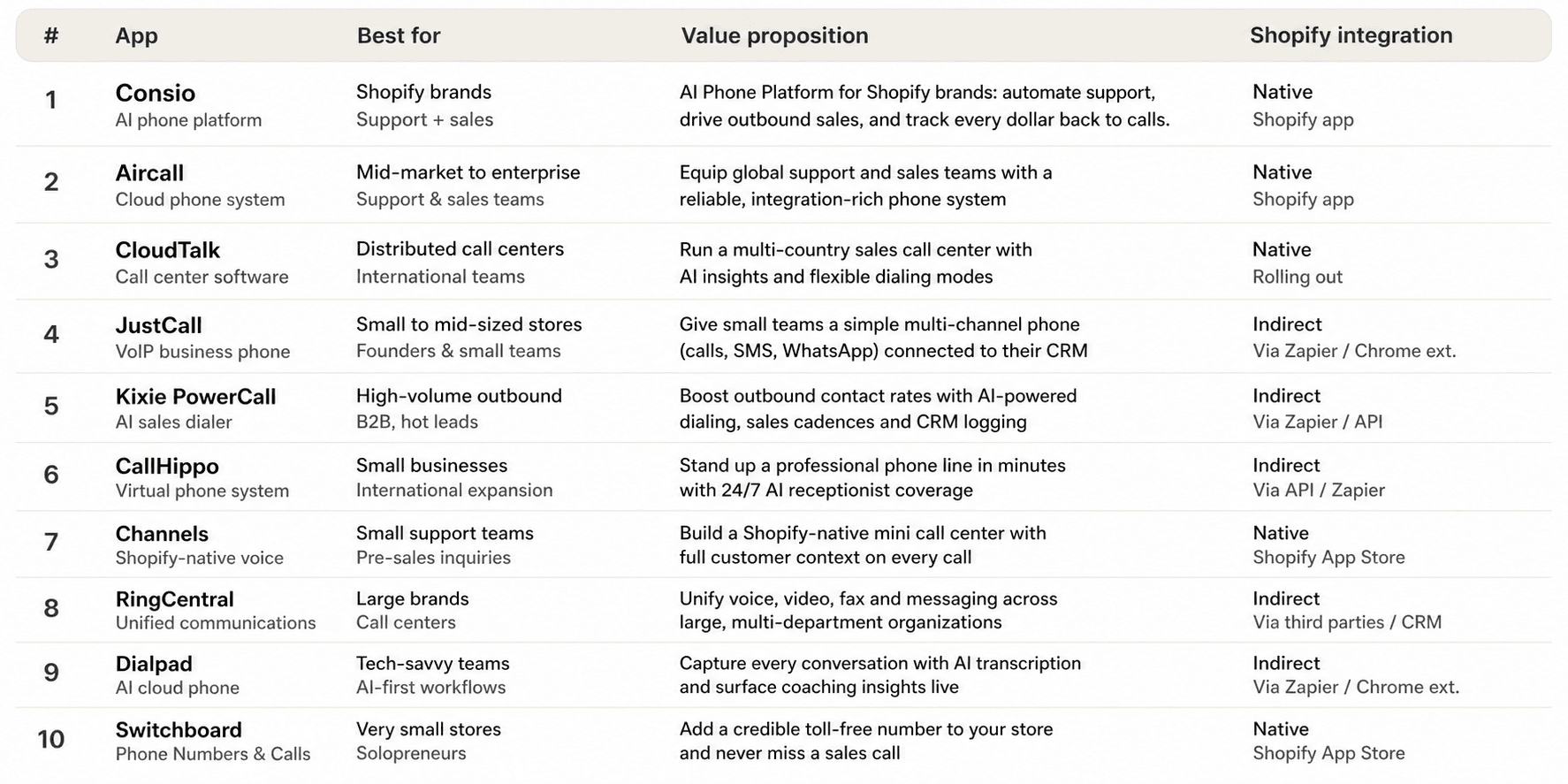
Top 10 Shopify phone sales apps for 2026
1. Consio – AI phone platform for Shopify brands
Consio is the AI phone platform built for Shopify brands, helping support teams automate a large share of calls and SMS with an AI Voice Agent that handles order status, returns, FAQs, and after-hours coverage, while helping sales teams use a power dialer, voicemail drops, and SMS follow-up to recover checkouts, convert hot leads, and drive more attributed revenue.
Inbound AI Voice Agent + smart routing: Consio answers calls instantly with full Shopify context, handles support and pre-purchase questions, sends tracking links or product links by SMS during the call, and routes callers to the right rep, team, external number, or voicemail when needed.
Outbound Power Dialer + automated voicemail drops: Launch segmented outbound campaigns from Shopify and Klaviyo audiences such as abandoned checkouts, VIPs, post-purchase follow-ups, and high-intent leads. Reps move from one call to the next without delay, while voicemail drops keep outreach fast and consistent.
Built-in SMS + AI Dialer Assistant: Send and receive SMS in the same workspace as calls for follow-up, payment links, promo codes, product recommendations, and missed-call recovery. During outbound calls, the AI Dialer Assistant also helps reps stay on script and improve consistency.
Unified analytics, call history, and revenue attribution: Track calls, transcripts, summaries, dispositions, live activity, and CSV exports across the workspace, while tying calls, voicemails, and SMS directly to Shopify orders through attributed revenue reporting.
Deep Shopify and support integrations: Consio gives agents rich Shopify customer context, including orders, spend, addresses, tags, notes, company details, and marketing consent, and integrates with tools like Gorgias, Kustomer, Richpanel, and Zendesk to keep support teams in one workflow.
Use cases: With Consio, Shopify brands use phone calls as both a support channel and a revenue channel. On the support side, AI voice agents can handle high-volume inquiries like order status, shipping updates, returns, FAQs, after-hours coverage, and VIP routing without adding pressure on human teams. On the sales side, brands use Consio to recover abandoned checkouts, follow up with hot leads at the right moment, qualify inbound sales calls, save failed payments, re-engage wholesale accounts, and run post-purchase outreach such as upsells, replenishment reminders, and VIP retention campaigns. Because calls, SMS, Shopify data, and AI workflows live in one system, teams can move from answering questions to converting intent much faster.
Result: The result is a more responsive customer experience, higher conversion from high-intent conversations, more repeat purchases, and better support efficiency at scale. Instead of treating phone calls as a disconnected support task, Shopify brands can use Consio to resolve more inquiries automatically, route high-value conversations to the right person, and generate measurable revenue from inbound calls, outbound campaigns, voicemails, and SMS follow-up. For merchants that want both stronger CX and clearer attribution, Consio turns phone into a fully trackable commerce channel connected to Shopify and the rest of the support stack.
Pricing: Consio has a friendly pricing model. There’s a free plan to get started, then paid plans like $30/month (includes ~100 minutes) and $60/month (400 minutes) with $0.10/min overage. Consio is a top choice for Shopify stores looking to proactively “call, connect, and convert” prospects into loyal customers.
2. Aircall – Enterprise-grade phone system for Shopify & support teams
Aircall is a cloud phone system and call center solution that offers a robust Shopify integration. In fact, Aircall is described as “the phone system built for online merchants”. It’s ideal for larger sales/support teams that need advanced call center features and reliability:
Shopify Data on Calls: Aircall’s Shopify app surfaces rich customer details on inbound calls, including the caller’s name, order history, order status, and even tracking links, so agents have context at their fingertips. This lets your team personalize conversations and solve issues faster. It also supports click-to-call so you can dial any customer directly from their Shopify profile with one click.
Omnichannel and Integrations: Aircall integrates with 100+ tools. Notably, it works with popular e-commerce helpdesks like Gorgias and Zendesk, CRM like HubSpot/Salesforce, and Slack for notifications. This extensive ecosystem means calls can seamlessly fit into your existing workflows (e.g., creating a support ticket in Zendesk automatically after a missed call).
Features for Sales Teams: It supports unlimited simultaneous outbound calls (great for busy sales floors) and essential features like IVR (phone menus), call routing, recording, and SMS/MMS texting. Aircall has also rolled out AI features: AI transcriptions of calls and even an AI Voice Agent add-on for basic automated call handling. Its higher-tier plans include a built-in power dialer and voicemail drop capability as well, so sales reps can rapidly dial through lists and drop pre-recorded voicemails when needed.
Use Cases: Aircall is often used by scaling customer support teams and sales teams that need reliability and global calling. For example, if you run a 24/7 customer service hotline for your Shopify store, Aircall’s infrastructure (with numbers in various countries) and call queueing will be beneficial. It’s also used for outbound inside sales teams who want one integrated platform for calls and CRM logging.
Pricing: Aircall is a premium solution. Plans start at $120/month (Essentials for 3 users), which effectively is a ~$40 per user baseline. The Professional plan is $210/month (3 users) with advanced analytics and the power dialer feature. Keep in mind 3 users is the minimum buy-in for these plans. While pricey for very small businesses, its feature depth and integration options make it a strong choice for midsize and larger Shopify operations. (Note: Some users have reported that Aircall’s support can be slow and setup can be complex, so it’s best suited for organizations with the time and budget to implement a full call center platform.)
3. CloudTalk – Scalable call center with Shopify CRM integration
CloudTalk is a cloud-based call center software built for sales and support teams, with an upcoming native integration for Shopify. It’s known for flexible dialing modes and strong analytics. CloudTalk is often recommended for merchants who need a “call center-type setup” that integrates with Shopify:
Personalize with Shopify Data: CloudTalk’s Shopify VoIP integration (currently rolling out) will import your Shopify customer list into CloudTalk and display order history and details during calls. Agents can see if a caller recently placed or abandoned an order, for example. It also allows click-to-call from Shopify : one-click in Shopify opens CloudTalk’s dialer to call that customer. Every call or SMS can be automatically logged as a note on the Shopify customer timeline, creating a unified history of interactions.
Advanced Dialer & Automation: CloudTalk shines in outbound calling. It offers multiple dialer modes (preview, power, and even parallel dialing) in one interface. For instance, reps can use Power Dialer mode to auto-dial through a list with adjustable pacing, or Parallel Dialer to call up to 10 numbers at once and connect to whoever answers first. It also features voicemail drop and answering machine detection so you don’t waste time on unanswered calls.
AI and Analytics: New AI Voice Agents in CloudTalk can act as virtual receptionists or sales assistants (24/7 auto-answer for simple inquiries) similar in concept to Consio’s AI agent. Additionally, CloudTalk includes AI-powered call transcriptions, sentiment analysis, and even AI call summaries with automatic call tagging to help analyze quality. Managers can monitor live calls and review detailed analytics dashboards to track team performance.
Use Cases: CloudTalk is great if you have a distributed or remote sales team. Companies that do international sales calls appreciate CloudTalk’s coverage (local numbers in 160+ countries) and high call quality. It’s also used by support centers needing features like IVR menus, call queues, and integrations with CRMs. On Shopify, a typical use case is to improve post-purchase support: when a customer calls, the agent sees their recent orders and can resolve issues without toggling between systems.
Pricing: CloudTalk’s plans start around $25 per user/month (Starter) up to $50 for advanced tiers, with a 14-day free trial available. Outbound calls are unlimited to certain regions on higher plans. Keep in mind any phone app will have telecom minute costs if you’re calling customers, but CloudTalk’s transparent pricing and the fact that the Shopify integration is free for users once launched make it appealing. Overall, CloudTalk is a solid choice for merchants that want a full-featured sales call center with Shopify CRM integration.
4. JustCall – Flexible VoIP sales solution with Shopify and CRM ties
JustCall is a popular VoIP business phone system known for its ease of integration. It doesn’t have a dedicated Shopify App Store listing, but it’s often cited as one of the best-rated VoIP solutions for Shopify because it can pull customer details on incoming calls via integrations and workflows:
Customer Info Pop-ups: With the right setup, JustCall will display Shopify customer name and order history when they call. This is usually achieved by connecting JustCall to Shopify through Zapier or similar, or by using JustCall’s Chrome extension with your Shopify admin. The result is similar to other apps: agents get real-time context to address the caller’s needs.
Multi-Channel Communication: JustCall isn’t just for voice calls; it also supports SMS and even WhatsApp integration. For sales teams, this means you can follow up a call with a quick text, all logged in one system. For example, after a support call resolving a product question, you might shoot the customer a “thank you” SMS with a discount code and JustCall will record that interaction.
CRM and Helpdesk Integrations: A big strength of JustCall is its out-of-the-box integrations with major CRMs (Salesforce, HubSpot, Pipedrive) and helpdesks. So if your Shopify store also uses a CRM, JustCall will log calls and recordings there. It can integrate with Gmail/Outlook to show email correspondence alongside call info, giving a 360° view of customer communications.
Sales Features: JustCall offers features like call logging, call recording, and even a basic power dialer for outbound campaigns. It might not be as advanced as Kixie or CloudTalk in dialing multiple lines, but you can automate calling lists of Shopify contacts via its integrations. It also has call monitoring and analytics to track performance.
Use Cases: JustCall is well-suited for small to mid-sized Shopify stores that want a reliable phone solution without heavy call center overhead. If you’re a founder who occasionally wants to call high-value customers, or a small team doing outbound courtesy calls (e.g. post-purchase check-ins, or pre-sale consultations for a bespoke product), JustCall’s relatively simple interface and strong mobile app are beneficial. It’s often praised for being “hassle-free” and Shopify-friendly.
Pricing: JustCall plans start around $25–$29 per user/month for the Standard package, which includes unlimited calling in certain regions and basic integrations. Higher tiers (Premium ~$49) unlock advanced automation and intelligence features. There is typically a two-user minimum. While not the cheapest, it’s more affordable than enterprise solutions and offers good value given its feature set and integration options (Gmail, Zapier, etc.). For Shopify merchants who want a versatile phone system that can grow with their tech stack, JustCall is a dependable choice.
5. Kixie PowerCall – AI-enhanced sales dialer for high-volume outreach
Kixie is a sales-focused calling platform that brands itself as an “AI-enhanced revenue communication” solution. It’s built to help sales teams connect with leads more efficiently, making it a strong contender for Shopify merchants doing a lot of outbound sales calls:
AI-Powered Dialer: Kixie’s core is a power dialer that can automate outbound calling with speed and intelligence. It can auto-dial through lead lists, detect voicemails, and automatically drop voicemail messages for you, similar to other power dialers, but it also uses AI to optimize the call cadence and timings. Kixie’s AI can prioritize leads or adjust dialing pace based on past connection rates (for example, slowing down if it detects many live pickups at a certain time).
Sales Cadence Automation: Beyond calls, Kixie can integrate calls into your broader sales cadences (sequences of calls, texts, and emails). Say a customer signs up on your Shopify store but doesn’t purchase. Kixie can be set to: Day 1 text, Day 2 call attempt, Day 3 email (via your CRM), etc., ensuring no lead falls through the cracks.
CRM Integration and Analytics: Kixie was built to plug into CRMs like HubSpot, Pipedrive, Zoho, and others. This means every call, text, and outcome can sync to the customer’s record. For Shopify, while Kixie doesn’t have a native app, you can connect it via Zapier or use the Shopify API so that new Shopify customers are pushed into Kixie call lists. The platform offers real-time analytics on call outcomes, agent performance, and even AI-driven coaching (like detecting if an agent is talking too much vs listening).
AI Voice Features: Kixie has begun introducing AI voice features akin to a virtual assistant. For example, live call transcription and keyword triggers, if a customer says “too expensive,” Kixie might pop up an AI-suggested response card for the agent. This is similar to some AI features in enterprise tools but at a mid-market price point. Kixie basically combines AI, automation, and seamless CRM integration to boost calling productivity while keeping conversations personal.
Use Cases: Kixie is great for Sales-driven Shopify brands, like those in B2B or high-end consumer products where follow-up calls are essential. If you have a list of warm leads (e.g., people who filled a “contact me” form for a custom quote), Kixie can power through these calls and ensure each lead is contacted promptly. It’s also used for calling abandoned checkout customers. An agent can use Kixie to rapidly call everyone who abandoned a cart in the last 24 hours and perhaps offer assistance or a discount. With Kixie’s voicemail drop, even if only 1 in 5 answers, the others get a friendly voicemail which might prompt them to return and complete the purchase.
Pricing: Kixie’s pricing is mid-range. The Integrated plan is around $35/user/month, and an Advanced plan with more automation and AI features is around $65/user (pricing can vary). There’s usually a free trial. While not the cheapest per-user cost, consider that it can drive a lot of extra revenue by increasing contact rate, its users often report it pays for itself in conversions. If your Shopify store has a dedicated sales or outreach team, Kixie’s specialized features (power dialer, SMS, AI insights) make it a powerful tool to have in the stack.
6. CallHippo – Easy business phone with AI voice agent capabilities
CallHippo is a cloud-based virtual phone system popular with startups and growing teams. It has made strides in e-commerce by integrating an AI Voice Agent and promoting Shopify connectivity. For Shopify merchants, CallHippo offers a balance of simplicity and advanced features:
Quick Setup & Numbers: CallHippo allows you to get local or toll-free business phone numbers in minutes and start making/receiving calls through their app. This is great for store owners who want to add a professional phone line to their store without hassle. Like SBoard (coming later), it gives that credibility of a published phone number, which can boost customer trust and sales by making you more reachable.
AI Voice Agent: CallHippo has introduced an AI Voice Agent that can integrate with Shopify. This AI agent can answer common customer calls 24/7, for example, providing order updates automatically by fetching Shopify order status, answering simple product questions, or taking messages. Essentially, it’s a virtual receptionist for your Shopify store that instantly responds to customer queries and provides order info without manual effort. This can significantly cut down response time and free up your human team for more complex sales calls.
Basic Call Center Features: The platform includes IVR menus, call forwarding (you can forward store calls to your cell if you want), call recording, and team collaboration (assign calls to team members, etc.). It also supports SMS on many numbers, so you can text customers from the same business line.
Integrations: CallHippo integrates with a variety of CRMs and helpdesks (it’s known to work with Gorgias so calls can create tickets in your helpdesk). For Shopify, while it might not have a one-click app, it boasts an integration via API/Zapier to sync contacts and call activities. They’ve publicized that with the integration, you can instantly see who’s calling and their Shopify order info, similar to other tools.
Use Cases: CallHippo is well-suited for small businesses and those new to having a phone support/sales channel. If you’re just starting to take phone orders or support calls, CallHippo’s intuitive interface and low cost of entry (even a free plan for basic use) are attractive. It’s also good for international selling because you can easily get international numbers to appear local to overseas customers. For example, a Shopify store expanding to the UK could get a UK number via CallHippo so UK customers can call a local number and be greeted by the AI agent or your team.
Pricing: CallHippo offers a Free plan (limited features), and paid plans that range from $16 up to ~$40 per user/month depending on features. The Bronze plan (~$20/user) includes a good chunk of calling minutes and basic features, Silver (~$30) and Platinum (~$40) add more minutes and advanced capabilities like call transfer, analytics, etc. Notably, the AI voice agent might be an add-on or included in higher tiers. Overall, CallHippo is a cost-effective way to get a professional phone system with some AI flair, making it a contender for best Shopify phone sales app especially for those on a budget or just testing the phone waters.
7. Channels (Channels App) – Web calls and IVR integrated with Shopify
Channels is a Shopify App Store-listed solution focused on connecting voice calls with your e-commerce data. It enables you to build a mini contact center in minutes, aimed at improving customer support and sales readiness:
Instant Shopify Data on Calls: Channels directly integrates with Shopify to show a caller’s details right when the call begins. This includes their name, email, and importantly their recent orders or cart status. The idea is to let you “get straight to the point of the call” by knowing the customer’s context upfront. For example, if a customer calls asking “Where is my order?”, the app will display their last order and tracking link for the agent immediately.
IVR and Call Routing: You can set up an IVR (interactive voice response) menu easily : e.g., “Press 1 for Sales, 2 for Support” so calls route to the right person. This is great for efficiency and giving your store a professional feel, even if your “departments” are just two people wearing multiple hats.
Call Recording & History: Channels automatically records calls and keeps history of all conversations. You can download recordings to review customer interactions (useful for training or dispute resolution). Having call logs tied to each Shopify customer means you never lose track of who said what.
Click-to-Call Widget: An interesting feature is the Click-to-Call widget that you can have on your website. Shoppers can initiate a call to you straight from their browser (web call), and it will ring into your Channels app. This lowers the barrier for customers to reach out, potentially increasing lead calls.
Works on Any Device: Channels offers a web app and mobile app, so you or your team can handle business calls from a computer or on-the-go. It essentially turns any device into a call center phone, synced with your Shopify store.
Use Cases: Channels is perfect for customer support hotlines and pre-sales inquiries. If you sell products that may require some consultation (say, custom furniture or high-end electronics), customers can call you directly from your shop and you’ll see exactly what’s in their cart or what they’ve ordered before. It helps turn what could be “going to the dentist” level painful support calls into smoother experiences by eliminating the need to interrogate the customer for info. It’s also useful for small teams who want a light-weight solution, setup is fast, and at ~$29/month it’s approachable.
Pricing: Channels starts at $29/month (Plus plan), which includes 3 users, 5000 web call minutes, a free number, and basic IVR/recording features. The Advanced plan is $75/month for 5 users and unlimited calls with some premium features like unlimited call history and unlimited free calls to US/Canada. Outbound calls to other countries incur per-minute charges on any plan. Overall, Channels is a cost-effective choice for a Shopify-focused phone solution. If you want to add voice support/sales to your store quickly, Channels is an app to check out.
8. RingCentral – Feature-rich business phone system (with third-party Shopify integration)
RingCentral is a veteran in the business telephony space, providing a comprehensive unified communications platform. While not built for Shopify per se, it can be linked to Shopify via third-party apps or integrations, and it deserves mention for larger merchants:
All-in-One Communications: RingCentral isn’t just phones, it includes voice, video meetings, fax, and team messaging in one. If your Shopify operation is part of a bigger business that needs a full communications suite, RingCentral can cover everything. For example, your sales team can use it for outbound calls, your support team for inbound calls, and your corporate team for video meetings, all on one system.
Shopify Integration: Although not native, some integration platforms allow RingCentral to talk to Shopify. This might involve using a connector (like Zapier or a custom app). RingCentral does integrate natively with CRMs like Salesforce and Zendesk, so one strategy is to have Shopify connected to a CRM and RingCentral connected to that CRM.
Powerful Call Features: RingCentral offers a huge feature set out of the box : IVR menus, skills-based call routing (routes VIP customers to certain agents), call queues, recordings, analytics dashboards, voicemail-to-email transcription, and more. It’s designed for professional call center usage or large organizations. Essentially, “RingCentral can do calls, video, fax—you name it”, it’s overkill if you just need a simple phone, but a workhorse if you leverage its breadth.
Scalability: One advantage is scalability and reliability. RingCentral can support hundreds of users if your business grows, and has redundancy so calls are less likely to drop. If you envision your Shopify store expanding into an enterprise where you have a call center with dozens of reps, RingCentral is a platform that can scale with you.
Use Cases: Typically, larger e-commerce brands or those with dedicated call centers choose RingCentral. For instance, an online retailer that also has wholesale clients might use RingCentral to handle both customer service and sales calls across different departments. Its multi-level IVR and extensions system allow a professional phone tree even for complex organizations. However, for a small Shopify store, RingCentral might be too much unless you specifically want the reliability and aren’t sensitive to cost.
Pricing: RingCentral’s pricing for the MVP (Message/Video/Phone) product starts around $30 per user/month for the Standard plan and goes up to $45–$60 for Premium/Ultimate with advanced analytics and integrations. It can be pricey, especially since it’s per user and often charged annually. There’s also typically an extra cost to enable some call center features. If you only have one or two phone users, RingCentral will not be cost-effective compared to others on this list. But if you need a rock-solid, full-featured phone system and are perhaps integrating Shopify via your helpdesk (like using Gorgias Voice which is powered by Twilio/RingCentral infrastructure), it’s a top-tier solution. In short, RingCentral is a “strong choice” for those needing a robust VoIP, but for most Shopify SMBs, a Shopify-tailored app might deliver more bang for the buck.
9. Dialpad – AI-powered cloud phone with sales and support functions
Dialpad is another major player in cloud communication, notable for its built-in AI and user-friendly interface. It’s known for combining phone calls with AI transcriptions and insights (they call it “Voice Intelligence”). For Shopify users, Dialpad can be an excellent phone system especially if you value AI analytics:
Voice Intelligence (VI): Dialpad’s standout feature is that every call can be automatically transcribed in real-time, and AI will pull out action items, sentiments, and keywords. For a sales call, this means you get a searchable transcript and even insights like “customer asked about return policy”. If you have lengthy phone consultations (say you run a custom apparel store where you discuss requirements over phone), having a transcript is gold, you can focus on the conversation while Dialpad notes important points.
Smooth User Experience: Dialpad is often praised for its modern interface : it works on web, desktop, and mobile seamlessly. You can send SMS from your Dialpad number, switch a call from your laptop to your cell phone on the fly, etc. For busy entrepreneurs, that flexibility is great: start a call on your office computer, continue it while driving to the warehouse via your phone.
Sales Features (Dialpad Sell): Dialpad has a specific product for sales teams which includes power dialer functionality, local presence dialing (shows a local number when calling different regions), and even coach transcripts that highlight if an agent is monologuing too much. For a Shopify store with an inside sales team, these features can help train reps and optimize calls. It also integrates with CRMs like HubSpot, Salesforce, and Zendesk for logging calls.
Shopify Integration: There isn’t a direct Shopify app, but you can connect Dialpad to Shopify through Zapier or use the Chrome extension to click phone numbers in your Shopify admin to call via Dialpad. Some merchants use Dialpad in conjunction with tools like Shopify Flow or CRM integrations to tie the data together (e.g., pushing abandoned cart contacts into Dialpad call lists).
Use Cases: Dialpad is a strong choice for tech-savvy teams that appreciate AI insights. If your support team wants to ensure no information is lost in a call, transcriptions help a lot. It’s also useful if you have frequent conference calls. Dialpad supports voice and video meetings, which could be useful for B2B wholesale conversations initiated from your store. For example, a B2B buyer browsing your Shopify store might schedule a call; with Dialpad you could easily escalate that to a screen-sharing demo if needed (since it’s one app for voice & video).
Pricing: Dialpad’s standard “Talk” plan starts at $15/user/month (billed annually) which is quite affordable, though it has some limits on minutes. The Pro plan is $25/user with more features. The Sales dialer (Dialpad sell) is more expensive (often ~$95/user as it includes more AI and dialing features). For a small team, the low-tier plan is cost-effective and still includes the core Voice Intelligence features, which is a differentiator. Dialpad gives a 14-day free trial. In essence, Dialpad is bringing what used to be enterprise-only AI call tech to small businesses at a reasonable price. If you want to appear cutting-edge and leverage AI to improve your phone sales/support, Dialpad is a great option to consider alongside your Shopify store.
10. Phone Numbers & Calls (Switchboard) – Simple Shopify phone line to boost sales
Rounding out the list is Phone Numbers & Calls by SBoard (#21Zoo Labs), often just called Switchboard. This Shopify app is a lightweight solution to set up a business phone number for your store, primarily aimed at improving credibility and capturing sales you might be missing without a phone contact:
Toll-Free or Local Number for Your Store: Switchboard provides a free US toll-free number (or local, depending on plan) that you can add to your Shopify storefront. Having a visible phone number can signal trust and improve customer confidence (no more looking like a fly-by-night operation). It’s noted that you can use this number to get verified on Google, Facebook, Alibaba, etc., as a legitimate business with a contact line.
Call Forwarding & Voicemail: You don’t need a fancy call center. Switchboard will forward incoming calls to your personal phone (or any number you choose). So if a customer calls the toll-free number on your site, it rings through to, say, your cell phone, but the customer never sees your personal number. If you’re unavailable, the app provides voicemail and even voicemail-to-email so you can return calls.
Text Messaging: On higher plans, the provided number can also receive SMS from customers. This is useful if customers prefer texting quick questions (which many do). All texts and calls are managed in a simple dashboard.
Use Cases: Switchboard is great for small Shopify stores or one-person businesses that want to offer phone support or sales consultations occasionally without investing in a full VoIP system. For instance, if you sell custom jewelry and someone has a question before ordering, a quick call can secure the sale. With Switchboard you won’t miss that call and you protect your privacy. Also, by scheduling availability (it allows setting business hours for calls), you can ensure customers only call when you’re ready to answer, reducing disruptions.
Pricing: Switchboard is affordable. Plans range from $8/month (Pay-as-you-go) to $10/month (Pro) to $20/month (Enterprise). The $10 plan includes 250 minutes and texting, while the $20 plan gives 750 minutes and more features. These price points are lower than most others on this list, reflecting the more basic feature set. But the value is evident for what it does: “Get a toll-free number for better customer service and to boost sales”. If you’re just starting to venture into phone communications on Shopify, Phone Numbers & Calls (Switchboard) is a perfect stepping stone.
With these ten options, Shopify merchants in 2025 have a rich selection of phone sales apps to choose from. The best choice depends on your store’s size, budget, and whether you prioritize outbound sales calling, inbound support, or a mix of both. In the next section, we’ll address some frequently asked questions to help you finalize the right solution for your needs.
FAQs
Why do I need a phone sales app for my Shopify store?
A phone sales app can unlock an additional revenue channel and build trust with customers. Modern platforms also combine AI voice agents, outbound calling tools, and SMS follow-ups to help Shopify brands engage shoppers at the right moment, answer pre-purchase questions, and recover lost sales such as abandoned checkouts.
Over half of customers still rely on phone calls at some point in their buying journey, so having a system to handle those calls professionally can increase your conversion rate and customer satisfaction. Plus, modern phone apps integrate with Shopify to give you context (orders, etc.) during calls, making each conversation more effective.
What is a “power dialer” and do I need one?
A power dialer is an automated calling system that dials numbers one after another from a list, without you manually punching each number. As soon as you finish or skip a call, the dialer calls the next contact automatically (often with minimal delay). This is useful for outbound sales campaigns where efficiency and call volume matter. If you plan to call lots of customers or leads (hundreds per day), for example, following up on every abandoned checkout, a power dialer is a huge time-saver and ensures no lead is missed. Apps like Consio, CloudTalk, and Kixie include power dialers specifically optimized for outbound e-commerce sales.
How do automated voicemail drops work, and are they useful for Shopify sales?
Automated voicemail drop is a feature that lets you instantly leave a pre-recorded voicemail message with one click, instead of having to recite the message every time. When you reach a customer’s voicemail box, you hit “drop voicemail” and the system plays your saved message (e.g., “Hi, this is [Name] from [Store]. I’m calling about your recent inquiry...”). Meanwhile, you can immediately move on to the next call. This is incredibly useful when doing outbound campaigns because a lot of calls go unanswered. Rather than spend 30–60 seconds repeating a message each time, you record a perfect one once and drop it in. For Shopify use, think about leaving a friendly reminder about a cart or a special promo. It ensures consistency and saves time. Consio, Aircall, and CloudTalk all support voicemail drops. Merchants see higher callback rates since the dropped voicemails are clear and crafted to prompt a return call or action.
What is an AI voice agent and can it really help my business?
An AI voice agent is an automated, voice-powered system that can handle customer calls in a natural way, using artificial intelligence to understand requests, respond in real time, and take action when needed. For Shopify brands, this means the AI can answer common questions like order status, shipping updates, returns, and product information, while also sending tracking links by SMS, sharing product links, or guiding customers through simple purchase-related questions.
Unlike a traditional phone bot, modern AI voice agents work with full Shopify context, including customer details, order history, and store policies, which makes responses far more relevant. They also operate 24/7, helping brands cover after-hours calls, peak periods, and repetitive support requests without adding headcount.
When a conversation requires human intervention, for example a high-value customer, a complex issue, or a sales opportunity, the AI can route the call to the right rep with context already captured, so the handoff is smooth. Apps like Consio offer AI voice agents designed specifically for Shopify, making them especially useful for merchants that want faster response times, fewer missed calls, and better support efficiency without losing the personal feel of phone conversations.
Can these phone apps integrate with my other tools like Klaviyo, Kustomer, Zendesk or Gorgias?
Yes, many Shopify phone sales apps have integrations with popular marketing and support tools. For instance, Consio connects with Klaviyo, allowing you to directly call segments from your Klaviyo lists (useful for marketing follow-ups). It also integrates with Kustomer and Gorgias, so that calls and voicemails can create tickets in your helpdesk for tracking. Aircall and others integrate with helpdesks like Zendesk and CRMs like HubSpot. When evaluating apps, check the “Works with” or integrations list; you’ll find that the top apps on our list connect with dozens of platforms, ensuring your phone channel doesn’t operate in a silo but rather enhances your overall omnichannel strategy.
What about using my personal phone or something like WhatsApp instead of these apps?
In the very early stages, some merchants do use a personal phone number or WhatsApp for customer calls. While this can work short-term, it has drawbacks: lack of professionalism, no integration with Shopify data, and no way to track or scale conversations. You could miss important calls or forget what was said. These dedicated phone sales apps provide professional features (call routing, recording, etc.) and data syncing that personal solutions can’t. They also protect your privacy (customers see a business number, not your personal cell). That said, many apps (like JustCall, Dialpad, etc.) have mobile apps that let you use your smartphone to handle calls on the go, but through the business line. In essence, using a true phone sales app elevates your customer experience and gives you tools to improve sales, whereas a personal phone approach can become chaotic as you grow. It’s usually worth the small investment once you’re serious about your store’s success.

Growth Marketing