Shopify AI Agent Stack: CX, Data, Retention & Voice
See how Shopify brands use AI agents across customer support, ecommerce data, lifecycle marketing, human CX, and voice to drive revenue.

A Shopify AI agent stack connects AI tools across analytics, customer support, lifecycle marketing, voice, and human CX so they can share customer context, take coordinated actions, and measure the resulting revenue.
The goal is not to add as many AI tools as possible. It is to connect data, decisions, and customer interactions across the full ecommerce journey.
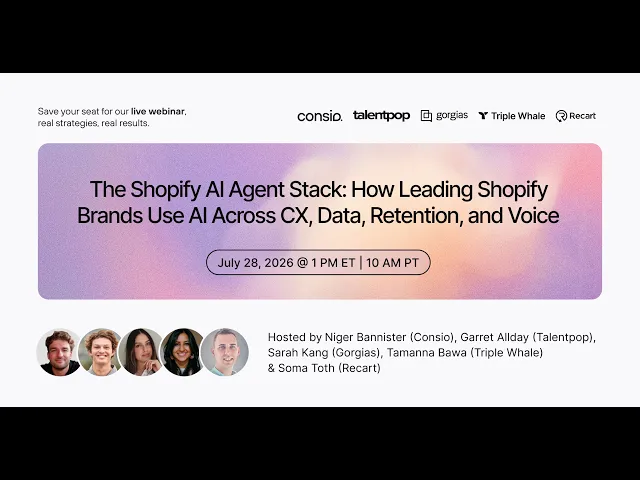
That was the central theme of The Shopify AI Agent Stack, a webinar featuring:
Nigel Bannister, Head of Partnerships at Consio, on AI voice agents and customer conversations
Garret Allday, Partnerships Manager at TalentPop, on human and AI collaboration
Tamanna Bawa, Tech Partner Manager at Triple Whale, on ecommerce intelligence and attribution
Sarah Kang, Technology Partner Manager at Gorgias, on AI-powered customer support
Soma Toth, Founder of Recart, on AI-driven SMS and lifecycle marketing
Together, they showed how Shopify brands can move from isolated AI features to coordinated workflows that improve customer experience, efficiency, retention, and revenue.
The Shopify AI agent stack at a glance
Layer | Role | Example workflows | Speaker |
|---|---|---|---|
Handle calls and generate revenue | WISMO, product recommendations, outbound calls | ||
Manage nuanced conversations | VIP support, subscription saves, abandoned-cart outreach | ||
Identify and prioritize opportunities | Attribution, incrementality, anomaly detection | ||
Resolve customer requests | Refunds, order edits, cancellations, escalation | ||
Personalize the next action | Cart recovery, SMS, win-back, post-purchase messaging |
What is a Shopify AI agent stack?
A Shopify AI agent stack is a connected set of AI systems that can understand store and customer data, decide what should happen next, and take approved actions across the customer journey.
A traditional ecommerce stack often separates:
Analytics
Customer support
Email
SMS
Phone calls
Human agents
Each platform may improve one workflow, but the customer context does not always move between them.
An AI agent stack connects those layers.
For example:
An analytics agent detects a conversion opportunity.
A lifecycle agent chooses the right message for the affected customer.
A support or voice agent answers questions and removes purchase objections.
A human specialist steps in for complex or high-value conversations.
Revenue attribution connects the interaction to an order.
The objective is not complete automation. It is coordinated execution.
1. Use voice AI to turn phone calls into a Shopify revenue channel
Nigel Bannister explained how Shopify brands can use AI voice agents to transform phone calls from a disconnected support channel into a measurable customer experience and revenue channel.
Most business phone systems can route and record calls. They are not designed to understand:
Shopify orders
Product catalogs
Customer history
Fulfillment status
Purchase intent
Revenue generated from conversations
This creates several common problems:
High-intent calls go unanswered.
Customers repeat information already stored in Shopify.
Agents manually search for orders and tracking details.
After-hours callers are sent to voicemail.
Revenue from calls remains difficult to measure.
A Shopify AI voice agent can use store context to handle many of these conversations automatically.
What a Shopify AI voice agent can do
It can:
Answer order-status questions
Send tracking links by SMS
Explain shipping and return policies
Recommend products
Answer pre-purchase questions
Create and send draft orders
Escalate complex cases
Cover after-hours and overflow calls
During the webinar, Nigel demonstrated an AI voice agent guiding a shopper through a product recommendation, asking follow-up questions, collecting customer details, and offering to send a draft order.
The agent was not simply reading a static FAQ. It was using product information and conversational context to move the shopper toward a relevant action.
Outbound AI voice workflows
Voice AI can also support proactive ecommerce workflows such as:
Failed subscription payments
Churn prevention
High-value return follow-up
VIP outreach
Replenishment reminders
Post-purchase education
Product onboarding after delivery
For example, a subscription brand could call a customer whose payment method is about to expire instead of relying only on an email that may never be opened.
A brand selling a complex product could trigger a post-purchase call after delivery to explain setup, answer questions, and reduce preventable returns.
The phone becomes more valuable when it is connected to Shopify data, customer intent, follow-up messaging, and revenue attribution.
2. Let AI handle volume and humans handle high-value conversations
Garret Allday focused on the relationship between automation and human customer service.
His central argument was straightforward:
AI should handle repetitive volume. Human specialists should handle conversations that require judgment, empathy, trust, or commercial awareness.
AI is well suited to:
FAQs
First responses
Basic order questions
Information collection
Routine subscription changes
Predictable support requests
Human agents remain especially valuable for:
Complex issues
Frustrated customers
VIP shoppers
Cancellation objections
Product consultation
Subscription saves
Sensitive escalations
Upsell and retention opportunities
The brand concierge model
Garret described the human specialist as a brand concierge.
Instead of spending the entire day answering repetitive tickets, the concierge can:
Contact abandoned-cart shoppers
Save subscription cancellations
Guide customers through product decisions
Support high-AOV purchases
Build relationships with repeat customers
Turn CX conversations into revenue opportunities
This model is particularly useful for brands selling expensive, technical, or high-consideration products.
AI creates capacity. Human agents use that capacity where it matters most.
The strongest model is therefore not “AI or humans.” It is AI for speed and scale, with humans reserved for nuance and value.
3. Use AI to prioritize the ecommerce problems that matter most
Tamanna Bawa explained that most ecommerce teams do not suffer from a lack of data.
They suffer from a lack of clarity.
Shopify, Meta, Google, TikTok, helpdesks, and lifecycle platforms all report performance differently. Teams can spend hours building reports without knowing which issue deserves attention first.
Tamanna presented a four-step framework:
Find the part of the business losing the most revenue or containing the largest opportunity.
Confirm that the data is trustworthy.
Take action confidently.
Measure whether the action worked.
Prioritize financial impact, not visual noise
The most dramatic-looking problem is not always the most valuable one to solve.
A small leak close to checkout may cost more than a larger drop-off near the top of the funnel.
AI should help teams connect anomalies and friction points to financial impact.
During the webinar, Tamanna shared several examples.
Hat Club: faster analysis
Hat Club used AI-assisted analysis to reduce reporting time.
According to the presentation, the team:
Saved more than 10 hours per week
Reduced customer acquisition costs by 25%
The value was not simply faster reporting. It was faster prioritization.
Crep Protect and Solus Bands: trusted measurement
Tamanna also explained how marketing mix modeling, geo-lift testing, and holdout testing can help brands identify true incremental performance.
Examples included:
Crep Protect, which reported a 34% increase in new-customer ROAS during the first month after applying marketing mix modeling
Solus Bands, which measured a 3.25x incremental ROAS before scaling Google Performance Max
These methods help teams distinguish genuine growth from platform-reported attribution.
Outcast Clothing: explain anomalies quickly
Outcast Clothing experienced a sudden 1,000% increase in organic TikTok traffic.
Instead of spending hours investigating reports and social activity, the team used AI to identify the reason: a celebrity had featured the brand in a post.
The advantage was not only detecting the spike. It was explaining it quickly enough for the team to act while the opportunity was still active.
Origin: move from diagnosis to action
Finding an opportunity is not enough. The business still needs to act on it.
Tamanna shared how Origin used identity resolution and follow-up workflows to recover $450,000 in incremental revenue from traffic the brand had already paid to acquire.
The most useful ecommerce AI should help teams answer:
What changed?
Why did it change?
What action should we take?
Did the action work?
4. Move from AI-generated replies to AI-resolved customer problems
Sarah Kang focused on the shift from AI-assisted responses to AI-completed resolutions.
For years, customer-support AI mainly drafted replies. A human still needed to review the message, find the order, perform the action, and close the ticket.
An AI support agent can now go further.
Depending on its permissions, it may be able to:
Retrieve a Shopify order
Check brand policies
Change a shipping address
Edit an order before fulfillment
Cancel an order
Process a refund
Recommend a product
Update the customer
Write the outcome back into the support platform
The distinction matters because customers do not care whether AI wrote the response.
They care whether the issue was resolved accurately and quickly.
Support AI needs shared customer context
Many brands already use AI across support, analytics, reviews, marketing, and search.
The problem is that these tools frequently operate in isolation.
That leads to:
Agents switching between tabs
Customers repeating information
Incomplete escalations
Decisions made without full context
Disconnected support and revenue data
A connected support agent can use:
Customer identity
Order history
Fulfillment status
Previous conversations
Brand policies
Repeat-purchase behavior
Approved actions
That allows each interaction to build on the previous one.
Create workflows from existing CX knowledge
Sarah also introduced Gaia, a Gorgias capability that can review existing policies and historical conversations to draft new AI skills and workflows.
The CX team still controls deployment by reviewing, refining, and approving the recommendations.
This can reduce the manual work required to build every automation from scratch.
Escalate with context
Some conversations should still go to a human.
Examples include:
Frustrated customers
VIP shoppers
Complex complaints
Unusual edge cases
Sensitive refunds
When escalation happens, the human agent should receive:
A conversation summary
Order history
Actions already completed
Relevant customer details
A suggested response
According to metrics shared during the webinar, merchants using Gorgias AI were seeing approximately:
64% automation for routine support conversations
A 28-second median response time
A 4.8 CSAT for automated conversations
The main benefit is not automation by itself. It is the ability to resolve routine requests quickly while keeping human agents available for higher-value conversations.
5. Replace rigid lifecycle flows with customer-level AI decisions
Soma Toth closed the webinar with a vision for the future of lifecycle marketing.
Traditional lifecycle marketing relies on deterministic flows:
Welcome sequences
Browse-abandonment flows
Cart-recovery flows
Checkout-recovery flows
Win-back campaigns
Post-purchase sequences
A customer triggers an event, enters a predefined path, and receives a scheduled set of messages.
These flows are useful, but they still place customers into broad groups.
Soma expects lifecycle marketing to move toward a central AI agent that chooses the next-best message and action for each individual customer.
From segments to individual context
The agent could consider:
Products viewed
Cart contents
Previous purchases
Current offers
Customer activity
Purchase intent
Available discounts
Free-shipping thresholds
Position in the customer journey
This is more advanced than inserting a first name or product name into a template.
For example, instead of sending a generic cart reminder, the agent could:
Explain that the shopper is close to free shipping
Recommend a matching accessory
Mention the most relevant active promotion
Adapt the message timing
Choose whether SMS, email, or another action is most appropriate
Soma described this as a gradual move away from dozens of fixed workflows toward a central agent coordinating the lifecycle experience.
The likely result is more personalized marketing without requiring teams to manually maintain an increasingly complex network of flows.
How the complete Shopify AI agent stack works together
Each layer of the Shopify AI agent stack becomes more valuable when it shares data and customer context with the others.
A connected workflow might begin when an analytics agent identifies a conversion opportunity or a source of lost revenue. The brand can then create or update the relevant customer segment, allowing a lifecycle agent to send a personalized email or SMS based on the shopper’s behavior.
For the highest-value customers, a voice agent can follow up directly, answer questions, remove purchase objections, and guide the shopper toward the next action. If the customer needs help, an AI support agent can resolve routine requests such as order updates, address changes, or cancellations.
When the conversation requires empathy, judgment, or deeper product knowledge, the interaction can be transferred to a human specialist with the full customer context already attached. Finally, Shopify attribution connects these interactions to orders, allowing the brand to measure the revenue generated by the workflow.
This is the difference between owning several AI tools and operating a connected AI agent stack. A connected system shares context, coordinates actions, preserves human handoffs, and measures business outcomes. Without those connections, each platform may improve its own workflow while the overall customer journey remains fragmented.
How to start building a Shopify AI agent stack
Shopify brands do not need to transform their entire operation at once. The most practical approach is to begin with one workflow that is high volume, repetitive, easy to measure, and directly connected to customer experience or revenue.
A brand might begin with WISMO inquiries, after-hours phone support, abandoned checkout follow-up, failed subscription payments, address changes, product recommendations, VIP escalation, or browse-abandonment messaging.
1. Connect reliable Shopify data
The first step is to connect the AI to accurate Shopify customer, order, and product data, along with the relevant interaction history.
This shared context allows the agent to understand who the customer is, what they purchased, what they viewed, where their order stands, and what happened during previous interactions. Incomplete or disconnected data will weaken every decision and action that follows.
2. Define permissions
Brands must clearly define what each AI agent is allowed to do.
Depending on the workflow, the agent may be authorized to process refunds, edit or cancel orders, send SMS messages, place calls, recommend products, or escalate a conversation to a human.
The agent should understand both its permissions and its limits. Sensitive or high-value actions may still require approval before they are completed.
3. Create handoff rules
Not every interaction should remain automated.
A human should take over when a conversation involves an angry customer, a VIP shopper, a high-value refund, a sensitive complaint, a complex product question, or an unusual case that falls outside the agent’s approved workflows.
The handoff should include the conversation summary, customer history, relevant order information, and actions already taken. This prevents customers from repeating themselves and allows the human agent to respond immediately with the right context.
4. Measure business outcomes
Automation rate alone does not show whether the stack is creating value.
Shopify brands should track customer satisfaction metrics such as CSAT, resolution rate, response time, and human escalation rate, alongside commercial metrics such as connected-call rate, conversion rate, recovered checkouts, retained subscriptions, attributed revenue, and incremental revenue.
These measurements show whether the AI is improving customer experience, reducing operational work, and generating additional revenue.
5. Expand gradually
Once the first workflow performs reliably, the brand can extend the stack to another part of the customer journey.
For example, a team might begin with automated order-status support, then introduce after-hours voice coverage, abandoned checkout calls, personalized lifecycle messages, and proactive VIP outreach.
The objective is not to automate everything as quickly as possible. It is to build a connected and measurable system that becomes more capable over time.
The future of AI for Shopify brands
The next stage of ecommerce AI will not be defined by how many tools a brand installs. It will be defined by how effectively those tools share context, coordinate actions, and contribute to measurable outcomes.
The most effective Shopify AI agent stack will connect trusted ecommerce data, AI-generated insights, customer-support actions, personalized lifecycle messaging, AI voice conversations, human judgment, and revenue attribution.
AI provides the speed, scale, and consistency required to manage repetitive decisions and high-volume interactions. Humans provide the empathy, judgment, and relationship building needed for complex and high-value conversations.
Together, they create a more connected customer journey in which data leads directly to action and every customer interaction can be measured against experience, retention, and revenue.
FAQs
What is a Shopify AI agent stack?
A Shopify AI agent stack is a connected set of AI systems used across ecommerce analytics, customer support, lifecycle marketing, voice, and human CX. The systems share Shopify context, make decisions, and take coordinated actions.
What are the best AI agent use cases for Shopify?
Common use cases include WISMO support, abandoned checkout recovery, product recommendations, address changes, subscription saves, VIP routing, personalized SMS, after-hours support, and revenue attribution.
Do AI agents replace ecommerce support teams?
AI agents are best suited to repetitive and predictable workflows. Human specialists remain important for complex issues, VIP relationships, sensitive complaints, product consultation, retention, and high-value sales conversations.
How should Shopify brands measure AI performance?
Brands should track resolution rate, response time, CSAT, conversion rate, retained subscriptions, recovered checkouts, attributed revenue, and incremental revenue.
Where should a Shopify brand start with AI?
Start with one high-volume, measurable workflow such as order-status inquiries, abandoned checkouts, after-hours calls, or address changes. Define permissions, create escalation rules, measure the results, and expand gradually.

Head of Partnerships