Customer service: what to automate with AI and what to keep human?
Learn what Shopify support tasks to automate and what to keep human. A practical guide to hybrid customer service outsourcing for ecommerce brands.

Support costs in e-commerce keep rising while customer expectations keep climbing. At the same time, speed is tightly linked to revenue. Forrester found that 53% of US online adults are likely to abandon an online purchase if they cannot get a quick answer to their question.
That combination is why Shopify customer service outsourcing is growing fast, and why many Shopify brands are moving toward a hybrid operating model. The goal is simple: automate the predictable, high volume requests, then route anything complex, emotional, high value, or policy sensitive to humans.
This guide shows exactly what to automate on Shopify, what to keep human, how to build clean handoffs, and how to think about pricing when you outsource customer service e-commerce.
What Shopify customer service outsourcing means today
When people say e-commerce customer service outsourcing, they usually mean one or more of these:
outsourcing humans to a BPO or a specialized e-commerce support partner
adding automation (AI voice agents or chatbots) to deflect Tier 1 requests
using a hybrid model, where automation handles volume and humans handle high impact conversations
Why Shopify brands outsource customer service in the first place
Most Shopify stores start with founder led support, then hit a point where volume and responsiveness become unsustainable. The trigger is rarely linear growth. It is spikes: launches, promotions, and peak season compress demand into short windows, and every delay creates more follow ups.
WISMO is the classic example. Radial notes that “where is my order” inquiries drive between 25 and 35% of contact center interactions and can spike to 50% during peak. When a third of inbound volume is status checking, paying humans to look up the same data repeatedly is rarely the most efficient path.
The second driver is coverage. International customers turn business hours into a conversion constraint.
The third driver is economics. Traditional outsourcing can work, but it still requires training, QA, and consistent brand voice. Meanwhile, many Tier 1 requests are deterministic and data driven, which makes them ideal candidates for automation when integrated properly with Shopify.
The automate vs escalate matrix for e-commerce support
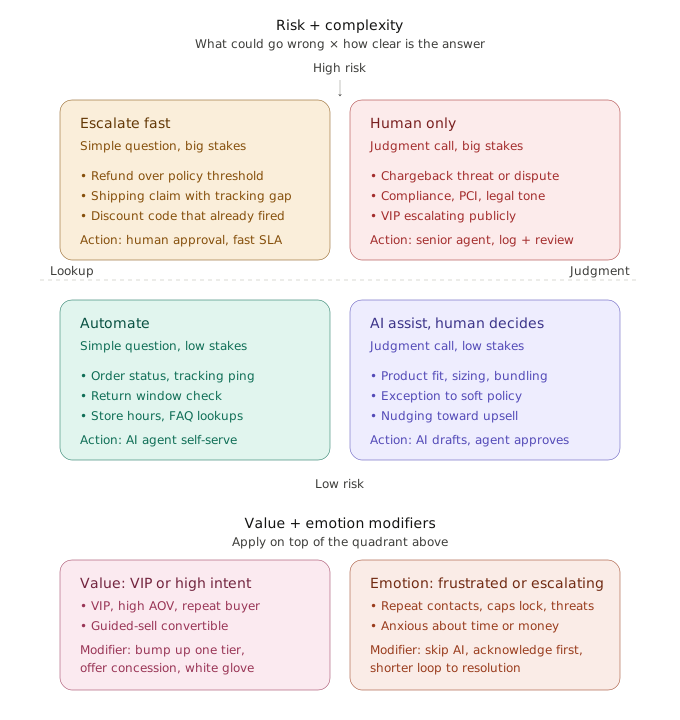
Instead of deciding by channel (email vs chat vs phone), decide by request type. A simple decision framework uses four signals:
complexity: is the solution a straightforward lookup or a judgment call
risk: could a mistake create refunds, compliance issues, or chargeback risk
value: is this customer VIP, high AOV, or likely to convert if guided well
emotion: is the customer frustrated, anxious, or escalating
If the answer is consistent and low risk, it belongs in automation. If it requires nuance, exception handling, negotiation, or empathy, it belongs with humans.
What to automate on Shopify
Shopify is automation friendly because common support questions map to Shopify objects such as orders, fulfillments, and tracking. Shopify’s admin API documentation explains how orders can be retrieved and how fulfillment tracking information is represented, which is why WISMO and shipping updates are so automatable when the integration is correct.
Order status and shipping updates (WISMO) : Automate WISMO by collecting an order identifier and returning live fulfillment and tracking updates in seconds.
Returns and exchanges information : Automate returns guidance by confirming eligibility and explaining the exact steps, then escalate exceptions or emotional cases to a human.
Store policies and FAQs : Automate policy and FAQ answers from a maintained knowledge source so customers get consistent, instant information.
Simple checkout and product questions : Automate basic checkout and product questions with a short guided flow, and route high AOV or complex decisions to a human closer.
Routing and qualification : Automate first line routing by intent and value signals (support vs sales, VIP vs standard) so the right team gets the right call fast.
What to keep human, even in a highly automated setup
Automation breaks down where humans shine: judgment, empathy, persuasion, and exception handling.
Refunds, disputes, and chargeback risk : These cases can impact revenue directly and often require nuance. Automation can collect details, but a trained agent should own outcomes and goodwill decisions.
Emotionally charged complaints : When a customer is angry about a delay, a lost package, or a product issue, empathy and de escalation matter. A hybrid model should trigger escalation quickly when frustration is detected.
High stakes sales and consultative questions : If the product is high consideration or technical, a real conversation can overcome objections and increase conversion. This aligns with Forrester’s finding that lack of quick answers can drive abandonment.
VIP and high value customers : These customers expect white glove handling. Use automation as a front door, but route quickly to a person when value signals are present.
What Consio is and how it fits in this model
Consio is an AI native phone platform built for Shopify e-commerce. It combines three layers in one system:
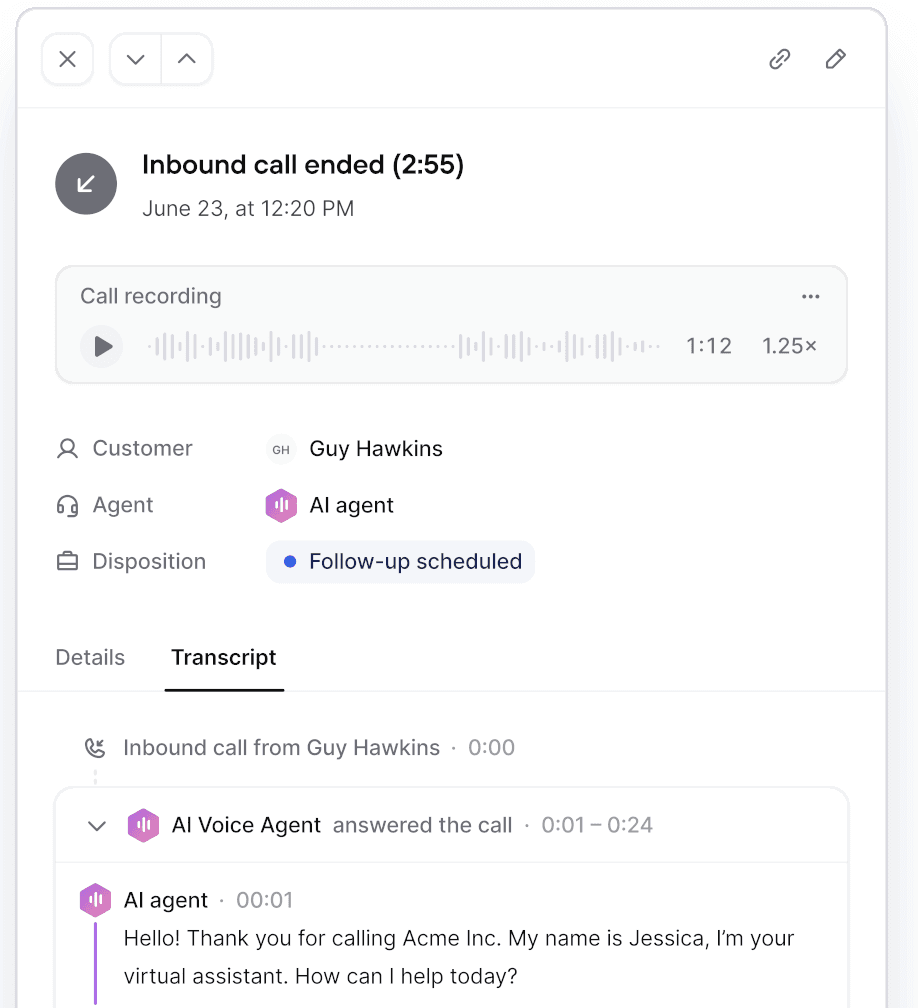
Inbound AI voice agent answers calls 24/7, understands intent, routes only the calls that need a human, and can send SMS during live conversations when needed
Outbound power dialer for segmented campaigns like abandoned checkout, VIP follow up, post-purchase follow-up, win-back campaigns, and high-value customer outreach
A phone hub with Shopify ROI tracking, so teams can see outcomes and attribution.
Shopify customer service outsourcing pricing
1. Consio
Consio is an AI-native phone sales and support platform built for Shopify brands. It combines 24/7 AI inbound answering with human agents, outbound campaign dialing, and Shopify-native attribution so teams can manage support and revenue conversations in one place.
Key features of Consio include:
• 24/7 inbound AI voice agent that answers calls instantly and resolves commerce questions (order status, shipping, returns, FAQs) and sends SMS messages in real time during calls
• Human agents available for escalations such as complex support, refunds, VIP customers...
• Two-way SMS/MMS from the same timeline to send links, order tracking, or payment pages
• AI call transcripts, summaries and recording so teams can review conversations and improve workflows
• Shopify-native revenue attribution connecting calls directly to orders and customer profiles
Pricing
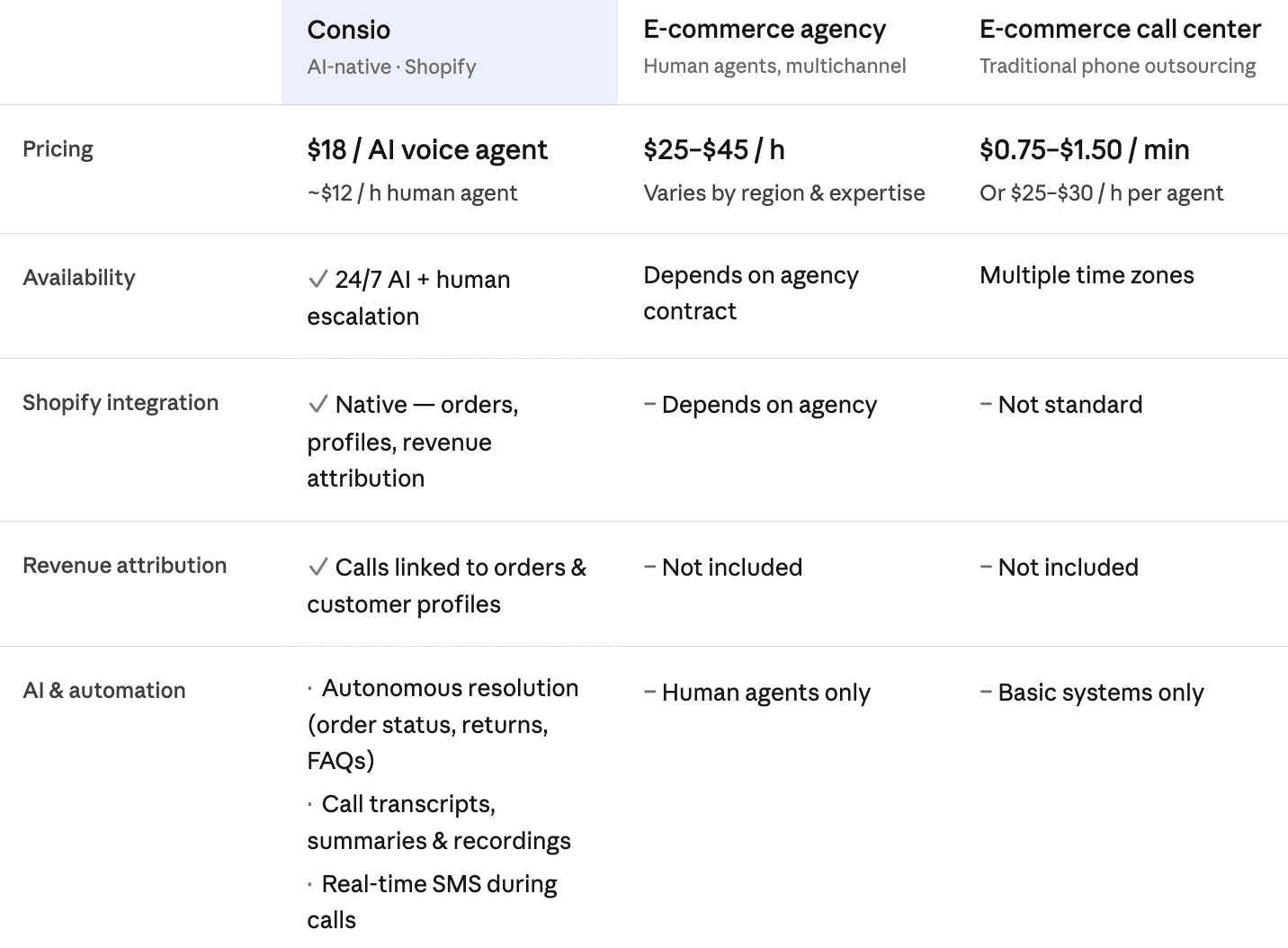
• AI voice agent: ~$0.30 per AI-handled minute
• Human agents: ~$12 per hour
2. E-commerce support agency
An e-commerce support agency provides trained human agents who manage customer service across channels such as email, chat, and phone.
Key features of e-commerce support agencies include:
• Dedicated human support agents handling tickets, calls, and chats
• Multichannel coverage across phone, email, live chat, and social media
• Quality assurance and support management provided by the agency
• Flexible scaling during peak periods or seasonal traffic
Pricing
• $25–$45 per hour per agent depending on region and expertise
• Some agencies offer monthly dedicated teams or shared agent pools
3. E-commerce call center
An e-commerce call center is a traditional outsourcing model where an external provider manages phone support for the brand. These centers focus primarily on inbound calls and large support volumes.
Key features of e-commerce call centers include:
• Inbound phone support teams handling customer service calls
• Large agent pools capable of handling high call volume
• Basic ticket and call management systems
• Support coverage across multiple time zones
Pricing
• $0.75–$1.50 per call minute depending on region and complexity
• Some providers charge $25–$30 per hour per agent
Pricing summary in a single image
Curious about the ROI for your Shopify brand?
Use the ROI calculator to estimate how much revenue you can generate from phone campaigns and how much support cost you can save with AI + human agents.
Why Shopify brands choose Consio over traditional outsourcing
Compared to traditional e-commerce customer service outsourcing, Consio introduces a hybrid phone model that combines automation with human expertise.
Key advantages include:
24/7 phone coverage without missed calls : Consio’s AI voice agent answers instantly at any time, so Shopify brands never miss high-intent customer calls or after-hours sales opportunities.
Automate repetitive commerce requests : Order status, shipping updates, returns policies, and FAQs can be handled automatically, reducing the amount of human support time required.
Humans focus on high-value conversations : Instead of answering repetitive questions, human agents can focus on complex support, refunds, VIP customers, and pre-purchase sales conversations.
Phone becomes a revenue channel, not just support : With outbound campaigns and power dialing, brands can call abandoned carts, follow up with VIP customers, and convert high-intent buyers.
Clear attribution and Shopify context : Consio connects calls to Shopify data and tracks outcomes, so teams can see which calls drive revenue instead of treating phone support as a black box.
Lower support costs with hybrid automation : By letting AI handle repetitive calls, Consio significantly reduces the cost per support interaction compared to traditional outsourcing models.
What about returns and warranty claims
Phone automation can tell a customer how to start a return. But processing the actual claim, collecting defect photos, validating warranty coverage, routing to the right resolution, recovering costs from suppliers, requires a dedicated workflow layer. That's where Claimlane fits in.
Claimlane is a warranty and returns management platform that handles the operational side of after-sales for Shopify brands and retailers. While Consio manages the phone conversation, Claimlane manages what happens after the call.
How it works in a hybrid support model:
A customer calls about a defective product. Consio's AI voice agent identifies the intent and provides the link to Claimlane's self-service portal, where the customer submits photos, serial numbers, and order details.
Claimlane's AI Agent, the first AI agent purpose-built for warranty claims and returns, analyzes the product images, checks warranty rules per product and supplier, and recommends or auto-approves the resolution. No human review needed for straightforward cases.
For complex claims, Claimlane's automated workflows route the case to the right team with full context, so the human agent picks up where automation left off instead of starting from scratch.
Defective products are automatically forwarded to the correct supplier through Claimlane's supplier forwarding, packaging the claim with complete documentation for cost recovery.
Analytics track every claim by product, defect type, and supplier, turning returns data into product quality intelligence.
The winning model
If you want Shopify customer service outsourcing that lowers costs without sacrificing brand experience, the winning approach is structured hybrid. Automate predictable, data driven commerce requests like order status and delivery updates, and keep humans focused on high stakes moments like disputes, emotional complaints, VIP customers, and consultative sales conversations.
If you want to see what a hybrid phone setup looks like for your Shopify brand, book a Consio demo here.
FAQs
What is Shopify customer service outsourcing?
Shopify customer service outsourcing is the practice of delegating customer support tasks such as phone, chat, or email support to external teams or automated systems.
What is an AI Voice Agent for Shopify?
An AI Voice Agent for Shopify is a 24/7 phone assistant that answers calls with a natural voice, handles FAQs and order questions, and routes high-intent calls to your team with context.
What support tasks can be automated on Shopify?
AI can automate repetitive inquiries such as order tracking and FAQs. Human agents are still needed for complex issues and sensitive situations. AI works best as a support assistant, not a replacement.
Is AI replacing e-commerce customer support agents?
No. Most Shopify brands use a hybrid model where AI handles repetitive questions and human agents handle complex support and sales conversations.

Head of Partnerships