RingCentral alternatives for Shopify brands in 2026
Compare the best RingCentral alternatives for Shopify brands in 2026, including pricing, features, and an AI phone option built for ecommerce.
RingCentral is one of the most recognized business phone systems on the market, but recognized does not always mean right for an ecommerce store. If you run a Shopify brand, most of your inbound calls are about three things: where is my order, can I return this, and is this item in stock. RingCentral was built for general office telephony, not for tying a phone call back to a Shopify order, a tracking number, or a draft cart.
This guide breaks down the strongest RingCentral alternatives for Shopify and ecommerce brands in 2026, what each one costs, and where each one fits. We will be specific about pricing, the gaps that frustrate ecommerce teams, and how to match a phone system to the way customers actually call your store.
Why Shopify brands look for a RingCentral alternative
RingCentral does the core job of a cloud phone system well: extensions, call queues, an auto-attendant, voicemail-to-text, and video meetings. The friction shows up when an ecommerce team tries to scale support and outreach without growing headcount.
The most common reasons Shopify brands start shopping around:
Cost climbs fast with add-ons. RingCentral's published plans for 2026 run roughly $20 per user per month on Core, $25 on Advanced, and $35 on Ultra when billed annually, and about $30, $35, and $45 respectively when billed monthly. The base price is only part of the story. Toll-free minutes, advanced CRM integrations, and the AI Receptionist (commonly $39 to $69 per month) are add-ons that stack on top. For a small support team, the real monthly cost is often well above the headline number.
Per-seat pricing punishes growth. Every new agent is another seat. During a product launch or a holiday spike, you either overstaff and overpay or understaff and miss calls. Ecommerce volume is seasonal, and per-seat licensing does not flex with it.
SMS is limited where ecommerce needs it most. RingCentral's Core plan caps SMS at 25 messages per user per month. For a brand that wants to text a tracking link or a discount code after every call, that ceiling is hit almost immediately.
Contracts and porting create lock-in. RingCentral agreements typically auto-renew with a one to three year minimum commitment, and customers frequently report slow number porting when they try to leave.
No native Shopify context. This is the big one. RingCentral does not know your customer's last order, their shipment status, or their lifetime value when the phone rings. Your agent still has to alt-tab into the Shopify admin, search the order, and read it back. The phone system and the store stay disconnected.
For a Shopify brand, the right question is not only "what is a cheaper RingCentral," it is "what phone system actually understands my store."
The best RingCentral alternatives for Shopify brands
Below are seven alternatives worth evaluating in 2026, grouped by who they fit best. Pricing is the publicly listed starting price and can change, so confirm current rates before you commit.
1. Consio (best for Shopify and ecommerce brands)
Consio is an AI phone platform built for Shopify and ecommerce brands. Its 24/7 AI Voice Agent handles inbound calls with Shopify order and product context, answers common questions, sends SMS links, and can create draft orders during the call.
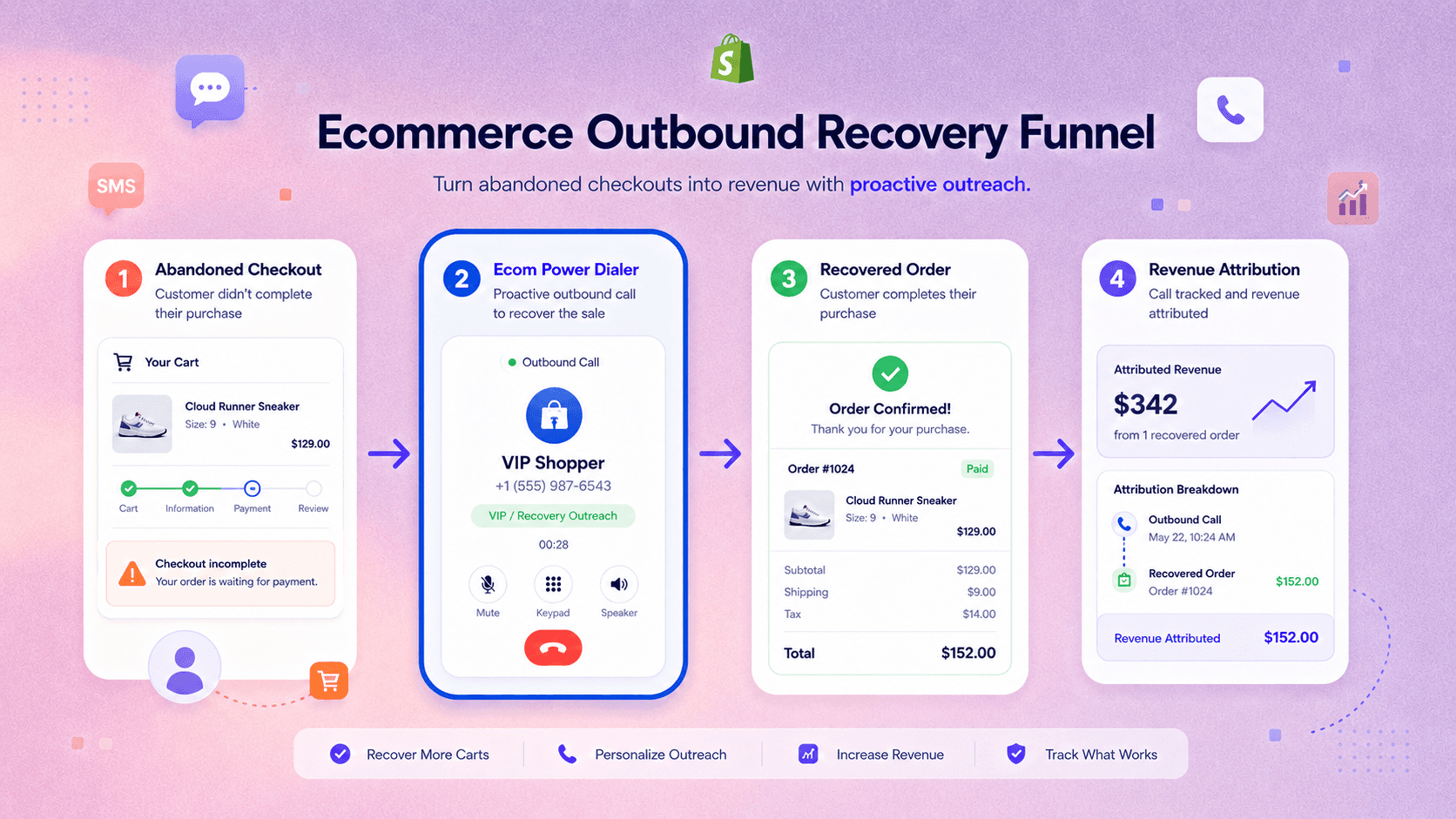
On the outbound side, the Ecom Power Dialer helps recover abandoned checkouts, follow up with VIPs, and run win-back campaigns, with revenue attribution tied back to Shopify orders.
Best for: Shopify brands that want order-aware support and outbound revenue from the same platform.
2. Nextiva (best for traditional support teams that want strong service)
Nextiva is a well-regarded RingCentral competitor with a reputation for customer support and reliability. Plans start around $18.95 to $20 per user per month. It covers the core VoIP feature set well and adds solid analytics.
Best for: Brands that want a conventional human-staffed phone system with dependable support.
3. Zoom Phone (best for low per-user cost)
Zoom Phone is among the cheapest credible options, with metered plans starting near $10 per user per month and an unlimited US and Canada plan slightly higher. If your team already lives in Zoom, the familiarity helps.
Best for: Cost-sensitive teams that need basic, reliable telephony.
4. Aircall (best for integration-heavy support and sales stacks)
Aircall is a cloud call center popular with sales and support teams, with pricing that generally starts around $30 per user per month and a multi-seat minimum. It has a large app marketplace and a Shopify integration that surfaces customer context in the sidebar.
Best for: Teams that want a polished call center with many integrations and do not mind per-seat pricing.
5. Dialpad (best for built-in AI call features)
Dialpad leans on AI for live transcription, sentiment, and call summaries, with plans typically starting around $15 to $27 per user per month. The AI features are useful, though the platform is general-purpose rather than ecommerce-specific.
Best for: Teams that want AI assistance layered onto a standard business phone system.
6. Quo (best for lean teams and shared numbers)
OpenPhone (now operating as Quo) is built for small, modern teams, starting around $19 per user per month. Shared numbers, a clean app, and simple texting make it easy to run. It is light on deep ecommerce automation.
Best for: Small DTC teams that mainly need a shared, easy phone and text line.
7. Grasshopper (best for solo founders and very small stores)
Grasshopper offers flat-rate plans (roughly $14 to $55 per month) rather than per-seat pricing, routing calls to existing phones. It is a virtual phone number rather than a full platform.
Best for: Solo founders who just need a professional business line.
Comparison table
Provider | Starting price | Pricing model | Built for ecommerce? | Native Shopify context | AI voice agent | Best for |
|---|---|---|---|---|---|---|
Consio | $30 / 100 min | Usage-based (per minute) | Yes | Yes, order and product aware | Yes, 24/7 | Shopify brands |
RingCentral | $20 / user / mo (annual) | Per seat | No | No | Add-on (extra cost) | General office telephony |
Nextiva | ~$18.95 / user / mo | Per seat | No | No | Add-on | Human support teams |
Zoom Phone | ~$10 / user / mo | Per seat | No | No | Limited | Low per-user cost |
Aircall | ~$30 / user / mo | Per seat (multi-seat min) | Partial (integration) | Sidebar via integration | Add-on | Integration-heavy support and sales |
Dialpad | ~$15-27 / user / mo | Per seat | No | No | Built-in AI features | Teams wanting AI on standard telephony |
OpenPhone / Quo | ~$19 / user / mo | Per seat | No | No | Limited | Lean DTC teams |
Grasshopper | ~$14-55 / mo flat | Flat rate | No | No | No | Solo founders |
Prices reflect publicly listed starting rates in 2026 and may change. Add-ons can raise the effective cost on per-seat platforms.
How to choose the right phone system for your Shopify store
The best choice depends less on feature checklists and more on how your customers actually call. Work through these questions in order.
Start with your call mix
Pull a month of call logs. If the majority of your inbound calls are order status, returns, and product or stock questions, you are running a repetitive, high-volume support line. That is exactly the workload an order-aware AI voice agent removes, because the answers live in Shopify. If your calls are mostly complex, one-off conversations, a human-staffed system like Nextiva may be enough.
Decide between per-seat and usage-based pricing
Per-seat pricing makes sense when call volume is steady and you can predict headcount. It works against you when volume is seasonal, because you pay for seats during the quiet months and scramble for coverage during launches and holidays. Usage-based pricing, like Consio's per-minute model, flexes with demand: you pay for the minutes you use, not the chairs you fill.
Check whether it knows your store
This is the single biggest differentiator for ecommerce. A generic phone system treats every caller as a stranger. A Shopify-native platform recognizes the order, the tracking status, and the customer history before anyone speaks. Ask any vendor directly: when a customer calls, does the system already have their Shopify order, or does my agent have to look it up?
Confirm the SMS and follow-up story
Ecommerce support is rarely finished on the call. Customers want a tracking link, a return label, or a discount code texted to them. Check the per-message limits and whether texting is automatic after a call. RingCentral's 25-message Core cap is a real constraint here.
Look past inbound to revenue
Support is a cost center until you connect it to sales. The strongest setups also run outbound: abandoned checkout recovery, VIP outreach, and win-back. Consio's Ecom Power Dialer and Shopify revenue attribution let you measure calls in orders recovered, not just minutes logged. That turns the phone line into a revenue channel.
Read the contract terms
Watch for multi-year auto-renewing commitments and number-porting friction, both common complaints when leaving RingCentral. Prefer options that let you start free or month to month so you can prove value before locking in.
Where Consio fits
If you run a Shopify store, the honest answer is that most RingCentral alternatives are still general-purpose phone systems with ecommerce bolted on through an integration. Consio is the opposite: it starts from your store. The 24/7 AI Voice Agent handles inbound calls, understands Shopify order and product context, answers customer questions, sends SMS links, and can create draft orders during the call, while the Ecom Power Dialer drives outbound campaigns and revenue attribution ties it all back to orders.
For a brand drowning in "where is my order" calls or paying per seat for coverage it only needs at peak season, that is a different economic model and a different customer experience.
Case study: Houndsy turns late-stage hesitation into $72K
Houndsy, a premium Shopify dog brand built around its design-led kibble dispenser, already had strong retention through email and SMS. What it was missing was a faster, higher-trust way to reach high-intent shoppers who stalled at checkout with last-minute questions.
Using Consio's Ecom Power Dialer across abandoned-checkout, abandoned-cart, win-back, and post-delivery campaigns, Houndsy added a real-time voice layer on top of its existing lifecycle channels. Over two months (February–March 2026):
$72,185 in attributed revenue
6,351 outbound calls, 1,177 connected
266 attributed sales
12.4% conversion rate on connected calls
“Consio has become one of our highest performing revenue channels, full stop. If you're running a Shopify store and phone isn't part of your revenue strategy yet, Consio is the reason to change that.”
— Pavan Bapu, CEO, HOUNDSY
See how Consio helps Shopify brands turn calls into revenue. Book a demo.
FAQs
What is the best RingCentral alternative for Shopify brands?
For Shopify and ecommerce brands specifically, Consio is the strongest fit because it is an AI phone platform built around your store. Its 24/7 AI Voice Agent understands Shopify order and product context, so order status, returns, and stock questions get answered instantly without an agent looking anything up. For traditional human-staffed telephony, Nextiva and Aircall are solid general alternatives.
Can an AI voice agent actually handle ecommerce support calls?
Yes, for the high-volume, repetitive calls that make up most ecommerce support. Order status, tracking, returns, and product or stock questions all have answers that live in Shopify, so an order-aware AI voice agent can resolve them directly and text a follow-up link. Brands using AI for 24/7 inbound coverage commonly see it handle a large share of calls, freeing human agents for complex cases.
Does RingCentral integrate directly with Shopify orders?
Not natively in the way an ecommerce brand needs. RingCentral is a general business phone system and does not surface a caller's Shopify order, tracking status, or customer history automatically when the phone rings. A Shopify-native platform like Consio has that order and product context built in, so the agent does not have to search the admin mid-call.

Growth Marketing