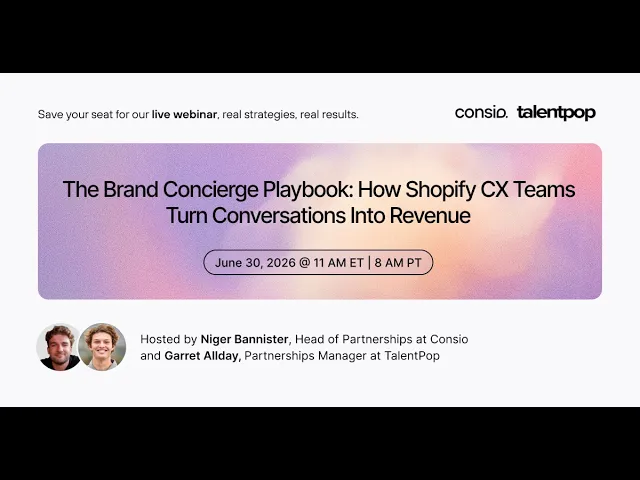
Shopify customer service: Turn CX into revenue in 2026
Learn how Shopify brands use proactive calls, live chat, AI agents, and customer segmentation to recover checkouts, reduce churn, and grow revenue.

Most Shopify customer service teams are measured on ticket volume, first response time, resolution time, and customer satisfaction.
Those metrics matter. But they only measure part of the value created by customer experience teams.
Every day, support agents speak with shoppers who are close to purchasing, customers considering canceling a subscription, VIP buyers looking for advice, and checkout abandoners with one unanswered question.
Handled correctly, these conversations do more than resolve tickets. They recover sales, improve retention, increase customer confidence, and create insights that can improve the entire business.
In a recent Consio and TalentPop webinar, Nigel Bannister and Garrett Allday explained how ecommerce brands are building a new type of customer experience function: the brand concierge.
A brand concierge combines proactive customer service, product guidance, live conversations, and revenue-focused customer outreach. The objective is not to turn support agents into aggressive sales representatives. It is to help customers make better and more confident buying decisions.
What is revenue-generating Shopify customer service?
Revenue-generating customer service uses customer data and real-time buying signals to identify shoppers who would benefit from personalized assistance.
Instead of waiting for customers to submit a ticket, brands proactively reach out at high-intent moments, including:
An abandoned checkout
A high-value cart
A first subscription order
A canceled subscription
A repeat or VIP purchase
A complex pre-purchase question
A post-purchase issue that could affect retention
The interaction might happen through a phone call, live chat, voicemail, SMS, or a combination of several channels.
The important difference is context.
A generic message says:
You left something in your cart. Complete your purchase and receive 10% off.
A brand concierge conversation says:
I noticed you were looking at this particular product. Do you have any questions about sizing, compatibility, shipping, or whether it is right for you?
The second approach does not immediately assume that price is the problem. It gives the shopper an opportunity to explain the real reason they have not completed the purchase.
Why traditional abandoned checkout flows are not enough
Shopify already enables merchants to automatically send recovery emails containing a link to an incomplete checkout. Shopify also provides reporting on the sessions, orders, sales, conversion rates, and average order value generated by those emails.
These automations are useful, but they cannot resolve every buying hesitation.
An email cannot always answer questions such as:
Will the order arrive before a specific date?
Which size should I choose?
Is this component compatible with my existing product?
What is the difference between two similar models?
Can I customize or modify the order?
What happens if the product does not work for me?
Which product is most appropriate for my needs?
These questions are specific to the shopper. They cannot always be addressed through a generic discount, FAQ page, or abandoned checkout email.
That is where direct conversations become valuable.
1. Automate repetitive support before adding outbound outreach
A customer service team cannot become proactive if agents spend their entire day answering repetitive questions.
Before launching a revenue-focused CX program, identify which inquiries can be handled through self-service or AI.
Common examples include:
Where is my order?
Can you send my tracking link?
What is your return policy?
How long does shipping take?
How do I begin a return?
What are the product dimensions?
Is this item currently available?
AI voice agents and automated support systems can answer many of these questions, send links by SMS, collect customer information, and escalate more complex issues to a human.
This does not eliminate the human team. It gives agents more time for conversations requiring judgment, empathy, persuasion, or detailed product knowledge.
During the webinar, TalentPop suggested that many teams can begin by automating roughly 30% to 40% of repetitive support activity, freeing agents to focus on more sophisticated conversations such as retention, product guidance, cross-selling, and checkout recovery.
2. Prioritize customers using intent signals
Not every shopper needs a phone call.
Successful programs use customer behavior to determine where a human conversation is most likely to create value.
Shopify customer segments are dynamic, rule-based lists. Customers can automatically enter or leave a segment when they meet specific criteria, allowing brands to communicate with the right shoppers at the right moment.
High-value segments can include:
Abandoned checkouts: These shoppers progressed far enough to begin checking out but did not complete payment. They may have a question about shipping, price, product fit, payment, returns, or delivery timing.
High-AOV carts: The more expensive or complex the purchase, the more reassurance a customer may need before committing. Furniture, jewelry, wellness devices, technical products, mattresses, appliances, and customized products are especially well suited to guided conversations.
VIP and repeat customers: Top customers can receive personalized product recommendations, early access, restock alerts, or proactive assistance. This recreates the clienteling experience traditionally offered by luxury and specialty retail stores.
First-time subscribers: A post-purchase welcome call can help new subscribers understand how to use the product, what to expect, and when they should begin seeing value.
Customers at risk of canceling: Instead of treating a cancellation as final, a brand concierge can ask why the customer is leaving and determine whether the issue can be resolved.
Trade or B2B prospects: Customers who purchase repeatedly, request large quantities, or browse commercial products may be suitable for a wholesale or trade program.
Consio turns Shopify and Klaviyo segments into dynamic calling campaigns. Agents open the dialer, see the relevant customer context and campaign script, and begin the next appropriate conversation without manually building call lists.
3. Resolve the objection before offering a discount
Discounts can help recover a purchase, but they should not be the default response to every abandoned checkout.
Some shoppers do not need a lower price. They need clarity.
They may be uncertain about:
Product suitability
Sizing
Shipping deadlines
Installation
Compatibility
Authenticity
Warranty coverage
Return conditions
Product differences
Customization
Offering a discount without identifying the real concern can unnecessarily reduce margin while leaving the underlying objection unresolved.
A better conversation starts with questions:
Was there anything specific that stopped you from completing the order?
Are you deciding between two products?
Do you need the order to arrive before a particular date?
Is there any product information I can help clarify?
In the webinar, Consio shared that some brands see conversion rates approaching 20% on connected abandoned-checkout calls. The speakers emphasized that these results are primarily driven by resolving individual hesitations, not simply distributing discounts. These results should be treated as examples rather than a universal ecommerce benchmark.
4. Use a multichannel outreach sequence
Customers do not always answer the first call.
That does not mean the campaign has failed.
An effective outreach sequence might include:
An initial phone call
A prerecorded voicemail if the customer does not answer
A personalized peer-to-peer SMS
A scheduled second call
An inbound reply from the customer when convenient
The objective is not necessarily to connect on the first attempt. It is to make assistance available and allow interested shoppers to continue the conversation through their preferred channel.
A customer may ignore the call but read the voicemail and respond by SMS. Another may call the agent back several hours later.
Consio and TalentPop explained that this combination of phone calls, voicemail, SMS, and follow-up attempts makes proactive customer service scalable across brands with different average order values and customer volumes.
5. Give agents context before every conversation
A proactive call feels intrusive when the agent has no context.
It feels helpful when the agent already understands why the conversation may be relevant.
Before contacting a shopper, the agent should be able to see:
The product or products considered
Cart or checkout value
Previous orders
Customer status
Subscription status
Recent interactions
The campaign that triggered the call
Relevant product and policy information
This allows agents to begin with a specific reason for reaching out rather than asking the customer to repeat information the brand already possesses.
Compare these two openings:
Hi, I am calling from the company. Were you trying to place an order?
And:
Hi, I noticed you were looking at our portable sauna earlier today. I wanted to check whether you had any questions about setup, dimensions, or delivery before ordering.
The second conversation immediately demonstrates relevance and preparation.
6. Create playbooks instead of rigid sales scripts
Agents need structure, but they should not sound as though they are reading from a script.
A strong playbook should include:
The objective of the campaign
A suggested opening
Questions to identify the customer’s hesitation
Common objections
Approved product recommendations
Discount rules
Escalation procedures
Compliance guidelines
A clear next step
Conversation outcomes and disposition labels
Different campaigns require different playbooks.
An abandoned-checkout conversation should not use the same language as a VIP outreach campaign. A subscription cancellation call should not sound like a product recommendation conversation.
TalentPop emphasized that training is one of the biggest differences between successful and unsuccessful programs. Brands that expect agents to “figure it out” without product training, clear positioning, or conversation guidance are more likely to create inconsistent customer experiences.
7. Protect the customer experience with operational guardrails
Proactive customer service must be carefully controlled.
Agents should never call a customer who has already completed the purchase, opted out, or lives in a time zone where calling would be inappropriate.
Useful guardrails include:
Dynamic campaign membership
Automatic removal after purchase
Time-zone-based calling hours
Opt-out and block lists
Maximum call attempts
Campaign-specific scripts
Clear escalation rules
Restricted discount permissions
Call recording and quality reviews
Approved compliance language
In Consio, campaigns can be connected to dynamic Shopify segments. When a customer completes the purchase and no longer meets the campaign conditions, they leave the segment and should no longer be contacted about that abandoned checkout.
The webinar also covered safeguards based on customer time zones, phone area codes, opt-outs, and campaign-specific scripts.
8. Support agents with an AI product copilot
Product knowledge becomes difficult to manage when a store has hundreds or thousands of SKUs.
A customer may ask an agent to compare two products, identify a compatible accessory, explain a material, or recommend the most appropriate item for a particular use case.
Agents cannot memorize every product page.
An AI copilot can search the brand’s approved knowledge, including:
Product descriptions
Product specifications
Help center articles
Shipping information
Return policies
Warranty conditions
Usage instructions
Approved product claims
The agent can enter the customer’s question and receive a suggested answer while still on the call.
This improves response confidence without allowing the AI to operate without human supervision.
For regulated categories such as supplements, wellness, or health products, brands should also establish strict guardrails preventing unsupported medical claims. The webinar specifically highlighted the importance of combining product knowledge with approved claim limitations.
9. Measure revenue and customer value together
A revenue-focused CX program should not be evaluated only by the number of calls made.
Track both commercial performance and customer experience.
Important metrics include:
Contact rate: The percentage of customers who answer the call or respond to the outreach.
Connected-call conversion rate: The percentage of completed conversations followed by a purchase within the attribution window.
Revenue per conversation: The total attributed revenue divided by the number of connected customer conversations.
Revenue per agent hour: The revenue attributed to the campaign compared with the amount of time agents spend on outreach.
Average order value: The average value of purchases generated after customer conversations.
Retention or save rate: The percentage of customers who remain subscribed or continue purchasing after an agent’s intervention.
Customer satisfaction: Feedback should confirm that customers find the conversations helpful, relevant, and supportive rather than intrusive.
Opt-out and complaint rate: An increase in opt-outs or complaints may indicate poor targeting, excessive contact frequency, or overly aggressive messaging.
Conversation insights: Call summaries can reveal recurring product questions, shipping concerns, pricing objections, competitor mentions, and weaknesses in the website experience.
Consio also allows brands to export calls and summaries to identify which competitors customers selected and why they abandoned the original purchase. These conversations create a form of customer research that is difficult to collect through standard ecommerce analytics alone.
Three Shopify customer service campaigns to launch first
Brands do not need to launch every possible workflow at once.
Begin with three clearly defined campaigns.
Campaign 1: Abandoned checkout recovery

Audience: High-intent shoppers with incomplete checkouts.
Objective: Identify and resolve the concern preventing purchase.
Channels: Phone, voicemail, and personalized SMS.
Primary metrics: Connected-call conversion, recovered revenue, revenue per agent hour, and opt-out rate.
Campaign 2: VIP clienteling

Audience: Repeat customers and high-lifetime-value shoppers.
Objective: Strengthen the relationship and provide personalized product guidance.
Channels: Phone and SMS.
Primary metrics: Repeat purchase rate, average order value, campaign revenue, and customer satisfaction.
Campaign 3: Subscription retention

Audience: First-time subscribers, skipped subscriptions, and customers beginning a cancellation.
Objective: Improve onboarding, understand churn reasons, and retain customers when an issue can be resolved.
Channels: Phone, SMS, and live chat.
Primary metrics: Save rate, subscription retention, recurring revenue, and cancellation reasons.
A 30-day implementation plan
Week 1: Select the opportunity
Choose one customer segment with clear intent and measurable commercial value.
Review:
Segment size
Average order value
Existing conversion rate
Common customer questions
Current email and SMS automations
Contribution margin
Available agent capacity
Week 2: Build the playbook
Create the campaign script, objection guide, offer rules, escalation procedure, and outcome labels.
Train agents using real examples rather than hypothetical situations.
Week 3: Launch a controlled pilot
Start with a limited customer group.
Review calls daily to identify:
Weak openings
Missing product knowledge
Common objections
Poor targeting
Unnecessary discounts
Compliance risks
Week 4: Measure and improve
Compare revenue and customer experience against the original baseline.
Do not optimize only for total sales. Evaluate whether the campaign creates profitable incremental revenue without increasing complaints or harming the brand.
Human agents and AI should handle different work
The future of Shopify customer service is not entirely human or entirely automated.
AI is best suited to repetitive, predictable, and high-volume interactions.
Human agents are best suited to:
Complex buying decisions
Emotional situations
Product recommendations
High-value purchases
Retention conversations
Negotiation
Exceptions
Relationship building
The most effective model uses AI to make human conversations more available, informed, and valuable.
During the webinar, TalentPop shared an example in which proactive live-chat conversion increased from approximately 11% to 23% over a six-month period as the agents, processes, and conversations improved. It illustrates why these programs should be treated as an operational capability that becomes stronger over time, not as a one-week campaign.
Customer service should create confidence, not pressure
Turning customer service into revenue does not mean adding a sales quota to every support interaction.
It means recognizing that many customers contact a brand because something is preventing them from making or keeping a purchase.
The role of the customer service team is to remove that friction.
When brands combine accurate customer segmentation, proactive conversations, trained agents, AI automation, product knowledge, operational guardrails, and revenue attribution, customer experience becomes much more than a cost center.
It becomes one of the most valuable parts of the ecommerce customer journey.
FAQs
How can Shopify customer service increase revenue?
Shopify customer service can increase revenue by proactively helping high-intent shoppers, recovering abandoned checkouts, recommending suitable products, retaining subscribers, supporting VIP customers, and resolving pre-purchase concerns.
What is a brand concierge in ecommerce?
A brand concierge is a customer experience agent focused on personalized product guidance, proactive support, retention, and conversion. The role recreates the assistance customers receive from a knowledgeable associate in a physical retail store.
Should Shopify brands call abandoned checkouts?
Calls can work well for high-value, complex, or high-consideration purchases. Brands should use consent-aware customer segments, appropriate calling hours, clear opt-out procedures, and limited contact attempts.
Are discounts necessary to recover abandoned checkouts?
Not always. Many customers abandon a purchase because of unanswered questions involving sizing, compatibility, delivery, returns, product suitability, or payment. Resolving the concern may recover the sale without reducing the price.
Can AI replace ecommerce customer service agents?
AI can automate repetitive requests and help agents find information, but human agents remain valuable for complex, emotional, high-value, and revenue-sensitive conversations.
How should a brand measure revenue from customer service?
Track attributed revenue, connected-call conversion, revenue per conversation, revenue per agent hour, average order value, retention, customer satisfaction, complaints, and opt-outs.
Which Shopify customers should receive proactive support?
Prioritize abandoned checkouts, high-value carts, VIP customers, first-time subscribers, churn-risk customers, repeat buyers, and shoppers considering complex products.

Head of Partnerships