How Shopify brands can build a brand concierge experience at scale
Build a brand concierge experience for Shopify with AI voice, SMS, and human agents that turn high-intent customer moments into revenue.

Most Shopify brands already have the tools to answer customers: email, live chat, helpdesk tickets, automated flows, and support macros.
But answering customers is not the same as guiding them.
A shopper asking about sizing may be close to buying. A customer checking delivery timing may need reassurance before completing checkout. A VIP buyer may expect more personal recommendations. A repeat customer may be ready to reorder but needs the right follow-up at the right time.
If every interaction is treated as a support ticket, these moments are easy to miss.
That is where ecommerce clienteling comes in.
Instead of treating every interaction as a support ticket, Shopify brands can use customer data, phone calls, SMS, AI, and trained agents to guide customers with more personal, timely help.
The goal is to create a brand concierge experience online: one where customers get the right answer, the right recommendation, or the right follow-up when it matters most.
In this guide, you’ll learn
What ecommerce clienteling means for Shopify brands
Why brand concierge experiences matter online
Which customer moments are best for clienteling
How AI and human agents can work together
How to measure clienteling performance
What is ecommerce clienteling?
Ecommerce clienteling is the practice of using customer data to create more personalized shopping and support experiences.
In physical retail, clienteling often means a store associate remembers a customer’s preferences, past purchases, sizing, and buying intent. In ecommerce, the same idea can be applied using Shopify data.
For example, a brand can use:
cart and checkout activity
order history
customer lifetime value
product preferences
subscription status
previous support interactions
SMS consent
VIP customer segments
abandoned cart segments
This context helps teams understand who the customer is, what they need, and what the next best action should be.
A first-time shopper with a high-value abandoned cart deserves a different follow-up than a customer asking for a tracking link. A VIP buyer deserves a different experience than someone browsing for the first time. Clienteling helps brands personalize the interaction based on the customer's intent.
Why Shopify brands need a brand concierge experience
Most ecommerce journeys still rely heavily on automated flows.
Email flows, SMS campaigns, chatbots, and helpdesk tickets all have a role. But they do not always solve the highest-intent moments.
A customer may ignore an abandoned cart email but answer a helpful call. A shopper may hesitate because they are unsure about sizing, ingredients, delivery, returns, or product fit. A repeat buyer may be ready to purchase again, but the timing needs to be right.
A brand concierge experience helps close that gap.
It gives customers a faster way to get answers, receive guidance, and complete their purchase. It also helps brands turn support and sales conversations into a more connected customer journey.
For Shopify brands, this is especially useful for:
high-AOV products
considered purchases
apparel and sizing questions
gifting products
The more questions a customer has before buying, the more valuable clienteling becomes.
Across Consio customer stories, this kind of voice-led concierge workflow has already delivered measurable revenue impact for Shopify brands.
Houndsy generated $72,185 in attributed revenue over 2 months, with 6,351 outbound calls, 1,177 connected calls, 266 attributed sales, and a 12.4% conversion rate on connected calls.
Cheech & Chong generated $97,909 in 15 days with 6,564 completed calls, a 33.32% connection rate, and a 33.47% conversion rate on connected calls.
AndorWillow generated $1.6M+ in attributed revenue across 30,052 completed calls, showing how high-intent phone outreach can become a major revenue channel for considered purchases.
This shows why clienteling is not just a customer experience idea. When it is connected to Shopify data, phone outreach, SMS follow-ups, and attribution, it becomes a measurable revenue motion.
Customers are more likely to convert when they get fast, contextual help at the moment of intent were 2.8x more likely to convert than visitors who did not, and spent 60% more per order on average. A proactive outreach can drive 3–5x higher engagement than reactive support.
Real-time, contextual guidance can directly influence purchase decisions. Ecommerce clienteling applies that same principle.
Key clienteling workflows for Shopify brands
The best clienteling programs start with specific workflows. Here are the most useful ones for ecommerce teams.
Abandoned cart concierge
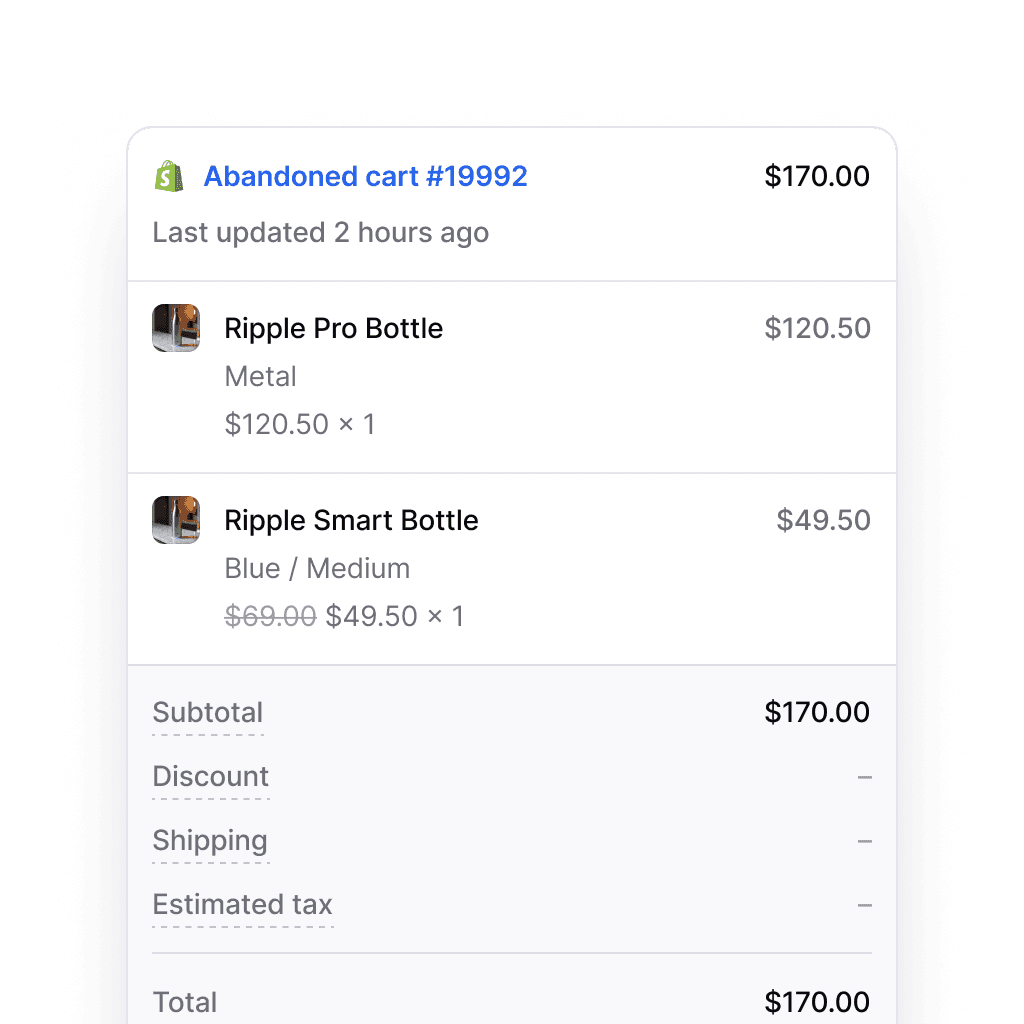
Abandoned carts are one of the clearest opportunities for ecommerce clienteling.
Instead of relying only on automated emails, brands can follow up with high-intent shoppers by phone or SMS. The goal is not to pressure the customer. It is to identify what is creating hesitation and answer the questions that stopped them from completing the purchase.
A concierge agent can help with:
product questions
sizing or fit
delivery timing
discount or payment questions
checkout issues
product recommendations
For Shopify brands with high-value carts, this can be one of the most direct ways to recover revenue.
Evolv converted 40%+ of abandoned checkout connected calls and generated $13,000 in phone sales in 30 days.
Michael Todd Beauty generated $20,627 in attributed revenue with a 27.68% conversion rate on connected calls.
This is especially important because timing matters in abandoned cart recovery. The faster a brand can answer a question, remove friction, or send the right checkout link, the more likely the customer is to complete the purchase.
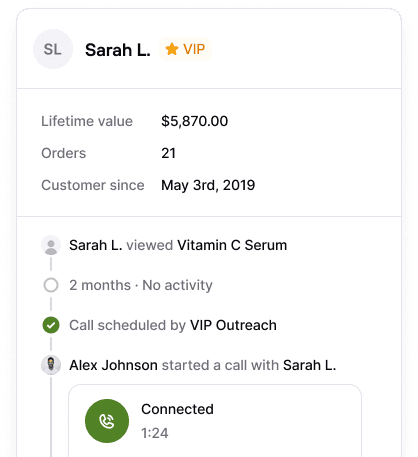
VIP customer outreach
VIP customers should not receive the same experience as every other shopper.
A clienteling workflow can help brands create more personal outreach for their best customers. This can include early access to new products, replenishment reminders, personalized recommendations, or follow-up after a major purchase.
The goal is to make top customers feel recognized without creating a manual process that is impossible to scale.
Clienteling is also valuable after the first purchase. Vitaly used Consio for lifecycle outreach across new purchase calls and 60-day winback campaigns, generating $53,996 in attributed revenue in 5 weeks from 6,088 scheduled calls.
For brands with strong repeat purchase potential, this turns phone into a retention channel, not just a support channel.
Post-purchase follow-up
The customer journey does not end after checkout.
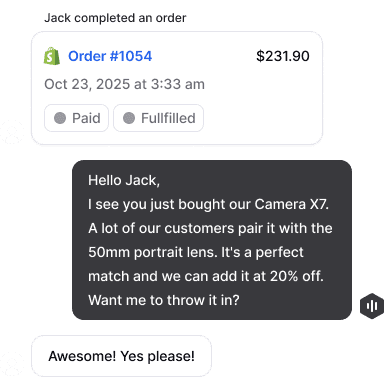
Post-purchase follow-up helps brands reduce confusion, improve satisfaction, and create a better path to the next order. This is especially useful when the product requires education, setup, sizing support, or usage guidance.
A simple follow-up can help answer questions before they become tickets.
Product education and guided shopping
Some customers do not need a discount. They need help making the right decision.
For products with multiple variants, use cases, bundles, or subscription options, guided shopping can improve the buying experience. A trained agent can help the customer compare products, choose the right option, and receive the right checkout link by SMS.
This turns support into a more helpful sales experience.
How AI supports ecommerce clienteling
AI can help Shopify brands scale clienteling without making every interaction manual.
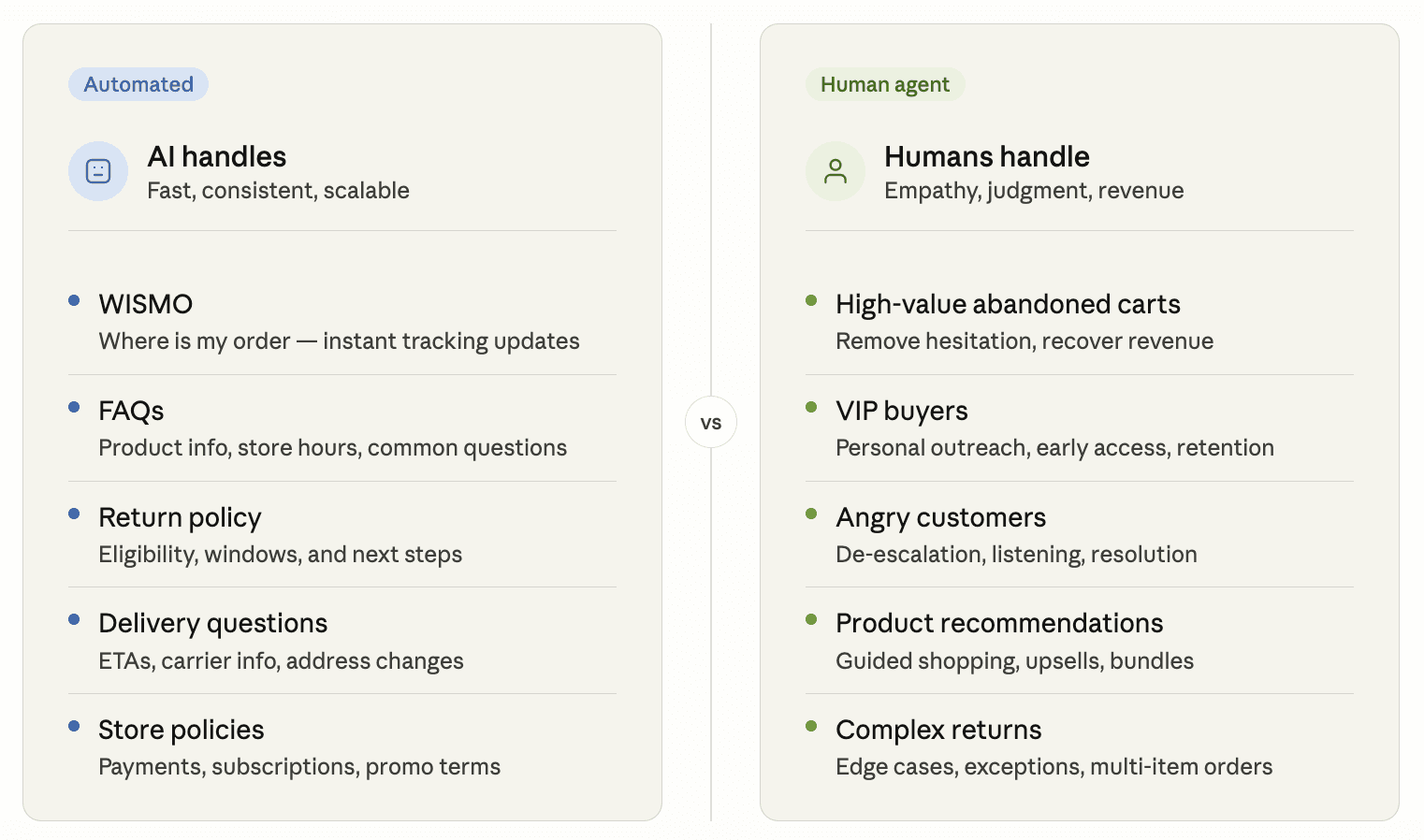
For simple and repetitive requests, the AI voice agent can handle the first layer of the conversation. This includes order status, FAQs, return policy questions, delivery questions, store policies...
AI can also help human agents by giving them better context before they speak to the customer.
For example, an AI phone system can identify the caller, summarize the reason for the call, surface Shopify order history, and route the conversation to the right person when needed.
This makes the handoff faster and more useful.
The key is to use AI where it improves speed and consistency, not where a customer clearly needs a human conversation.
Where human agents create the most value
Human agents are most valuable when the conversation requires judgment, empathy, or product guidance.
That includes moments like:
high-value abandoned carts
angry or frustrated customers
complex returns or exchanges
VIP buyers
subscription save attempts
product recommendations
post-purchase reassurance
customers comparing multiple products
This is where trained ecommerce agents can make the biggest difference.
A human agent can listen, adapt the conversation, understand nuance, and represent the brand in a way that feels personal. For brands that do not want to hire and manage a full internal team, trained external agents can help run these workflows while still following the brand’s voice, policies, and customer experience standards.
Example: combining Consio and TalentPop for concierge workflows
Childsplay Clothing, a Shopify brand using TalentPop specialists with Consio built a clienteling workflow without starting from zero.
TalentPop provides trained ecommerce specialists who can represent the brand in real customer conversations. These specialists can support product guidance, abandoned checkout follow-up, VIP outreach, post-purchase check-ins, and customer conversations that require empathy, context, or a more personal touch.
Consio supports the operational layer behind those conversations: phone campaigns, SMS follow-ups, Shopify context, AI assistance, and revenue attribution.
Childsplay Clothing created a segment of high-intent abandoned checkout shoppers inside Shopify or Klaviyo, launched an outbound call campaign in Consio, and had TalentPop Brand Concierge Specialists follow up with customers directly. Before each call, agents can access relevant customer context, such as cart details, order history, customer information, and previous interactions.
This helps TalentPop specialists have more useful conversations. They can answer questions, recommend the right product, reassure hesitant shoppers, and send an SMS with a product link, checkout link, or follow-up message after the call.
The brand can then track which calls and SMS conversations contributed to revenue.
This creates a scalable brand concierge model: TalentPop brings the trained human specialists who deliver the customer experience, while Consio gives them the phone, SMS, AI, Shopify context, and attribution tools needed to run those workflows at scale.
How to measure ecommerce clienteling
Clienteling should improve the customer experience, but it also needs to be measurable.
Shopify brands should track:
connected call rate
conversion rate after customer conversations
revenue attributed to calls
revenue attributed to SMS follow-ups
abandoned cart recovery revenue
average order value
escalation rate
customer satisfaction
revenue by campaign or agent
The strongest clienteling programs connect every conversation back to revenue. That means tracking not only how many calls were made, but how many connected, how many converted, how much revenue was attributed, and which campaigns drove the most impact.
For example, brands can compare abandoned checkout recovery, post-purchase follow-up, VIP outreach, winback campaigns, and active-on-site outreach to understand where phone and SMS create the highest return.
This is what makes ecommerce clienteling scalable: the brand can see which moments deserve more human attention, which can be handled by AI, and which workflows are directly creating revenue.
Building a scalable brand concierge experience
Ecommerce clienteling is not about replacing support teams or automating every customer interaction. It is about using the right mix of data, AI, phone, SMS, and human agents to create better conversations at the right moments.
For Shopify brands, the opportunity is clear. Abandoned carts, VIP outreach, product questions, post-purchase follow-up, replenishment reminders, and routine support requests can all become more personal, more scalable, and more measurable.
The results from Consio customer stories show the revenue impact clearly: $72K+ for Houndsy in 2 months, $97K+ for Cheech & Chong in 15 days, $100K+ for KALA in 30 days, and $1.6M+ for AndorWillow across high-intent outbound campaigns.
Consio AI voice agents can automate commerce inbound questions like WISMO, return requests, delivery updates, product FAQs, and store policy questions, while human agents focus on the conversations that need empathy, judgment, or revenue-focused guidance.
The brands that do this well will not treat customer conversations as isolated support tickets. They will treat them as part of the customer journey.
That is what makes clienteling powerful: it helps Shopify brands deliver a more personal experience online while turning high-intent customer moments into measurable revenue.

Content Marketing