Ecommerce AI Agents: A 2026 Playbook for Shopify Brands
Learn how Shopify brands use ecommerce AI agents across ads, support, phone, SMS, direct mail and retention, with results from six partners.

Ecommerce AI agents are software agents that read your store data, take a defined action or make a recommendation, and hand off to a person when judgment is needed. For Shopify and DTC brands, they now cover the whole funnel: ad creative, support tickets, phone calls, SMS, direct mail and retention flows. The problem is that most brands adopt them one tool at a time, so each agent gets smarter in its own slice while the customer still talks to a disconnected business.
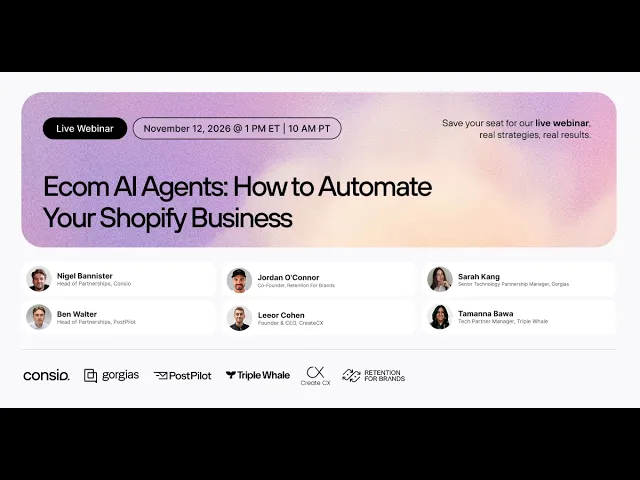
In the Consio webinar Ecom AI Agents: Automate and Grow Your Shopify Business, Nigel Bannister, Head of Partnerships at Consio, brought together six teams working on different parts of that funnel: Tamanna Bawa from Triple Whale, Leeor Cohen from CreateCX, Ben Walter from PostPilot, Jordan O’Connor from Retention For Brands and Sarah Kang from Gorgias. Each speaker shared one practical workflow and the results behind it. This guide turns the session into a playbook you can apply this quarter. Watch the full replay below.
Ecommerce AI agents at a glance
Agent | What it does | Workflow shown | Result shared in the session |
|---|---|---|---|
Creative analysis (Triple Whale) | Reviews ad performance and suggests the next test | 14-day Meta creative review plus a morning budget brief | 78% less weekly reporting time for one agency |
AI phone and outbound (Consio) | Answers routine calls and starts sales conversations | AI on inbound, reps on a dialer, two-way SMS | About 50% of calls automated, about 20% of called abandoners convert |
CX operations (CreateCX) | Keeps AI and human agents fed with the right context | BFCM capacity model and connected data | 30 to 50% of peak tickets handled by AI |
Support and shopping assistant (Gorgias) | Resolves orders and recommends products in chat | End-to-end order actions plus product suggestions | +11.3% AOV, AI conversion at 20% vs 8% for humans |
AI direct mail (PostPilot) | Finds lookalike households and mails them | Acquisition AI with holdout testing | 3.43x incremental ROAS for Fair Harbor |
Retention operations (Retention For Brands) | Reviews, monitors and builds retention campaigns | Weekly review, alerts, campaign builder | Over $7K a year saved on one Klaviyo bill |
The pattern across all six is the same. Each agent owns a narrow, repeatable job, a human owns the decision that carries risk, and the value grows when the agents share the same customer and order data. The sections below walk through each workflow in the order the funnel runs: first purchase, conversation, support, then repeat purchase.
1. Use AI agents to decide what creative to test next
Most ecommerce teams have more performance data than time to read it. Tamanna Bawa, Tech Partner Manager at Triple Whale, framed the job of a creative agent around three questions every marketer asks while staring at a dashboard: what is working, why is it working, and what should we do next? Triple Whale’s AI assistant, Moby, is built to answer them faster.
The three bottlenecks in creative review
As brands ship more ads, review work grows with them. Tamanna pointed to three recurring problems. Manual review comes first: someone has to watch the ads and work out whether the hook, the product demo or the offer drove the result. Missing context comes second: an ad with a spectacular ROAS on a handful of purchases looks like a winner next to an older ad with a much larger spend base, yet you can act on it with far less confidence. Timing comes third: during a promotion, waiting for next week’s report means a problem keeps running or an opportunity closes.
Write prompts that end in a decision
The starting prompt she shared is worth copying as is: “Compare our Meta creatives over the last 14 days. Which hooks and formats deserve another test? Flag low spend ads.” It works because it sets a time period, focuses on a specific decision and asks the AI to flag weak evidence. From there, open individual ads next to their spend, CPA and ROAS, and ask follow-ups such as what could change in the opening, or another way to communicate the product benefit.
The goal is to leave every review with one clear hypothesis. If product demonstrations look promising, keep the product and the offer constant, show the product in use in the first seconds, and test only that change. Before you invest more, check that the compared ads share an objective, have enough conversions, and were not distorted by different offers or timing.
Automate the morning check, keep a human on the budget
Once the review process is useful, automate the parts you repeat. A daily agent can review performance each morning, apply your spend and efficiency rules, flag exceptions and queue budget changes for approval, for example moving a campaign from $1,000 to $1,100 a day. Your team sets the schedule, metrics and thresholds. Someone still checks pacing, inventory and whether the offer is about to end before approving, and Tamanna advised against changing creative and budget at the same time, since you lose the ability to tell what caused the result.
Case study, a digital growth agency running Moby agents. In a published Triple Whale example shared during the session, an agency reported a 78% reduction in weekly reporting time and more than 10 hours saved each week across its client portfolio, with seven or more agents live across five clients within two weeks. Creative analysis was one of its use cases. These are agency-wide results, so treat them as a signal of time saved rather than a guaranteed creative outcome.
2. Let AI answer routine calls and free your reps for sales conversations
Consio’s view, as Nigel put it, is that conversations convert shoppers. A checkout abandoner rarely leaves for one reason. They wonder which product fits, whether it will arrive before the holidays, or whether it works with what they already own. A template SMS with a discount code cannot answer those questions, so the shopper goes to a store down the street or to a competitor who can.
Automate the routine half of inbound calls
The lowest-hanging fruit for any brand with a phone number is to let an AI voice agent handle routine calls: where is my order, subscription updates, order cancellations. Nigel shared a working benchmark of about 50% of calls automated. That protects you during peak season, and it means callers with pre-purchase questions always reach someone, so CX can finally be credited with the revenue those calls create. See how this works on the Consio AI Voice Agent.
Redeploy reps into proactive outreach
Taking half of the calls off the team’s plate creates capacity. Consio’s approach is to move the reps who know your products into a dialer that connects them with checkout abandoners and churned subscribers. Even for high AOV, high consideration products, Nigel cited around 20% of checkout abandoners converting after a phone call. When the shopper does not pick up, the background runs on its own: a voicemail is left automatically, a follow-up text goes out, and AI agents reply to the SMS conversation. Read more on the Consio Ecom Power Dialer.
Use two-way SMS that invites the objection
Calls do not scale to every lead list or every AOV. Consio’s newest workflows are outbound sequences that start with SMS, with iMessage coming soon. Instead of a reminder, the message prompts the shopper to reply with the reason they did not buy, or a churned subscriber to say why they left. An AI agent then handles the objection, creates a draft order and helps the person check out. For highly considered products, prompting a reply and answering it converts better than a generic nudge.
Case study, a subscription brand recovering expiring cards. Leeor Cohen described how CreateCX uses Consio for a client with a large subscription business. Customers whose credit cards are about to expire are called by human agents, texted, and worked through by the AI agent so none of them churn by oversight. His framing of the economics: if 1,000 calls in a day generate $5,000 in revenue, that may be only 50 orders, yet it can pay for a month of CX depending on the size of the business.
If your phone line is still a cost center, book a demo to see how Consio attributes revenue to each call and text.
3. Treat your AI knowledge base like a team member
Leeor Cohen, founder and CEO of CreateCX, a fractional VP of customer experience agency with its own BPO, joined Nigel for a short Q&A. His first point was about mindset. Many brands treat AI as set and forget: upload the brand guidelines and product information once and move on. In practice, an AI agent is a living part of the team that needs the same updates a human agent gets.
Audit the knowledge base before peak
According to Leeor, the place brands get burned with automation is the knowledge base that serves as the brain of voice and written agents. Go through it with a fine-tooth comb before a promotion. Whatever you would tell a customer in store or in a marketing email, your AI agents need to know too. CreateCX starts BFCM preparation in August and September, and gives CX a simple one-page rollout plan, since marketing and finance usually own the promo calendar and CX hears about it last.
Model peak volume before it arrives
CX is one of the easiest functions to forecast. Using the prior two years of BFCM data, a brand expecting 1,000 orders on a given day can plan for roughly 500 tickets. If the AI agent resolves 30, 40 or 50% of them, the human team covers the rest. Skip that planning and the backlog grows, first responses slip past 24 hours, and the new customers you paid to acquire have a poor first experience, which hurts retention and repeat purchases. Our BFCM customer service playbook covers the staffing math in more detail.
Connect the stack so every agent has context
Leeor’s lowest-effort win is connecting the systems. A brand might run Consio, Gorgias, PostPilot and Triple Whale side by side. Unifying that data gives AI and human agents the full customer picture at the moment of the conversation, which is what makes a response thoughtful. The same applies to AI phone support that runs without humans on the line: it works when it hands off to the help desk with context whenever an escalation is needed.
Prove CX revenue with before and after
To move CX from call center to revenue team, CreateCX starts with cost per ticket before and after: what you spend on people, platforms and systems, and where efficiency is lost. The next level is testing CX responses the way a retention agency tests flows, for example measuring whether a reply leads to a pause or skip instead of a cancellation.
4. Resolve tickets and sell inside the support conversation
Sarah Kang, Technology Partner Manager at Gorgias, started from a familiar diagnosis. Most Shopify brands Gorgias talks to run around six tools across support, marketing and data, and they do not talk to each other. A simple request such as changing the size on an order sends the agent across Shopify, the help desk and a customer history tool before replying. Adding AI to each tool makes each slice smarter, yet the team still starts from zero on every ticket until the context is shared.
Resolve routine requests end to end
With the conversation layer connected to store data, the AI agent can cancel an order, edit an address, issue a refund or place a reorder by pulling from Shopify, taking the action and writing the result back, with no human touch. For most brands, that removes a large share of the queue, starting with the most common question: where is my order.
Turn product questions into multi-item orders
Many support chats are purchase questions in disguise. Does this come in gold? Will it layer with the necklace I already own? A shopping assistant that knows the full catalog can answer instantly and suggest complementary pieces in the same chat, turning a support moment into a buying moment.
Hand off with full context
When a person is needed, the AI hands over a summary, the order history and a suggested reply, so the agent starts one step ahead. Put together, these three capabilities turn support from a cost to manage into a channel that drives revenue.
Case study, Caitlyn Minimalist. The jewelry brand wanted to turn single-piece purchases into full collections. With the Gorgias shopping assistant, 18% of shoppers clicked product recommendations, average order value rose 11.3%, and AI-driven conversations converted at 2.5 times the rate of human agents (20% vs 8%), largely because the AI answers instantly with the whole catalog in hand. During its biggest product launch, ticket volume jumped 160% and the team absorbed it without adding headcount.
5. Use AI to find new buyers offline with direct mail
Ben Walter, who leads partnerships at PostPilot, made the case for an old channel rebuilt with AI. Prospecting by mail used to depend on rented lists or broad demographic targeting, with little ability to measure the result. PostPilot’s Acquisition AI flips that logic.
Build lookalike audiences from Shopify purchase history
The model starts with your own Shopify purchase history to learn what your best buyers have in common, then finds US households that closely resemble them using hundreds of thousands of data points, from demographics and income to buying behavior and interests. Existing buyers are excluded automatically. You run it like any paid channel: set a monthly budget and the best-fit prospects are mailed every day. Holdout tests measure incremental lift, and the model improves with each cycle.
Get insights, benchmarks and a forecast before you spend
The same AI answers the questions you usually wait on an analyst for. Customer insights show who your buyers from the last 12 months are, refreshed daily and included in every plan. AI benchmarks compare your ROAS, incremental ROAS, conversion rate and order value with brands of similar revenue, price point and vertical, with recommendations on what to change. A prospecting forecast shows how you would have performed over the last 30 days at volumes from 10,000 to a million postcards.
Pipe direct mail results into your own AI
Every brand can set this up today: the Google Sheets integration writes one row per campaign per day with postcards sent, spend, conversions, revenue and incremental ROAS, with up to two years of history. Connect that sheet to the LLM you already use and analyze direct mail next to every other channel. An MCP connection is on PostPilot’s roadmap.
Case study, Fair Harbor. The apparel brand saw a 3.43x incremental return on ad spend with automated prospecting through Acquisition AI, strong enough that it moved part of its budget away from Meta and other paid channels into direct mail. Jordan O’Connor added that Retention For Brands has seen a 2.5 to 3x return on Acquisition AI at tens of thousands of dollars a month.
6. Run three retention agents every week
Jordan O’Connor of Retention For Brands started from the idea that your data already knows your next sale. Retention teams face three problems: too much data and no time to act on it, things that break quietly in Klaviyo and other tools, and channels that do not talk to each other. His answer is to go beyond email and SMS to full retention, adding direct mail, phone, support, loyalty and push, and to run three agents that a brand or its agency can set up.
Agent 1: the weekly review
Every week, an agent reviews what went out across email, SMS, direct mail and phone, what worked, what did not and what to change, and posts the summary to Slack. The best performers are checked against paid media. For one client, a winter angle in an email outperformed most of its Black Friday emails. Nobody had tested it on the front end, so the team turned it into an ad and it took a large share of spend.
Agent 2: alerts for quiet failures
Audits keep surfacing the same issues: a landing page link changed inside a flow, triggers that stopped firing, unused SMS credits, deliverability problems with Gmail or Hotmail, a declined card on a vendor account. An alert agent scans every retention channel and pings Slack as soon as something breaks, before revenue drops. With deliverability in particular, waiting until the problem is visible usually means it takes a lot of work to recover.
Agent 3: the campaign builder
The third agent handles strategy, angles, copy, segments and send time, so the team only schedules. Using Klaviyo’s MCP with Claude, much of this can now be automated. For one client running a full AI setup, the data showed a product with a 50% higher LTV than anything else, one the brand was not planning to restock. It became the main focus on the front end. AI-written campaigns beat the previous email performance, and the feedback loops cut the client’s Klaviyo bill by over $7,000 a year.
To go deeper on channels beyond the inbox, read our guide to Shopify retention strategies beyond email and SMS.
7. How to roll out ecommerce AI agents without losing control
Every speaker landed on the same rollout advice, from different angles. You do not need to overhaul the stack at once.
Start with one workflow. Sarah recommended picking your highest-volume conversation, often product questions or order editing. Tamanna suggested one creative review, one test and one recurring brief. Jordan’s three agents can be added one at a time.
Measure for 30 days. Track time saved, the usefulness of recommendations and the business outcome: AOV, resolution time, CSAT, conversion from calls and texts, incremental ROAS.
Keep a named human on the decisions with risk. Budget changes, escalations and anything customer-facing that the AI is unsure about should land with a person who owns the final call.
Connect the data before adding more tools. As Sarah put it, the brands that win are the ones whose tools share the customer context. Our overview of the best AI tools for Shopify brands can help you map which tool owns which job.
Want to add the phone and SMS layer to that stack? Book a demo with Consio.
Key takeaways
Give each AI agent one job. Creative review, routine calls, order actions, lookalike mailing and retention monitoring all work best as narrow, repeatable workflows.
Automate the routine to fund the proactive. Automating about half of inbound calls frees reps to call checkout abandoners, where around 20% convert after a conversation.
Feed AI like a new hire. Audit the knowledge base before every promotion and connect help desk, phone, ads and retention data so agents have context.
Let support sell. Product questions in chat are buying moments: one brand saw AOV rise 11.3% and AI conversion reach 20% vs 8% for humans.
Start with one workflow and 30 days of data. Measure time saved, AOV, resolution time, CSAT and incremental ROAS before expanding.
FAQs
What are ecommerce AI agents?
Ecommerce AI agents are AI systems that connect to store data such as Shopify orders and customer history, then complete a defined job: answering a call, resolving a ticket, recommending a product, reviewing ad creative or building a retention campaign. The best setups hand off to a human with full context when a decision needs judgment.
Which workflow should a Shopify brand automate first?
Start with your highest-volume, most repetitive conversation. For most brands that is order status, order edits or product questions. Automate one workflow, track AOV, resolution time and CSAT for 30 days, then expand. On the phone, a realistic benchmark shared in the webinar is about 50% of calls automated.
Can AI agents find customers if I just launched in a new market with little data?
Yes. PostPilot confirmed during the session that it can still help brands entering a new market with limited customer history, with a strategy that depends on the maturity of the brand and the market. Lookalike models improve as purchase data and holdout results accumulate.
Is AI direct mail prospecting available outside the US?
PostPilot is available in the US, the UK and Canada. Product specifications vary slightly by country, and everything shown in the webinar is available in the US.
How do I check that my AI support agent is ready for BFCM?
Audit the knowledge base line by line against your current offers, shipping cutoffs and policies, since outdated information is where automation fails during peak. Agencies such as CreateCX review AI agent setups in Gorgias and other help desks, and can help model how many tickets your AI and human agents will each handle.
Is there a replay of the Ecom AI Agents webinar?
Yes. The full replay is embedded at the top of this article and available on Consio's YouTube channel, with all six speakers: Consio, Triple Whale, CreateCX, PostPilot, Retention For Brands and Gorgias.

Head of Partnerships