Shopify retention strategies beyond email & SMS (2026)
Learn 3 Shopify retention strategies using direct mail and phone outreach to recover abandoned checkouts, drive second orders, and win back customers.
Email and SMS are still essential Shopify retention channels, but they shouldn't be the entire retention stack. Direct mail and phone outreach can add high-touch interactions at the moments that matter most: after checkout abandonment, after a first purchase, and when a customer has lapsed or churned.
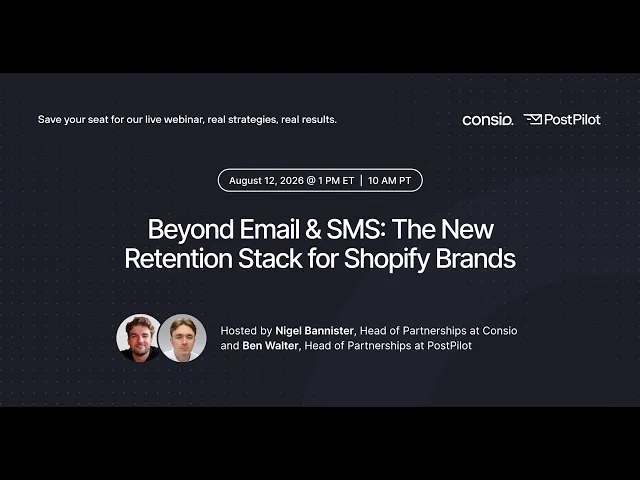
During a recent Consio × PostPilot webinar, Nigel Bannister, Head of Partnerships at Consio, and Ben Walter, Head of Partnerships at PostPilot, shared how Shopify brands are combining email, SMS, direct mail, and phone calls to recover more revenue and build stronger customer relationships.
The core idea is simple: you don't need to replace email and SMS. You need to layer additional channels onto the customer journeys you already know work.
Quick takeaways
Abandoned checkout: Use email and SMS first, then add direct mail and phone outreach for high-intent shoppers who still haven't converted.
Second purchase: The period immediately after a first order is an opportunity to welcome customers, introduce loyalty benefits, and accelerate repeat purchases.
Win-back: Phone and direct mail can create a new touchpoint with customers who have stopped responding to your usual digital campaigns.
High-AOV products benefit most from conversations: Furniture, jewelry, supplements, and other high-consideration purchases often involve questions that one-to-many marketing cannot easily answer.
The channels work best together: Email and SMS provide scale, direct mail creates a physical touchpoint, and phone gives shoppers a chance to have a real conversation.
What is a Shopify retention strategy?
A Shopify retention strategy is the set of campaigns and customer experiences a brand uses to turn first-time shoppers into repeat customers and bring inactive customers back.
Most ecommerce retention programs revolve around email and SMS flows such as:
abandoned cart and checkout reminders;
post-purchase sequences;
replenishment campaigns;
loyalty messages;
subscription reminders;
customer win-back campaigns.
Those flows work, but Shopify brands can run into a simple problem: every competitor is using the same channels.
As inboxes become more crowded, especially around Black Friday, Cyber Monday, and the holiday season, brands can add direct mail and phone to create interactions customers are less accustomed to receiving.
The modern Shopify retention stack
A strong retention stack doesn't assign the same job to every channel.
Channel | Best used for | Main strength |
|---|---|---|
Education, promotions, automated lifecycle flows | Scalable and inexpensive | |
SMS | Time-sensitive reminders and short follow-ups | Immediate and highly visible |
Direct mail | Cart recovery, personalized offers, win-back | Physical, memorable touchpoint |
Phone | High-intent shoppers, high-AOV purchases, post-purchase and win-back | Two-way conversation and objection handling |
The goal isn't to send more messages everywhere.
It is to choose the right channel for the right customer at the right moment.
1. Recover abandoned Shopify checkouts with more than another email
Abandoned checkout is one of the highest-intent moments in ecommerce.
The shopper has already discovered the brand, evaluated the product, added it to their cart and started the buying process. Something prevented them from completing it.
Most Shopify stores respond with an abandoned checkout email or SMS flow.
That should remain the first layer.
But when those automated messages don't convert the customer, adding a second channel can give the brand another opportunity to close the sale.
The direct mail play
PostPilot's approach is to add a direct-mail trigger after the initial digital recovery window.
A typical sequence could look like this:
Checkout abandoned
Email and SMS recovery flows begin
Customer doesn't purchase
3–7 days later: a personalized postcard arrives
The postcard highlights the abandoned product, an offer, or another reason to return
Because the campaign is connected to ecommerce and Klaviyo data, the mail can be personalized around what the customer was actually considering.
PostPilot shared examples of brands generating strong returns from these automated campaigns, including double-digit ROAS for Caddis Eyewear and 7x+ incremental ROAS for Clocks and Colors.
The important point isn't simply that direct mail works.
It's the timing.
Instead of mailing every customer, brands can trigger the additional touch only when a high-intent shopper fails to convert through the usual digital flow.
The phone play
Some abandoned checkouts aren't caused by a lack of urgency.
They're caused by an unanswered question.
A shopper considering a $3,000 table might wonder:
Will it fit in my room?
How will it be delivered?
How difficult is assembly?
Can it be carried into my apartment?
When will it arrive?
Which configuration should I choose?
A discount email cannot necessarily solve those problems.
A conversation can.
Using an ecommerce power dialer, brands can prioritize high-value abandoned checkouts and let a sales or customer experience agent proactively contact those shoppers.
The call doesn't need to feel like traditional telemarketing.
It can simply be a proactive customer service interaction:
“Hey, I noticed you were looking at one of our products and wanted to make sure you had everything you needed. I'm happy to help with sizing, shipping, or any questions about your order.”
If the shopper doesn't answer, brands can also leave a branded voicemail and follow up with SMS, where appropriate.
Real example: Clocks and Colors
Clocks and Colors uses phone outreach for abandoned checkouts.
According to data shared during the webinar:
18.41% of connected abandoned-checkout calls resulted in a purchase within seven days
the program generated $223,000 in attributed phone revenue in three months
the outreach was handled by one agent working part-time
The conversations also give the brand something normal cart-recovery campaigns don't: direct insight into why shoppers almost bought but didn't.
That feedback can inform FAQs, product pages, shipping information, merchandising and future marketing campaigns.
Real example: Transformer Table
The strategy can become even more valuable as order value increases.
Transformer Table sells high-consideration furniture with an average order value above $2,800.
For its abandoned checkouts, 16.6% of connected calls resulted in a purchase.
That is why phone outreach can make particular sense for categories such as:
furniture;
jewelry;
consumer electronics;
premium apparel;
health and wellness products;
other high-AOV or high-consideration purchases.
The more questions a customer is likely to have before buying, the more valuable an actual conversation can become.
2. Turn the first Shopify order into a second purchase
Customer retention shouldn't begin when someone becomes “lapsed.”
It should begin immediately after the first order.
The period following a customer's first purchase is when the brand can turn a transaction into a relationship.
When should you target a customer for their second order?
PostPilot shared data from its 2026 BFCM benchmark showing that, across its merchant data, the 31–60 day period after the previous order represents an especially strong window for incremental returns.
The exact timing varies by brand and product category.
A supplement brand may have a predictable replenishment cycle. A jewelry or apparel customer may behave differently.
The important lesson is to use your own purchase data to identify when first-time buyers naturally become likely to buy again, then introduce the retention touchpoint before they disappear.
Use direct mail to personalize the next purchase
A post-purchase direct mail campaign can recommend the next logical product instead of simply sending a generic coupon.
For example:
If customers who buy Product A typically purchase Product B next, the brand can trigger a personalized piece showcasing Product B around the customer's expected repurchase window.
That turns direct mail from a mass-marketing channel into an automated lifecycle channel.
Use phone calls to welcome first-time buyers
Phone outreach can take a different approach.
Instead of immediately asking for another sale, the brand can make the first interaction customer-first:
thank them for their purchase;
welcome them to the community;
answer product questions;
explain loyalty benefits;
provide usage advice;
confirm they know what to expect next.
That creates a natural opening for the second purchase without making the call feel purely promotional.
Real example: HK Army
HK Army, a paintball brand with a strong community identity, uses post-purchase phone calls to welcome customers.
During the conversation, the rep can see customer information such as loyalty data and explain how many points the shopper has earned and how to redeem them.
The result shared during the webinar:
More than 16% of customers who answered the welcome call made another purchase within seven days.
For community-driven brands, that call can reinforce something email struggles to communicate: the feeling that the customer has actually joined the brand.
Post-purchase calls for subscription brands
Subscription businesses have another opportunity.
A first-time subscriber may still have questions such as:
When should I start using the product?
How often should I take it?
When will my next shipment arrive?
How do I manage my subscription?
Which results should I expect?
A post-purchase conversation can answer these questions before they become reasons to churn.
That makes the phone useful not only as a conversion channel but as an LTV and retention channel.
3. Win back churned and lapsed Shopify customers
Eventually, every ecommerce brand builds up a large segment of customers who haven't purchased in months.
Most brands already have an email win-back flow.
The problem is that the customers you're trying to win back are often the same customers who are no longer opening those emails.
That's where another channel becomes useful.
Direct mail for lapsed customers
A physical piece of mail creates a completely different interaction from another promotional email.
Brands can segment campaigns based on:
days since last order;
previous products purchased;
customer lifetime value;
number of previous orders;
subscription status;
VIP status.
The offer can then become stronger as the customer's inactivity increases.
Instead of treating every inactive shopper identically, brands can build a graduated win-back strategy based on value and recency.
Phone calls for churned customers
Phone has an additional advantage: it can reveal why the customer left.
A win-back conversation might uncover:
the product wasn't right for them;
they still have too much product;
they didn't understand how to use it;
the subscription frequency was wrong;
they had a bad delivery experience;
the price became too high;
they simply forgot about the brand.
Even when the shopper doesn't return, these conversations create valuable voice-of-customer data.
When hundreds or thousands of calls are transcribed and analyzed together, brands can identify recurring objections and churn drivers that would otherwise remain hidden.
Real example: BattlBox
BattlBox contacts subscribers after they have already been churned for 120 days.
These aren't customers who canceled yesterday. They are genuinely lapsed subscribers who have already gone through the normal lifecycle.
According to the webinar results:
nearly 14% of connected calls resubscribed within seven days
one part-time support agent had generated 302 win-backs year to date
the subscription has an average order value of approximately $140
This is a useful example of why brands shouldn't assume that a customer who has churned is permanently lost.
Sometimes a conversation is enough to restart the relationship.
How email, SMS, direct mail and phone should work together
The best strategy isn't to choose between email, SMS, mail and phone.
It's to orchestrate them.
Abandoned checkout
Email → SMS → phone/direct mail → conversion
Use digital channels first, then reserve higher-touch channels for shoppers showing enough intent or value to justify the additional effort.
First purchase
Order → post-purchase email → welcome call/direct mail → second purchase
Use the additional touchpoint to reinforce the customer's decision and introduce the next logical reason to buy.
Lapsed customer
Win-back email/SMS → direct mail/phone → reactivation
Once existing digital flows stop generating engagement, switch the medium instead of simply sending more of the same message.
Which Shopify brands should test phone and direct mail first?
Not every Shopify brand needs every channel.
These strategies become especially compelling when at least one of the following is true.
You have a high average order value
When a conversion is worth hundreds or thousands of dollars, a more expensive retention touch can still produce attractive economics.
Customers need help choosing a product
If shoppers regularly ask about sizing, compatibility, ingredients, delivery, installation, variants, subscriptions or product fit, conversation can remove friction that an automated sequence cannot.
Your product requires consideration
Furniture, jewelry and similar categories naturally generate hesitation before checkout.
That gives phone outreach a clear job: resolve the hesitation.
You have a subscription model
Post-purchase education, cancellation recovery and long-term win-back all create natural moments for conversation.
You have strong repeat-purchase behavior
If customer LTV depends heavily on the second or third order, improving the transition from first-time buyer to repeat customer can materially improve acquisition economics.
A practical Shopify retention playbook
You don't need to launch every campaign at once.
Start with the moment closest to revenue.
Step 1: Start with abandoned checkouts
Identify higher-value carts where answering a question could materially change the outcome.
Step 2: Keep email and SMS running
The new channels should complement, not replace, the lifecycle infrastructure you already have.
Step 3: Add one high-touch channel
Test either phone or direct mail against a defined audience.
Step 4: Track incremental revenue
Measure:
connected call rate;
purchase conversion after contact;
attributed revenue;
revenue per call or mail piece;
second-purchase rate;
resubscription rate;
time to next order.
For phone campaigns, a healthy connect rate discussed during the webinar was approximately 18–22%, which is why voicemail and follow-up can matter alongside live conversations.
Step 5: Analyze the conversations
Don't measure calls only as a sales channel.
Analyze the transcripts to understand:
why people abandon checkout;
which questions delay purchases;
why subscriptions churn;
what customers misunderstand;
which products generate the most purchase anxiety.
That information can improve the rest of your Shopify funnel.
How to prepare your retention stack for BFCM
Black Friday and Cyber Monday bring a wave of first-time customers, and a much noisier digital environment.
That makes BFCM a particularly useful time to think beyond the initial transaction.
Before peak season, Shopify brands can prepare:
abandoned-checkout audiences by cart value;
post-purchase campaigns for first-time BFCM buyers;
loyalty and VIP segments;
subscription onboarding;
lapsed customer cohorts;
voicemail and SMS follow-up messaging;
direct-mail creative and offers;
reporting for attributed revenue and repeat orders.
For brands preparing their retention strategy ahead of peak season, Flowium offers a BFCM Retention Audit as well as a BFCM Ebook with practical guidance on Klaviyo flows, segmentation, and post-purchase strategies for turning peak-season customers into repeat buyers.
The goal isn't just to maximize Black Friday revenue.
It's to make sure the customers acquired during Black Friday come back after Black Friday.
FAQs
What are the best customer retention strategies for Shopify?
The strongest Shopify retention strategies combine lifecycle messaging with well-timed customer experiences. Email and SMS remain the foundation, while direct mail and phone can add higher-touch interactions for abandoned checkouts, first-time customers, VIP shoppers, subscribers and lapsed customers.
Is email still effective for Shopify customer retention?
Yes. Email remains one of the most scalable ecommerce retention channels. The opportunity is not to replace it, but to add another channel when email alone fails to generate a response or when a shopper needs a two-way conversation.
How can Shopify brands recover more abandoned checkouts?
Start with automated email and SMS flows, then identify high-value or high-consideration checkouts that justify additional outreach. Phone calls can address specific objections, while personalized direct mail can create another touchpoint several days after abandonment.
When should Shopify brands contact first-time customers?
The ideal timing depends on the product and natural repurchase cycle. The webinar highlighted PostPilot benchmark data showing particularly strong incremental returns in the 31–60 day window after an order, but brands should use their own purchase data to determine the best timing.
Do phone calls work for abandoned Shopify checkouts?
They can work particularly well for higher-value purchases where shoppers have unanswered questions. Clocks and Colors reported that 18.41% of connected abandoned-checkout calls converted within seven days, while Transformer Table reported a 16.6% conversion rate on connected calls for orders with an AOV above $2,800.
How can Shopify brands win back churned subscribers?
Use your existing email and SMS win-back flows first, then test additional channels for customers who remain inactive. A phone conversation can both create another opportunity to resubscribe and reveal the underlying reason the customer churned.
What is the best retention strategy for BFCM customers?
Plan beyond the initial Black Friday purchase. Build post-purchase onboarding, loyalty, second-order, subscription and win-back campaigns before peak season begins so first-time BFCM buyers immediately enter a structured retention journey.
Build a retention stack that goes beyond the inbox
Email and SMS aren't going away. But the next opportunity in Shopify retention may come from adding channels your customers encounter less frequently.
Direct mail creates a physical moment. Phone creates a conversation. Email and SMS keep the entire lifecycle scalable.
Used together, they give brands more ways to recover high-intent shoppers, accelerate the second purchase and bring customers back after they churn.
The brands that win retention won't necessarily send the most messages.
They'll be the ones that know when a customer needs another message, and when they need a completely different interaction.
This article is based on the August 12, 2026 webinar “Beyond Email & SMS: The New Retention Stack for Shopify Brands,” hosted by Nigel Bannister, Head of Partnerships at Consio, and Ben Walter, Head of Partnerships at PostPilot.

Head of Partnerships